And I asked them all, "Do you see
yourself using products like OneSignal
from inside of the OneSignal dashboard,
or do you see yourselves using it from
within Gemini, Claude, or ChatGPT?"
And they were roughly split.
Hey, my name is Jacob Rushfinn,
founder and CEO of Botsie and the
host of the Price Power Podcast.
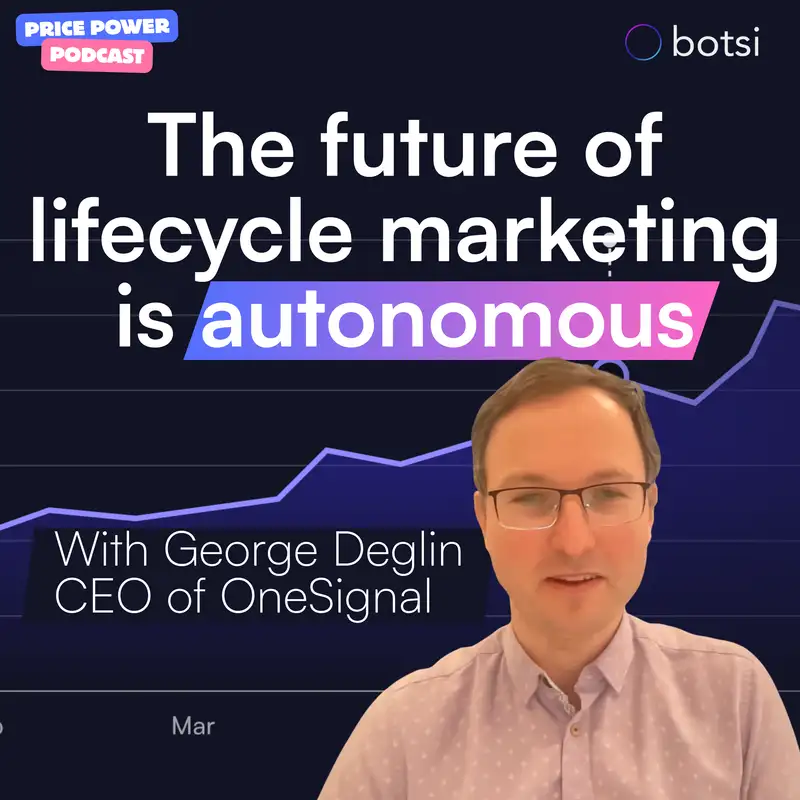
Today, we're talking with George
Daigle, the CEO of OneSignal.
If you haven't heard about OneSignal,
OneSignal is the autonomous lifecycle
marketing engine for B2C app companies.
Marketers can orchestrate the campaigns
that onboard, engage, and retain users,
increasing LTV and reducing churn.
Companies like Zynga, Bitcoin.com,
and Phillips use OneSignal today to drive
outcomes with AI that scales with you.
In this episode, we talk about how
organizational silos between product and
lifecycle teams show up in marketing,
how OneSignal is building an AI-first
vision, why the dashboard is dying,
and George's proposed lifecycle
autonomy ladder, and much more.
Hey, George.
Uh, super excited to have
you on the podcast today.
Thanks for joining.
Thanks, Jacob.
I'm glad to be here.
So we have, uh, a lot of stuff on,
on kind of the future of AI and life
cycle marketing I wanna get into,
but first, you know, most of what
we talk about is subscription apps.
And, you know, at One Signal, you
guys have an amazing purview of so
many different subscription apps
and tons of different data points.
I, I was curious, uh, when you see, um,
subscription apps succeeding at life
cycle marketing and, and making a large
impact, is there a kind of obvious pattern
or strategies of what, uh, uh, the ones
kind of doing well versus the ones doing
it badly, and kinda what separates them?
Yeah.
I think that the main thing that comes to
mind is whether the app is running their
life cycle marketing on a calendar, or
largely on a calendar, or whether it's
actually tied into the product experience.
I think by virtue of organizations,
especially organizations as they get
bigger, you start to get, like, silos
between different groups, and so you have
the life cycle marketing team doing one
thing and the product team doing another.
But the reality is that these teams,
the more that they can work in tandem
and make the messaging a core part
of the product experience, the more
successful they're gonna be on both
sides Uh, and the other one, uh, believe
it or not, is that I really feel that
there are some very common channels
that are extremely underutilized.
Probably the biggest one
that comes to mind is email.
I think a lot of apps, um, invest in push
notifications, uh, but their investment
to email is limited or completely absent,
and that's a huge missed opportunity.
Um, not only is email generally
effective when done well, but it's
also a really important channel
to engage with people when maybe
they've uninstalled your application.
Um, it's surprising to see how much
money companies spend on paid media
and win-back campaigns, uh, instead
of funneling that money and attention
towards even rudimentary practices,
um, in life cycle marketing and,
and product-triggered messaging.
You think there's a reason
why, like, people aren't--
are investing less in email?
It's more work.
You can't just type a few lines of
sentences versus in a push notification.
I think, um, a lot of it is because the
marketing teams at, um, businesses are,
are often very focused on paid media.
It's, in a way, it's, it's maybe easy and
it's attractive to run high-budget paid
media campaigns and to refine those or to
work with agencies that help with that.
Uh, but that can become a bit of
a myopic focus, uh, for a company.
Um, when in contrast, yes, like setting
up, uh, effective email marketing, right,
takes a different set of expertise.
Um, it's a different place to look at.
It involves having to work
more closely with the product
team and cross-functionally
throughout the organization.
So I think maybe that there's higher
organizational barriers, uh, that exist,
um, in setting up, um, email as part
of a life cycle marketing program.
Uh, but the results we see among our
customers that, that do so and that
really tie it together with the other
messages they're sending, uh, whether
that's through push notifications or
SMS, they see really substantial results.
So, um, yeah.
Uh, again, real- quite surprising
'cause it's not expensive to send email.
Um, it does take some
time and some expertise.
Uh, but especially in today's world,
where you can use AI to help you do all
this, um, I think there's less and less
of an excuse to, to not make sure that,
that you're fully adopting that channel.
Yeah.
I, I see great lifecycle
marketing is typically an
extension of the product, right?
You, you're, you're taking that
same value and extending it,
bringing outside the product,
going back to your kind of calendar
versus, like, triggered messaging.
Th- this is, thisâ¦
People came to use your product.
They didn't came to get a, a seas- your
seasonal calendar from the marketing team.
They came to kind of understand
and, and realize the value of, of
kind of what, what they're using.
Um, on the, on the, uh, um, yeah,
lifecycle marketing component and,
and kind of, you know, growth verse,
you know, retention, uh, you know,
consumer apps just have such high churn
too that it's probably part of the
reason that, like, you know, s- okay,
most of your impact will come, uh, in
terms of revenue from user acquisition.
That is, like, it's just the nature of the
beast of, of kind of consumer products.
But still, like, if you can make a, a,
a dent in your churn and, and decrease
it a little bit, like, this will cause,
you know, cohorts to stack and compound
and, and ultimately will, will make
your, your paid marketing cheaper.
Yeah, exactly.
Um, not only, uh, does it make your,
uh, paid marketing cheaper, but
it, it improves your LTV, right?
And a lot of the times that, um,
uh, marketers are always looking for
an edge, like what's a new channel,
a new campaign, new creative that
they could use to attract more
audiences and, and increase revenue.
Um, and they look at other teams, like,
okay, maybe it's the products team, the
products team's responsible for LTV.
Um, but the reality is, like,
marketing's very responsible for
that as well, and when you can tie
that together, uh, then the overall
business will perform much better.
Yeah.
The, the edge they're looking for is
spending meaningful time to create
meaningful experiences and, uh, improve
retention to create more, more engagement
throughout the product lifecycle.
You know, like, uh, w- when it get,
like, there's usually no shortcuts there.
It's like, no, you, you've got to
just make, uh, uh, the product better,
invest more time, engage these users,
make your lifecycle marketing a, a
kind of extension of that value and,
and, um, it's like, like your point,
it's easier to just go, "Oh, well
let's spend a little more on ads.
Let's test more on ads," where,
where, uh, but, but ultimately, yeah,
the, the, the long-term impact, you
know, meaningfully compounds there.
Cool.
So, so you mentioned AI.
This is a g- good foreshadowing
into kind of what, what we, what
we're kinda diving into here.
And so you, um, you wrote a
super interesting blog post and
article about the, the future of
lifecycle marketing as autonomous.
Um, and, and I think
that's- Change is hard.
Uh, and I, you know, I, I was thinking
about kind of my past experience in
lifecycle marketing and how other
people are reacting to this and, you
know, there, there's, um, tons of
different feelings and sentiments,
um, when you're reacting to AI, and I
think that, like, making these broad
statements, you know, maybe it's meant
to be provocative, I don't know, probably
a little bit, but, but like they often
get pushback in terms of, "Okay, well,
like I don't know if that's true.
Like this is, this isâ¦
I'm not doing this.
Maybe I can generate some new copy."
Um, so, so tell me about like,
uh, uh, your thinking where
like, you know, ultimately the
product is still a dashboard.
Every lifecycle marketing tool,
people are setting things up manually.
Um, tell me about your thinking here
and like what, what the intent was,
uh, kind of when putting this out.
Yeah.
So, um, yeah, well I think one of the
provocative statements, uh, in that
essay is, is I said dashboards are dying.
Um, and this is not a new
hypothesis or realization.
Where I first started to imagine this
as a future was Maybe two or even three
years ago, and it was when the very
first, uh, browser use and then later
computer use tools, uh, started to
be introduced, uh, by, uh, companies
like, uh, like OpenAI and ChatGPT.
And the reason that it was so interesting
to me-- I mean, first as a, as a, you
know, technical founder and, and former
engineer, the idea that software could
now use a computer like a person was
just, like, really intriguing, um, and I
think something that, uh, would've beenâ¦
kind of nerd-sniped me, uh, in a way.
Uh, and then as, as a CEO,
it was very attractive to me
because so much of my day, uh, is
looking at different dashboards.
I'm looking at Salesforce, I'm looking
at our business intelligence tools,
I'm looking at different reports that
people have emailed me, I'm going through
and deleting spam from my email inbox.
It's so much of just using all of these
different software applications and, um,
going through all of this manual process.
Um, and in playing with, um, with
these computer use tools, I could
just tell it, um, "Go through
my email and delete the spam.
Uh, go cross-reference this dashboard, and
if you notice an anomaly, let me know."
Um, now at the time, and I, and I think
this is kinda true today, uh, one of
the problems of these, uh, these tools
is that they are impressive for the
first few minutes, um, and then they
start to fall apart due to some of
the technical limitations, um, that
I think are still being worked on.
So, uh, it has turned out that in
fact, um, the world didn't go towards
"Let's just ask OpenAI operator to go
and do all this for me," but instead
a lot of software applications have
started to p-put in AI capabilities
to automate work inside of them, and
then you also have standards like
MCP that have made this possible.
Um, and so this sort of trend that I
identified a while back, um, is now
starting to be realized in, um, these
new technologies that are being developed
Uh, as we started to see this happen, we
went and we talked to a bunch of our, our
customers, um, probably about 20 of them.
And I-- This was at the beginning
of the year, um, January 2026, and I
asked them all, "Do you see yourself
using products like OneSignal from
inside of the OneSignal dashboard?
Or do you see yourselves
using it from within, um, uh,
Gemini, Claude, or ChatGPT?"
And they were roughly split.
There were people that sort of argued
in favor of the dashboard, um, and
the trust and user experience there,
and there were others that just said,
"I just wanna do it for my agent.
Um, I prefer that to be kind of
the home of where I get work done."
I would guess if you asked them today, um,
you know, roughly six, seven months later,
um, it's probably leaning more towards
people that want to use the product from
within their AI agent, just because I
think the experience is so much better.
Um, it's faster, and it can also
string together intelligence from
multiple different tools, um, instead
of having to rely on just the knowledge
in each individual tool itself.
Does that mean every tool turns, turns
into like a transactional layer that's
like, you know, uh, where a, a lot of
the value and a lot of the lifecycle
marketing tools is the orchestration
capabilities on top of the, the
sending capabilities, the dashboard.
And like I, I, I think today
it's, it's, um All these tools
are kind of augmenting, right?
You can get a summary of your
dashboard, summary of results.
You can kind of have in a individual
message, um, you can generate AI copy
or AI creative where there's not, like,
the full end-to-end workflows today.
And so yeah, I, I guess, like,
taken to the end result, yes, it,
it turns into kinda what you're
saying, a full experience through,
you know, chat-based interaction.
But, like, I, I think, umâ¦
Do you think we'll really see it
to that end where, like, you'll
be able to do things end-to-end?
Or will this be, like, kind of this
bifurcation of like, okay, well, I'm
gonna have to still paste in my DNS
records into the platform, but like
I can tell it to build a journey and
that, like that works really well.
Do, do you think it's gonna be this
like middle ground for a while?
Or like this, this i- in terms of
like augmentation or, or like how do
you see this actually progressing?
Yeah.
So there's, I think right now we're
in a time where people have things
that they're used to doing, um,
and software is still catching up.
But I do believe in the near future
more and more people will want to
use software in a headless way.
Um, and in your example, I don't think
it's just headless when it comes to
day-to-day utilization like reporting.
I, I think it also includes things
like configuration of the platform.
That's not to say that software just
becomes like this sort of like API layer
with no real intelligence behind it.
I think the intelligence that we're
building into One Signal, um, and
that, uh, other software solutions
will be building into their products,
that is still core and critical
and will be how they differentiate
and provide value to customers.
But the user experience, um, and how
people interact with the product, uh,
will be less through the dashboard
that that product provides and more
through the APIs, um, and, uh, uh,
agent layer that the product exposes.
Yeah.
And I guess, like, you could alwaysâ¦
developers could always build via the API.
They could always do 95% of the same
functionality in terms of sending messages
to, to different people via APIs before.
But I guess the difference is now
that this, uh, programmatic layer
has opened up to a much larger
portion of the population to-- that
can, can interact with, with that.
Sort of.
There are definitely capabilities
in OneSignal that were not
previously exposed through API.
Uh, so for example, um, configuring
different parts of the product
was something that we expected
people to do through the dashboard.
It'd feel, um, to do it through API was
a little unusual 'cause it's something
you only do once, uh, for example.
Um, but in a world where more and
more interaction with the full product
experience, uh, people may wanna
do from within Cloud, for instance,
you actually do wanna expose a
lot more through, through the API.
So in fact, a lot of our development
attention right now is going into exposing
APIs for all of the product's capabilities
so that the agent rarely or never has
to tell you, like, "Oh, I can't do this.
You have to go do it yourself."
More and more, we want people to
be able to ask the agent to go
do something and watch the agent
reliably, uh, see it through.
How do you think about, um,
the visual layer of this, like,
visual feedback loop, right?
Like, people want to do
something and then see it.
And the iteration process today for,
like, let's say, like, just simply, um,
getting, uh, uh, you know, ChatGPT or
Claude to, to create an image for me.
Like, it takes a few minutes, um,
if it's good, and it gets back,
and like, "Oh, that's not right.
I wanna tweak it," and then it's
another few minutes where, like, in,
in kind of the dashboard visual, you
know, builder interfaces for, you know,
life cycle marketing platforms, but
all platforms, it's instant feedback.
I do something, like,
"Oh, that's not right.
Let me tweak this, change
this, construct this."
Um, how do you think about that,
like, experience and process?
And, like, does that translate?
That this feels a little trickier
to me in this chat-based flow.
Uh, yeah, so, so curious
how you think about that.
Yeah, that's a good point.
I think there are-- there is something
to be said for, um, the responsiveness
and visual experience that's
offered by, um, a product dashboard.
There's also, I think one of the reasons
why some of our customers stated that
they would really value the dashboard
interface is because it provides an
opinionated view, um, on how the product
functions and is performing, uh, versus
if you're just interacting with API layer,
everyone's gonna see something different,
and maybe that's not actually desirable.
Um, that said, uh, yeah, I'm not certain
how, how things are gonna shake out.
Obviously, OneSignal will
always have a great dashboard.
We're continually making it better.
I expect people will continue to rely
on it and, and use it alongside agents.
But it will be interesting to
see, um, how that evolves, right?
We may evolve the dashboard to be much
more focused on reporting, uh, and less
on, uh, like, like setup, um, and manual
processes because that will be handled
more through, through an agent experience.
The other, uh, direction that things
could go is we are starting to see,
um, uh, standards like the Model
Context Protocol introduce support
for rendering, um, visuals, um, and
it's actually visuals that are--
that can be rendered, um, inside of a
frame with the technology that, that
the, um, that the vendor chooses.
So you could see a world where you're
actually maybe crafting an email campaign
in OneSignal, um, inside of Claude,
and you're able to preview the email,
uh, and various, like, analytics or,
or different configuration options
from within the, the Claude UI without
having to go to the OneSignal dashboard.
But too early to say exactly how,
how that's gonna, um, uh, shake out.
It's, it's a very-- it's an interesting
time because we're-- we simultaneously
know that customers want us to be
building these things, but we don't
know exactly, um, what the technology
will look like in six months and what
customers will want in six months.
So we're just trying to stay on, uh,
on the bleeding edge of, of what's
actually, uh, useful and, and aligned
with the vision of the business.
Yeah, yep, yeah.
When early days on the internet, you
have a bunch of, you know, blue links
on a page, you know, you couldn't
have anticipated the iPhone, right?
And, and so, uh, uh, there will be
changes and, and we'll see what happens.
Um, yeah, it, it's a good point.
Um, okay, cool.
So in, in the article, you also
talk about this autonomy ladder.
Uh, maybe you can just, uh, um, run
through the autonomy ladder y-y-you
talked about, and then I can, I
can dig in there a little bit more.
Sure.
Um, so the autonomy ladder, the
way we got to it is we, we first
arrived at the long-term vision.
Uh, and the long-term vision is that
lifecycle marketing will be largely
done through an autonomous agent
that runs in a self-improving loop.
Now, of course, if we try to just
build and launch that today, um,
it's probably not gonna work,
like super well on day one.
Like we have to-- There's a few
things that, that need to happen.
So first, there's a lot that we have
to build to bring this into the world.
Uh, there are improvements happening
in the foundational models,
uh, that are probably necessary
to make this truly effective.
Uh, and then we have to make sure that
customers are, um, develop the level of
comfort necessary to utilize the product
in this way and to trust that it's gonna
be able to, to give them good results.
So that's the vision.
I-- And we definitely want to make sure
we're working towards it because, um,
I have the complete conviction that,
that this is gonna be what the world
is gonna look like in the future.
But we want to deliver real
value to customers along the way.
Um, and so that's how we got to the
autonomy ladder, all the way from, from
L0, which is basically no autonomy.
It's just the sort of traditional like
SaaS dashboard experience that, uh,
that products have had, um, all the
way up to L4, which is full autonomy.
And the different steps along the
way that map to the different product
capabilities that we'll be rolling out,
but also, uh, the ways that customers
can start to hand off more work to AI
agents, um, uh, to build the level of
trust and context necessary to eventually
reach, um, uh, full level four autonomy.
So today we're, we're at kind
of this L1 of assistance.
We have help, we can kind of what I
talked about before, draft copies, maybe
make suggestions, summarizes analytics,
but you're still controlling everything.
Um, there's less, uh, I guess
proactive elements, and I think this
is the major distinction between this
L1 and L2 where there's proactive
recommendations, suggestions, changes.
I, I, I think that this, go, going with
the trust angle that, that you mentioned,
like this takes a lot of trust, right?
For, for people to relinquish
some level of control, and I'm
curious how you think this happens.
Uh, I, I'm sure at some, some
level it's quality, right?
If the- Mm-hmm ⦠suggestions are
good, like, and they're right, people
go, "Well, yeah, this is awesome."
Um, if they're in between, like they
need to be like pretty, pretty good
for peop- even if there's like a few
errors, people like they have distrust
and they're gonna double-check anything.
And I imagine there's also some-
Yeah ⦠you have to kind of work with
cultural shifts, uh, uh, in terms of
just like customer acceptance of the
overall state of the world of AI.
Is that how you think about it as like
what do you think it takes- Yeah ⦠what
do you think it takes to move from just
this assistant to this like real proactive
recommendations doing things for you?
Yeah.
I think you described it as, as spot on.
Uh, first, people are still in the
driver's seat, uh, and AI is helping them
apply their judgment and expertise and
decisions to just doing work more quickly.
So that, I think, does a very good
job of demonstrating that the product
can be run, uh, in an agentic way,
uh, with the human in control.
The next is recommendations, so that's
where you start to build a trust of not
only is the product capable of going out
and doing these things when I tell it
to do so, but the product can actually
provide recommendations that complement
my judgment or are maybe even things that
I hadn't considered would be beneficial.
So that's when you, we start to see the
mindset shift of, okay, not only is, is
AI like a good productivity enhancer, it's
a good judgment enhancer, uh, and maybe
I can start to trust it, um, to do more
and more work on my behalf, and I can
just start accepting these recommendations
It also gives us the opportunity to see
which recommendations are landing so we
can start to improve our system, um, in
a very safe way because people are still
in, in the driver's seat and applying
their, their judgment and expertise.
Um, L3, uh, is when things start to
say, "Okay, well now that there are
certain things that I'm comfortable
handing off, I can start to hand
off some of the recommendations.
I can have AB tests run, um, autonomously.
Um, I can have, like, the winning
variant selected autonomously.
I can have reports sent to me on
a regular basis based on a, um,
on a, uh, sequence that I set up."
So all of that kind of builds this
level of trust and capability.
Um, and even at L4, even when we sort
of talk about this full autonomous
vision, it's not that you just
turn on the agent and it goes off
and you never look at it again.
Obviously, it's only gonna know the
information and guardrails, um, that
you've provided it, so it needs to also be
aware of its limitations, um, and interact
with people or interact with other agents
when it identifies that more information
is necessary to do its work best.
Um, so those, yeah, those are the steps
that, that take us all that, all the way
up to, uh, L4 And, and so in today of
we're at this assistance layer or we're
trying to kind of move to this expert
assistance of proactive recommendations.
Any like-- For that, and then that's
L2, like any specific like examples you,
you get really excited about that you
think empower people and, and that, uh,
uh, you guys are, are kind of exploring
today that you're able to share?
Yeah, definitely.
So some of the ways we're already
seeing people use the L1 systems we've
introduced, um, a lot of it is that
there's a lot of complexity, uh, in these
channels, uh, when it comes to setting
up push notifications or email or SMS.
There's just so, so many nuances
and complexities involved.
Um, and traditionally the way that
people would get these questions answered
is they'd be scouring the internet or
they'd have to ask our support team.
And I think a lot of people, they
just, they didn't get the answers,
so they wouldn't proceed forward.
Or they would get only a piece of the
answer and so they would, they would
sort of proceed with doing something
that wasn't like fully effective.
And now what we're seeing is because
the agent is right there present
in the product experience, it has
all the context on things that
they've been doing in the platform,
and it knows about their business.
People are very comfortable starting
to ask it these complex questions
like, "How do I run the most
effective email warm-up campaign?
How do I set up web push for iOS devices?
Uh, what are the regulations
around sending SMS in Brazil?"
Uh, and so it's really fascinating
just to see the level of knowledge
that the agent is providing people.
The next is that there were
certain processes in the product
that were just very tedious.
Um, when we look at how people use the
product, a lot of the time was spent going
through and like looking at different
reports and summarizing those reports to,
to send to, um, uh, to their manager or to
put into some spreadsheet that they have.
Um, you know, some of our customers,
they have like dozens of apps, and so
you would see them, they would go to
the first app, they'd like copy and
paste this number or copy and paste this
one, and they would spend like an hour
a day doing this, and it was painful.
Um, and now they can go into the
agent and they can say, "I need
this report," um, and it generates
it for them, and it's done.
Uh, so it's literally, it's like saving
people hours of time, uh, each week, uh,
which is really, uh, quite impressive.
So these sorts of like use cases, like
providing knowledge, generating reports,
generating information, and then doing
all sorts of tedious, previously tedious
tasks, um, is really quite impressive.
And already we're starting to see
inklings of people u- relying on
it to recommend how to do things.
And what we're building next and
we'll be releasing in, in the coming
weeks is, is the L2 level of autonomy,
which is this recommendation system.
And the way it works is we are aggregating
what we see as best practices across
all the people that have ever used
One Signal, uh, and, uh, starting
to generate recommendations that
we're gonna start exposing to people.
And people can choose, um, to just click
on a recommendation, and then it'll
start interacting with the agent to
implement it, uh, or they can dismiss it.
Um, and from that, the system starts
to learn which recommendations are
actually valuable and which ones aren't.
Uh, and that helps us supply better
recommendations to that person,
but also to improve the overall
system, the overall harness for every
single, uh, One Signal customer.
That's really interesting.
I, I think that's, that's quite powerful,
especially for new people starting
off, uh, uh, kind of that don't have,
you know, a decade of experience,
you know, in lifecycle marketing.
Where, where do I start?
What do I do?
Um- Yeah ⦠I would almost want
like, I don't want the recommendations
from everybody on One Signal.
I want the recommendations for the top
10% of, of One Signal customers that are
doing the best work, and it's like that,
that would be super interesting to me too.
Or maybe, you know, there's a,
a nuance of like, okay, here's
recommendations for people like
you that are just getting started.
A little more simple, get started,
and then we easier, easy way in
to b- uh, uh, to kind of more
sophisticated strategies over time.
Um- Yeah, exactly ⦠but I, but I guess
this is the, this is possible right
today to, to kind of figure out and do.
Yeah, yeah.
You may know that the, the vision
when we started One Signal was to
democratize customer engagement.
Um, and initially, right, the way that
we were delivering on that vision is,
okay, let's make the tools, uh, really
easy to use and, and widely available,
uh, with the way we go to market.
But the part that was always a limiting
factor is we could give someone all of
the best tools, and we could try to make
it really simple, but if they didn't
have the expertise or the judgment or the
time, it just wasn't gonna w- they weren't
gonna get like wonderful results from it.
Uh, and all of a sudden, AI
has removed this barrier.
We can give every single person in the
world, uh, access to an incredible,
uh, lifecycle marketer, um, that, you
know, initially, uh, can go toe-to-toe
with some of the, the world's foremost
experts, but of course, over time can,
can outperform them because it can see
everything, and it can learn agentically,
uh, and it can operate, uh, 24 hours and
handle huge numbers of parallel campaigns.
To be able to provide that to, to every
single, um, consumer or, uh, business in
the world, um, is, yeah, it's, it's an
incredible opportunity and, um, something
that, yeah, I'm very, very excited about.
I think something that is constantly
a concern among people is the data
sharing across platforms internally.
Is someone gonna steal my, uh,
hard-earned secrets and, and, and
my competitor's gonna copy them?
How do you think about, um, those
controls around certain customers
or competitive secrets or advantages
and, you know, I'm sure everything is,
you know, aggregated, anonymous, but,
but curious how you think about that.
Yeah, definitely.
So most importantly, we're not,
we're not sharing any customer data
from, uh, one person to the next.
Uh, more so the way I think about it is
we have, um, you know, pre-AI, uh, we
had a product that people would use, and
we would get feedback about things that
were easy or hard that they wanted, and
we'd use that to improve the product.
And the same is true for how we
look at the LLM capabilities.
Uh, we have an agent that customers
use, and then, uh, we get feedback
on whether the agent is doing a good
job for people or not and whether the
recommendations are accurate or not.
And then we apply those
recommendations for everyone, just
like the, you know, previous product
improvement cycles would work.
Uh, so really no, no sensitive data,
and it's not like we're, we're trying to
like take expertise or knowledge from any
customer and, and apply that to others.
It's all about how do we, um, uh,
take all of the world's knowledge
and, and how people interact with
the agent, uh, and then use that to
make the agent better and better.
And of course, the-- a big
bulk of the benefit comes even
outside of what we're doing.
It comes from the foundational,
uh, models also improving.
Right.
Rising tide lifts everybody.
Um, h- and so, you know, y-
you're building out kind of this
recommendation engine for constructing
campaigns and for what to send.
H- how do you think about, um, how AI
can help the personalization of the
actual messages being sent to consumers?
Do you think this supports, umâ¦
Or do you think it makes sense
to have one-to-one communication?
Technically, this is
possible today, right?
We can generate a message
for every consumer.
Does it, from a cost
perspective, make sense, TBD?
Uh, uh, and is it effective?
Maybe, maybe not.
But how do you think about the,
the, the effect AI has on the, the
personalization capabilities of
life cycle marketing, of sending the
right message to, to each person?
Yeah.
So there's, uh, there's been kind
of an interesting trend, uh, as, uh,
AI has become a bigger focal focus
point in the industry, and a lot of
attention, uh, in the market, a lot of
noise in the market is all around this
concept of one-to-one personalization.
It's everyâ¦
Yeah, the idea that every single person
will get a message that is completely
unique and personalized to them, right?
In the past, it was
like semi-personalized.
It was like put in, put in their
name, um, things like that.
But now it's like, let's use a model to
generate completely, uh, unique messages.
Um, uh, and in cert- certain cases,
I think that's incredibly valuable.
Um, there are cases where, uh,
businesses just have very, very
complex, uh, like a lot of complexity.
And so when you think about a business
like, uh, like Amazon, for instance,
every single person interacting with
Amazon is probably gonna be pretty
different, and you do wanna probably
lean more into one-to-one personalization
based on a really complex, uh, set
of behaviors and product taxonomy.
But most businesses are, are not Amazon.
Um, uh, most businesses, kind of as we
maybe sort of touched on at the beginning,
um, are presently largely running their
lifecycle campaigns, um, on a calendar.
Uh, and so the, the biggest unlock
that we wanna bring to the market is
let's get everybody away from that.
Every single message should be based
on behavioral triggers, because
behavioral triggered messages perform
somewhere between four X to nine X
better than just scheduled sends.
So what we don't want is we don't want
everyone's got a scheduled send, and
each scheduled send just, just like uses
some L model to personalize the content.
Yeah, it's better than nothing, uh,
but it's not gonna be as effective as
having really refined behavior-triggered
messages that go out to users And of
course, those messages can very well be
personalized if the behavioral trigger is
based on, um, a pro- a specific product
that a person looked at, um, a specific
level they are in a game, a specific
action that you want them to take.
Uh, obviously that level of
personalization is really crucial,
uh, but, uh, that's the biggest
gap that we want to close.
Um, and in the future, uh, yeah,
we'll build capabilities that let
you then take all of that and then
start to apply AI to have, like, fully
unique messages to, to each person.
Um, but, uh, but yeah, we wanna focus on
what the, the sort of biggest needle mover
first before we start to, to, you know,
start to get everyone to try to implement
a really complex ML model, for instance.
Yeah, where there, there's so much, uh,
potentially low-hanging fruit with just
building structures, having correct
triggers for a lot of people, that
this will be a bigger needle mover.
And, and typically, um, you know, when
you talk about personalization with
larger companies, uh, this is because
you've done every, all the basics, right?
This is why you start kinda
getting into this world of true
personalization because the, the, the
low-hanging fruit are gone, right?
Uh, y- you, you're set up really well.
You have all the triggers.
You have kind of good
life cycle structure.
You understand the users.
You have good segmentation.
Uh, and, and so I think this makes sense.
It's also, um, most people when
they talked about personalization,
it was really segmentation, right?
Uh- Mm-hmm ⦠a- a- and so
personalization we think of, you
know, Spotify playlists or, you know,
Amazon, uh, you know, recommendations.
This is real personalization.
Uh, a- a- and I think that's still, and,
and probably for a while, like, um, ML
systems are the better tool here to kind
of drive these personalization algorithms.
You know, do you have--
Is it AI-supported?
Maybe.
And, and so understanding, okay, what
is this use case, you know, for the
LLMs versus more traditional ML versus
a mix of both or, or a kind of hybrid
approach I, I think is also interesting-
Yeah ⦠uh, to kind of understand.
I think the, one of the important things
for us is we want it to work quickly
and out of the box as much as possible.
I think one of the downsides of some of
the companies that I see adopting these
really complex ML-based personalization
systems is it places an enormous burden on
them to get these systems up and running
and then to continuously maintain them.
Uh, it often involves, like, going
through and, like, taking all of
the data they have and putting that
in some sort of standard taxonomy,
and then running an ML training
run, and then retraining the model.
Um, all of that is, is great.
Uh, and, uh, and yeah, to your point, it
can drive incremental lift if everything
else is already working perfectly.
Um, you know, this will take you
from, uh, like 95% to 100%, but
most businesses are not at 95%.
Um, uh, or if they think they
are, they're, they're probably
overlooking a lot of the basics.
Um, and if we can, if we can get every
business up to 95%, then amazing.
Uh, and then we'll, we'll start
to lean, uh, more of our attention
towards getting them to 100.
Yeah, yeah.
I, I think this, this makes a lot of
sense just thinking about all the time
I've spent setting up campaigns and, uh,
building reporting in, in my past lives
about how, how excited I would be, uh, uh,
to, um, to have some of this automation.
Uh, a- and so, you know, something,
uh, I think, you know, I don't wanna
keep, uh, uh, potentially asking
you about risks and downsides,
you keep having to defend stuff.
But, uh, you know, you sell to marketers,
and it's like, uh, people could be
worried about, like, getting replaced.
There, there's constantâ¦
I mean, I think something I, I think
was a huge mistake of, of OpenAI
and Claude is they kept selling that
they're gonna replace everybody's jobs.
Clearly this isn't gonna happen.
But, uh, there, there still is this
fear-based thinking around AI of how
do you think about, um, uh, are, are,
are we gonna need less marketers?
Are our marketers gonna be out of a job?
Are we gonna need less people to do this?
How, how do you think about this
efficiencies and, and, and what
kind of results from, from these
in terms of bigger teams, smaller
teams, or what actually happens?
Yeah.
I think that the important thing to,
to, uh- Realize here, and I'm sure
you've seen this as well, is, um, most
marketing teams are, are drowning.
Lifecycle marketing is, is never feels
like they have excess time or capacity.
Um, it is, it is a very
tedious, uh, manual job.
A lot of these products, um, sort of
market themselves as like, "Okay, we'll
go in and set it up and then forget it,"
and your, your sort of like journeys will,
will run in the background automatically,
and that is so far from the truth.
The reality is you're in there for,
for hours a week, like, like many of
our customers are today, managing these
systems and generating reports and
tuning things and getting approvals.
Um, it is very, very far from high
leverage work, um, and a lot of
it is, is very tedious and doesn't
provide many opportunities for, for
growth or judgment or creativity.
Uh, and so, uh, you know, it's similar
to where we've seen AI, um, play into,
into, um, uh, other industries like
software development, is there was so
much that was previously very error-prone
and tedious, and now people are going
and they're getting a step away from a
lot of that, and they're able to start
applying their time in ways that are much
higher leverage, much more focused on
creativity or strategy, and then they're
using the AI to, to, uh, do the rest.
Uh, now, shy away from the, the fact
that, well, yeah, sure, this might
mean that, um, a company doesn't need
to hire as many lifecycle marketers,
uh, because now they don't need as
many people doing that tedious work.
But that wasn't a very desirable or high
leverage, uh, type of work for technology
companies to be doing in the first place.
Uh, and my hope is that these, uh,
this technology, the technology we're
building and that we're seeing being
built across the industry will, um,
unlock just much more, uh, opportunity
for growth and creativity and, and,
um, uh, creating more business value,
uh, for, for everyone in the space.
Yeah.
It's the, what, Jevons paradox, uh,
which, which I-- we don't need to go into.
Everybody else talks about it too
much everywhere, so, uh, but, but
that necessarily, you know, you
can't operate in a scarcity mindset.
And to your point, like, I've never met
a lifecycle marketing team, I've never
worked on a lifecycle marketing team
where we go, "Oh yeah, life's good.
We have plenty of time.
We can do everything we want."
It's like, no, you're always drowning.
You can never get everything done.
It's constant prioritization.
Everything is breaking all the time.
You're constantly fixing things.
And so I, I think that the more I
could get out of putting together
manual reports, uh, monitoring my email
deliverability, uh, to, to actually
building out impactful campaigns, uh,
that I think people will be excited.
And, and ultimately, yeah, if maybe
lifecycle marketing teams don't grow,
but maybe more companies invest in
lifecycle marketing because it's easier
to do and more people are able to
kind of build out the, these messages.
Something I say to a lot of, um,
you know, early consumer app teams
is, you know, ultimately optimizing
your product experience is gonna
be higher impact short term.
It's because you're probably gonna have to
hire a lifecycle marketer to manage these
things, and probably wanna wait a little
bit to, to really invest deeply in here.
'Cause you think about, okay, maybe
we're getting a 10, 15% revenue
lift from lifecycle marketing.
Okay, well, probably until you're at,
like, a million ARR, you can't really hire
someone to do that, uh, and invest it.
But if it becomes much more
efficient, much cheaper, then it,
it makes sense a lot earlier on a-as
a, as a viable, uh, uh, strategy.
Yeah.
I think one of the things that we'll see
is a lot more businesses get created,
'cause previously a lot of businesses, um,
would hit this wall, uh, to your point.
And like, you can't hire experts
to do this until you have the, the
resources and the capital to do so.
But you can't get the resources or the
capital without doing it, and so you
end up in this chicken and egg problem.
Um, and if you can start to, to rely on
AI to help you get a large portion of
the way there, then all of a sudden that
opens up the opportunity for many more
businesses to be founded, um, and to be
able to just provide, um, you know, great
technology to, and services to people.
Yeah.
Do you worry about the quality
of the messages being sent?
Like, if it's so much easier for everyone
to send messages and there's much lower
barrier, you know, I think we see this in
the, uh, marketing outreach cold email.
Mm-hmm.
Or there's much more cold email.
It's muchâ¦
Well, it was always kind of
low quality, but, uh, that's
that, uh, to the spam messages.
But, but in terms of, like, life
cycle marketing campaigns for, for
companies and triggered messaging,
because it's easier to set up.
Do, do you worry that this will, uh,
um, have a lower bar for kind of what,
what these messages are being sent
because people are spending less time
on, on thought around these messages?
Uh, yeah, I actually see it a little
differently in that, uh, I think, I
think we're gonna see a couple of things.
So the first is that a lot of these
messages are getting sent anyway,
but one of the, the things that's
like, um, that really frustrates
people is that a lot of the messages
we're getting are not relevant to us.
They're sent on a calendar
versus on behavioral triggers.
Um, uh, they, uh, often sort of
there's like mistakes or just
the quality is, is not very high.
When I think about the apps that I
like to use on a regular basis, um,
uh, I really appreciate when they're
sending me relevant communication
about things that are interesting
to me or that I want to know about.
Uh, and the idea of, like, more apps being
able to do that and to have existing apps
to be able to do that better, like, that's
great for me as someone that, um, that
uses a lot of, a lot of these services.
The other thing that I think we'll
see is that, um, a lot of, uh, the
messages that people get are going to
be filtered through, uh, AI as well.
So the volume of messages, uh,
may increase, um, but people
have AI that filters the stuff
that's most relevant for them.
Um, and so then it becomes increasingly
important for businesses that are sending
these communications to make sure that
the messages are very relevant, um, uh,
and, uh, and will be received positively
so that those filters let them through,
uh, and that ultimately the person getting
them, um, engages in a positive way.
Yeah.
This is, um, a, a good, a good
concept to think about of, umâ¦
It forces you to raise the bar
essentially- Right ⦠in terms of
what you're sending, and, uh, a- a- and
so it'll, it'll probably be similar.
You know, we see this on, uh,
you know, iOS and some push
notifications today, right?
There, there's, you know, they, they, they
constantly decrease the visibility of push
notifications that you don't engage with,
and there's algorithms that surface, you
know, the push notifications you want.
And, and so we, we already see
this happening in, in some extent.
Yeah, and I think that's great.
Um, if everybody raises the bar
and then sends very high quality
messages, um, and then there is, uh,
like a user layer that filters out
what messages people are receiving,
then I think that's a win all around.
Um, people get a better experience, and
every business has an equal chance, uh,
to get in front of, uh, their customers.
Yeah.
I, I think this makes sense.
I think this makes sense.
Um, we know that not everybody will,
will raise the bar, but we hope more
people can because they have more
time to spend on actually the creative
interesting work versus putting
together spreadsheets of click-through
rates, uh, uh, for, for the messages.
Um, cool.
So this is awesome.
I, I've got a last, a last
couple questions for you.
Uh, and so I would love, um,
this is the Price Power Podcast.
We spent a lot of time, and then I think
this is valuable for subscription apps
to kind of improve their monetization.
But, um, I, I'm curious in terms of, uh,
pricing and packaging wins or AB tests
that, that have improved monetization,
what's the, the biggest win you've seen
for a customer or in, in your own work
that you think is interesting to share?
Yeah, let's see.
I think a general industry trend
that we've observed over time, um,
is when we started the business,
a lot of mobile applications were
monetizing predominantly on one-time,
uh, virtual good sales or one-time
purchases, uh, or through advertising.
Uh, and since then, the world has,
has really shifted, and it's all moved
to subscription-based, um, billing.
Uh, and my observation is a lot
of the companies that w- maybe had
moderate or low success, uh, in more
of an ad-supported model when they
introduced subscription billing and
really dialed it in, uh, saw massive,
massive growth as a consequence of that.
Um, I think it's been very, very
good for the overall ecosystem.
There was a time where people
didn't think you could make money
building mobile apps 'cause it was
like, well, nobody wants to pay more
than a dollar to download the app.
Um, and now, of course, it's a huge,
um, uh, industry, uh, with some really,
really remarkable product experiences
and a lot of like phenomenal businesses
that have been built around it.
So I think that's, that's one trend
that's been really, really impressive.
I think one thing I'm keeping an
eye on now is there's a lot of these
trends on, um, uh, app to web, uh,
billing, um, now that we see some of
the, the regulatory, uh, pressures
that are arising out of that.
Um, and it feels like the jury is still
a little bit out over what the perfect
experience, uh, is in, uh, in, um, billing
users through a web-based UI versus
continuing to, to go through Apple or
Google's, uh, subscription, uh, systems.
Uh, so I think that's one where maybe
in a way my expectation when all this
happened is that it would be a bigger
revenue, uh, uh, driver and bigger
margin driver, uh, for businesses and,
and that hasn't exactly panned out.
Uh, but it still feels like there's like
promising innovation, uh, that a lot
of people are, are working hard on and
thinking hard about that, that could be
very disruptive in the, in the market.
Yeah.
What, what, what I've seen is that,
um, one, th- there's still additional
kind of conversion friction from
sending someone outside the app.
Right.
And so it's like balancing
the conversion friction.
I, I've seen some good flows that
end up winning, uh, uh, or making
a meaningful difference, and it's a
big enough conversion rate, uh, a-
and the proceeds are, are meaningful.
Uh, but you have to beâ¦
You definitely have to be at, like,
above a million in revenue, so you're
at the higher threshold, uh, of
kind of at 30% versus 15% for Apple.
Then it's like, okay, now this
is a tactic that's viable.
If you look at how many apps are
actually above that, like, it's not
the majority, uh, of apps, you know?
And, and so it's like, okay.
And then, but, but the other probably
bigger thing is that, um, more apps
are investing in, um, web-to-app
acquisition funnels, so acquiring
more users on web subscriptions
and sending them into the app.
Um, and it seems like this has
potentially caught more focus
than the app-to-website, uh- Yeah
which is interesting.
Uh, a- a- and potentially this
is kind of part of that is too.
But I've seen, um, uh, uh, some, some
good results from some clients and,
and so I think it, it's happening
slowly and people are learning here.
You know- Yeah ⦠in, in the, the early
days, um- Uh, we, we launched a lot of
tests through lifecycle marketing tools
to be able to kind of validate app to
web before actually building out a full
paywall and full flow that we could
basically trigger in-app messages through
our lifecycle marketing tool, have
some links out to, you know, a Stripe
checkout page or other checkout page.
And so I think for people looking
to explore more the app to web,
like lifecycle marketing tools
are, are an amazing way to
kind of validate this early on.
Uh, uh, even with push notifications,
have a, have a link out, uh, a- a- and
test kind of monetizing, converting
users on, on web from your app.
So I think it, it, uh,
it'll only increase, yeah.
Um- Yeah, definitely.
Okay.
I think one thing that will be interesting
to keep an eye on, I don't know if
you've, um, you follow this, but, uh,
one of the interesting technology,
technology developments happening in
SMS is the introduction of RCS, um, uh,
messaging or RBM in the context of, of
when it's, uh, sent through a business.
Um, and it's similar to text message, um,
but it has a lot more rich capabilities
like high-resolution images or video.
And one of the things that's being, um,
considered right now is to have, uh,
the ability to show a payment flow, uh,
without leaving, uh, the conversation.
Uh, and so I've been, uh, I've been
hypothesizing that what we might start
to see, uh, in apps is rather than
sending you out to a website or even
doing like web billing to app, you'll
instead get, um, uh, a text or RCS
message on your device, and then you
can pay through Stripe, uh, right there
and then bounce back into the app.
Um, and that might be, uh, be interesting
to see how the conversion, um, uh, differs
and how the user experience, um, might
be better through that kind of flow.
Yeah, kind of like, uh, the, the
iMessage apps that, you know, people
just play pool through, but could,
uh, uh, a-actually use for payments.
And it also reminds me of,
like, app clips, um- Right
that's, were, like, actually
really, really cool i-in terms of
the capabilities of app clips, but,
like, I think the only one I ever see
them use is, like, Toast at, like, a
restaurant to, to pay through app clips.
Um- Yeah.
Yeah, they're really fun ⦠and,
and so it seems like bothâ¦
Yeah.
Whi-which is interesting, and
maybe it's not enough customization
or flexibility for developers.
But yeah, th-th-they'll be super
interesting to see, and, and maybe that'll
be the key to success as well in those,
like, d- is there enough flexibility
and customization for developers
to really to, to make it useful?
Um, that it'll be super interesting
to see- Yeah, it does- ⦠to kind
of keep track of that ⦠does
the experience feel native enough?
I think prob- part of the problem is
people are so used to the traditional,
like, subscription system and apps that
whenever you do something outside of
that, um, it, uh, I can understand why,
why people are a little surprised and,
and might be less likely to convert.
But yeah, if you can, if you can make
it feel really native, um, uh, then, uh,
then, uh, yeah, people might feel, like,
perfectly comfortable proceeding, and you
can, uh, you can maintain your conversion
rate and, and get a much higher margin.
Yeah.
We, will be super interesting
to see how those, those evolve.
Um, okay, last question.
Uh, a hot take on AI that, that maybe
you get pushback on from your team.
Maybe this whole blog post you
get pushback from your team.
I, I don't know, but, but curious if you
have any, uh, um, uh, counterintuitive
or, uh, uh, takes that, that you think,
yeah, go against the grain or, or other
people may disagree with but, but,
but you think will, will end up right.
Yeah.
Let's see.
I think one of the conversations
that a lot of companies are having
right now is around token costs.
Um, and this is something that we've,
we've obviously, like, uh, started to
keep a closer eye on because our internal
usage of AI is, is growing exponentially,
and now we're releasing AI products,
um, and we're using frontier models for
it that, that have fairly high costs.
Uh- Uh, as I've looked into it, I,
so I think a lot of people in the
organization like have some anxiety
over it and, um, uh, you know, thinking
about, oh, well, do we need toâ¦
Should we be charging for, uh,
OneSignal AI because it incurs a
cost when people, people use it.
Um, and I have a couple thoughts there.
The first is that, um, uh, no, we really
shouldn't charge for something that
is, uh, in my mind, going to become
more and more of the de facto, uh,
method at which people use the product.
Um, it's not, it's like we don't,
we don't charge for when we improve,
you know, the, the placement
of a button on our dashboard.
Um, it's like, no, it's,
it's a better place for it.
It's the way people want
to be using the service.
Um, let's make sure we're, we're
enabling that and we're not sort of
nickel-and-diming them, um, to get it.
Um, and then, uh, that's also connected
to, to, um, yeah, kinda this, this, the
fact that when I look at the rate at which
the costs are dropping, uh, for really
powerful models, um, I think any, any
sort of concerns, if anything, like we
should be building features that cost us
more money, um, because if that delivers
more power, more capability, then great.
Um, because, uh, you know, a year
from now, uh, those same tokens
will be, you know, like, like 50%
of the cost, maybe 10% of the cost.
It's gonna be a lot cheaper.
Uh, and so we're better off leaning into
expensive use cases, um, in anticipation
of falling prices, which we're seeing
like very, very, um, uh, very, very, uh,
uh, frequently in the, in the market.
Yeah.
This is, this is super interesting.
I think is very relatable to, to everybody
using AI, not specifically to kinda your,
your platform and use cases where, um,
uh, uh, it, it won't be just a straight
line out, you know, uh, of this is how
much things cost and, and we're gonna use
it more, it's gonna get more expensive.
Like, no, the, theâ¦
We're, we're still so early, uh,
in, in everything- Yeah ⦠to
see how everything evolves.
Um, yeah.
Well- Yeah, I think the prices will
fall, fall considerably, um, both
for, for the models we-- certainly
for the models that we use today.
But I think more and more we're gonna
see very, very powerful models, um,
at a very affordable per-token price.
And, you know, by virtue of
that, we'll probably start to
see people use them in novel ways
that, that still cost more money.
Um, but that's fine.
I think it's, that just means,
um, there's more and more powerful
capabilities that will be unlocked.
Yeah.
I, I, I think you're probably right.
Um, well, this was awesome, George.
I, I think so many amazing insights and
k- super interesting to hear your view
of the future and kind of predictions.
We'll, I'll come back in a year
and we'll see, we'll, we'll
see if they're true or not.
Uh, but, but this w- was super, uh,
uh, valuable, I think, for everybody
to kinda see, hear your insights to
kind of how things are developed, and
I'm super excited to see how, uh, kinda
OneSignal, uh, kinda progresses from here.
Um, any, uh, umâ¦
Obviously, you know, uh, if you, if
you wanna get started with lifecycle
marketing platform, go try OneSignal out.
Um, but any other kind of things
you want people, you wanna promote
or have people go check out?
Yeah, would love for people to
look into some of the recent, uh,
AI announcements that we've made.
Um, and if you look at OneSignal,
um, try out OneSignal AI.
We have a big release, uh, coming in the
next, uh, few days, uh, that will make AI
an even more central part of our product.
Um, and I really invite people
to, to send us feedback.
It's something we're monitoring
really closely, and we wanna make
it as, as incredible as possible.
Um, but yeah.
Yeah.
Thank you so much, Jacob.
It was great to be here.
And I can t- I, I'm a
testament to the feedback.
I, I, I sent you feedback
maybe a year ago now.
Uh, you, you guys took that in-into
account and, and, and so definitely
go check things out and, and let them
know what you like or don't like.
So yeah, really thanks y- thank
you for coming on, George.
This was great.
Uh, I really appreciate it.
Thanks.
All right, thanks.
Bye.
Thanks for listening.
Hope you enjoyed.
Please go to pricepowerpodcast.com
to see all the episodes.
Go to Spotify and YouTube and
give us a subscribe and follow
so you don't miss any episodes.
All right, talk to you next time.