Speaker 2: Some days I was
up at like 12 in the night.
I was trying to do it and I was so tired
from the day, and I was passing out
on the phones, getting up, scrolling
a bit more, posting on two phones,
then passing out, then doing it
again on the mess of the two phones.
Speaker 3: Hey, my name is Jacob
Rushfinn, founder and CEO of Botsie and
the host of the Price Power Podcast.
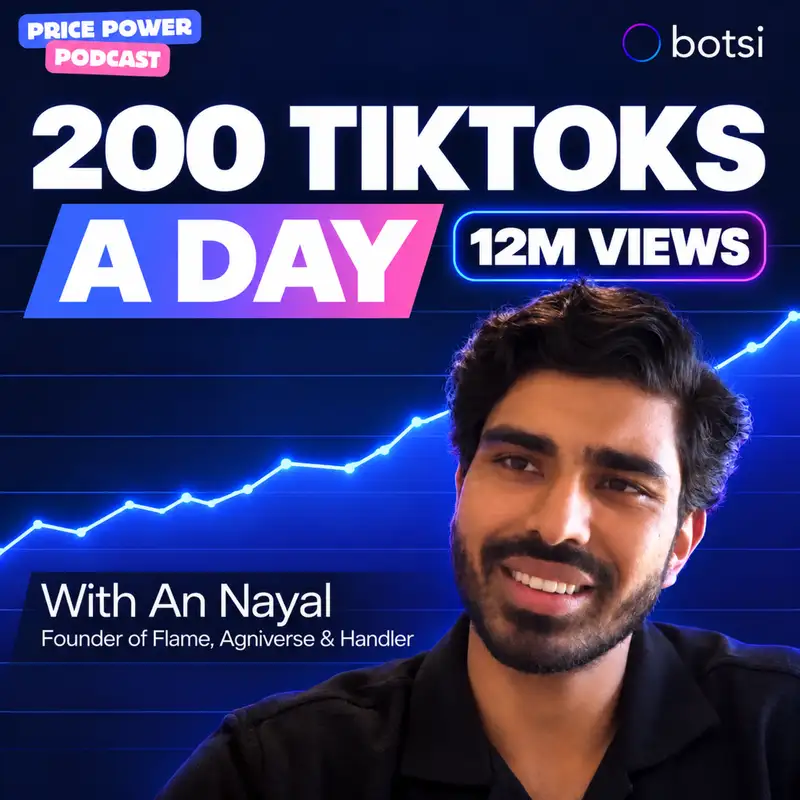
Today, we're talking with An Nihal.
An is the founder of Flame, a couples
app that was actually acquired this year.
Before An got into apps, he
ran a chain of gyms in China
and competed as a bodybuilder.
Now he runs Agniverse, a UGC
creator agency and platform.
Today, we talk about how one daily feature
took Flame's day 30 retention from 4%
to 50%, why paying users for referrals
brings in the wrong type of users, how 10
TikTok accounts and 150 plus posts a day
and led to an acquisition and much more.
Speaker 4: Hey, Aan.
Super excited to have you on
the podcast today and, and kinda
learn more about your journey.
Speaker 2: Same here, brother.
I'm really happy to be here.
Thank you for having me.
Speaker 4: Yeah, yeah.
Thanks for joining.
So I, I guess to start, if you just
wanna little, tell me a little bit about
how you got started in the app world
Speaker 2: I have a funny
story about that, right?
Because originally, anyone who
has looked into my background
will know that I'm, I'm a gym bro.
I had a chain of gyms in China.
I was also an active bodybuilder.
So, you know, coming from yelling
"biceps" to yelling "App Store, you
motherfuckers" has been a journey.
And, uh, it was back in-- I think
it was back in '22, '23, I remember.
I was looking around, I was like: Hey, I
want to get back into building a business.
I was in Europe at the time, and I
realized why not build an app, right?
Everyone is doing it as a cool thing.
I think I watched a bit too much
of Social Network and, uh, Silicon
Valley as well and got too inspired.
So I went in and I go over to my
friend's home who are, like, one is
a UX/UI designer, one is a developer,
and I'm like, "I want to build an app."
And I thought it'd be as easy as writing
English, and it turned out not to be.
They asked me: Do you have
the UX/UI design ready?
Do you have the screens on Figma?
And this was way back
when GPT didn't exist.
Do you have the screens in Figma?
Do you know what language
you're going to be coding in?
Is it a, like, a native app?
Is it a cross-platform?
Is it a progressive web app?
And I could just say three words.
I said, "What the fuck guys?
I just want to build an app.
Why is it so complicated?"
But anyway, learned through the
lessons and I initially launched a
date planning tool called Sparks.
We got lucky.
Y- y-- I would call it luck because,
you know, I did what every founder
has to go through, the rite of
passage, where you just apply to
every single thing you can find.
So I applied to every single
accelerator, every single sort of
pitching competition, et cetera, and
we got into TechCrunch Disrupt, right?
So the top of the top.
Um, so there I am flying to San
Francisco with this product build,
which is gonna help couples connect
with each other by having them go
on fun, uh, you know, novel dates.
Um, we launched the product.
Uh, we got lucky in the manner
that it somehow hit off.
We grew organically,
uh, 800% week on week.
I think it was a lot because we
realized that you don't only go on a
date with your partner, you also go
on a date with your friends, with your
family, and we kept it open to all.
So you could invite your friends,
you could invite your family.
Uh, so launched the product, goes
really well, and then a month passes,
I'm back, I'm settling in, and I get a
little notice saying that, uh, a pretty
little cease and desist on the top.
And it said because we picked up a
lot of media, we got featured in a
lot of places, we grew really fast.
That is why we had-- Our name was
quite similar to another brand
that which was out there in the
dating market, and they were making
hundreds of millions, which means
they had much bigger budgets than us.
So I suppose they went after every
brand which shared the same name.
So they came after us and they
told us you cannot use Sparks
the app Um, and you know, Jacob,
I just went into app building.
I had no idea, and on top of that,
I have to deal with this as well.
I was, uh, shitting my pants, man.
I was scared.
I was like, "Okay, what do I do now?"
Contacted four lawyers.
I was like, "Who can help?
Who can advise me?"
And everyone told me the same
thing, "Leave your ego on the side.
It doesn't really matter
if you have to rename.
It's not worth going in and
challenging them right now."
It's not worth anything, right?
Because the brand was new.
There was nothing built up.
Um, and then I realized another
thing at the same front, that we had
almost no retention on the product.
So people came because it
was quite a novel idea.
People were excited about it,
and everyone left by day 30.
Uh, so I used this as a nice pivot to also
go out of what we were building and try to
understand what did couples actually want.
Then went into building that, went
into discovering what couples wanted,
talked with about, uh, dozens of couples
and realized that people-- couples
genuinely just wanted to connect.
They didn't-- You know, the tech is
a way to do things, but it's not what
people are coming to it for, right?
People are coming for an objective.
They wanted to connect.
That was the prime goal.
Oh, you know, you would think
the second time the wiser, Jacob.
I, I would go out in the market,
build something to help them connect.
No.
30th of November 2022, ChatGPT came out.
Tell me a single person who wasn't
caught in the wave of how incredibly
awesome it was and build around it.
So we built an AI coach for couples.
Right?
Uh, and again, the same,
then same story repeated.
We came on the LA Times, they
featured our app on there.
They're like, "Hey, look, someone built
this for couples, someone did this."
Amazing, right?
As a ego, it's my founder ego getting
boosted again and again because I'm like,
"Look at me, I'm such a cool founder."
Well, the users did not resonate, and they
didn't reflect, uh, in the same manner.
Uh, if you remember GPT back in the
days, right, it was pretty crappy, and
also building a AI relationship coach
around the problem statement we didn't
even understand didn't make sense.
We just slapped it on there because
that's what everyone did at that time.
Um, usage was almost nil.
We had-- I think, I
believe we went from 0.8%
to roughly 4% day 30, and, uh,
we had another awakening where we
realized, okay, we need to change
things if we are gonna make this work.
You know, do you want me to pause there?
Because I know I'm taking, I'm driving you
through this entire journey, and it's- No
throwing things at
Speaker 4: you.
This is, this is great.
I think that one thing, um, I'd be
curious about, I think that a lot of other
founders h- are, are super curious, like
how do you get this initial traction?
How do you get started?
And it seems like you did that
successfully twice in terms of the initial
launch and, and then the, the AI coach.
H- like, how do you, how did
you think about getting thatâ¦
It sounded like some press, uh,
but how do you get that initialâ¦
A- and h- like was this intentional?
How did you think about kind of-- And
were there tests in there that, that,
uh, um, you tried out or to get this
initial kind of, uh, kind of traction
and visibility and traffic early on?
Speaker 2: I was a, I was a founder in
my 20s, really new to the scene, really
excited by tech and being a tech founder.
So not a, not a founder, novel
founder, but a new tech founder, right?
So I did what any enthusiastic
20-year-old would do.
I tried doing everything I tr- mailed
everyone, I applied to every single thing
I could find, reached out any places
I could, and some of the things stuck.
So I would say as a summary, if you
ask me what our strategy was, it was
throwing everything we could at the
wall and seeing what is sticking,
and that's what happened, right?
With the TechCrunch part, with
the media element, with happening
the second time around as well.
All of it combined was because
of-- Like, that's not how I'm
launching my current company.
The, the system is a
lot more developed now.
But back in the days when I just
entered, it was slapping everything on
the wall and hoping something sticks.
You know, we're honest about it, right?
I told you before we started this, I'm
gonna be honest, I'm gonna share whatever
we went through, so I'm gonna do that.
Speaker 4: And I think that's
important to think about where
you don't have any budget, right?
You, you don't have any revenue coming in.
How do you get something?
How do you get anything?
Some hint of traction?
And so it sounds like, I, I mean,
kind of a lot of pitching of PR-type,
type things of, of, uh-- and, and
that helped get some early press.
Speaker 2: Jacob, the-- When we
launched initially, we had, we had a
couple of hundred people on the wait
list, and I apparently didn't know
that you could schedule the emails
and have them go out sequentially, so
I mailed everyone handwritten notes.
Not handwritten, but
like handwritten emails.
Um, no, I think, you know, what I would
recommend if I was starting all over
again right now, the best ways to reach
out is, I, I genuinely believe in this,
and I, I believe that you should do it
manually, and not because that is the most
scalable method, but there is something
you learn when you talk with users again
and again and again and again, which
automating it doesn't teach you, right?
Which looking at the product
metrics on PostHog or Mixpanel
or Amplitude doesn't teach you.
And this is one of the most vital
lessons I think everyone who's building
a product right now should keep in mind,
especially when it's easy to just slap
on an agent, which is gonna automate
the outreach and reach out continuously.
Talking with users has never
been more important, right?
Getting this feedback face to face
where you talk with people, realize
what is working, what is not working,
what could you do next, most important
pass-- piece of the pie right now.
Speaker 4: Got it.
And so there's-- Yeah, I
think never underestimate the
value of actually learning.
Um, and, and so tell me about how you did
that, and then, you know, you're kind of
struggling with this early poor retention.
Did, did, uh, figuring out what to do to
improve this come from talking to users?
Did it come from quantitative analysis?
How did you move to a place where
the app actually, like, uh, uh, you
could see early signs that people
actually liked it and wanted to use it?
Speaker 2: Reversing back, we-- Going
back again to, to February 2023, we
launched on Valentine's Day again
after the whole branding rename,
et cetera, and we got featured by
TechCrunch Again, super cool, right?
Like a founder getting on TechCrunch
twice in six months, amazing story.
You know, I was, I was a new tech founder.
So, uh, for me, this was the epitome.
This was when I was living
my Silicon Valley dreams.
And again, the same problem hit us.
We discovered that we did not
have retention on the product.
We were sticking at roughly 4.2%
day 30, which is quite miserable.
Um, not even talking about conversions
at that point, Jacob, because you'd be
surprised to know this, we didn't have
any monetization put into the product.
I believe-- I watched
"Social Network," man.
I watched "Social Network."
I watched Mar- Mark Zuckerberg build
a billion, a trillion-dollar company
by getting people on for free.
I was like, "In the next five years, I'll
have every couple in the world on my app,
and we'll think about monetizing then."
Well, so reten-- going back,
retention is what we are working on.
We launched the product,
discovered retention is, again
Not hitting up to the mark.
Well, that's when I really went
deep into product building.
What I did is I initially
began with quantitative data.
I mapped out everything on Mixpanel, and
I saw what were people coming back for.
What were the four point two percent
of the people who were coming back for?
Why were they coming back?
Once I understood that it was not
the AI coach, it was a bunch of other
things we put in the product out
of them, it was the daily question.
It was such a simple way for them
to connect on a regular basis with
their partner without, you know,
having to go the extra mile, without,
you know, thinking of a routine to
draw or this to do or that to do,
especially for busy couples and
couples who were long distance.
Once we understood this, then we dedicated
ourselves just to this one feature.
Like, that's when we really focused.
We went deep inside and we saw,
okay, how can we make this feature
ten times of what it is, right?
How could we hone down on the thing?
Instead of trying to make the whole
app the perfect app, instead of
just that, just taking one feature
and going deep into it, running
a lot of AB tests, understanding
what's working, what's not working.
Um, so one of the biggest pivotal
moments came when we realized that
one of the advantages we had as
a couples app was that we did not
have to call people back to the app.
Their partners could do it for us in the
sense that let's say you're there with a
partner, we do- don't need to tell you,
"Come and answer the daily question."
We could have your partner
doing activities which would
trigger a response on your side.
So let's say your partner answered
the daily question, you want to go
in and check her answer or check
his answer, or your partner is
planning a date, you want to come and
accept the date invite, et cetera.
We discovered this was one
of the big triggers, and we
used this to our advantage.
We, instead of going and developing
more things, we took this one feature,
and we enabled a carrot-and-stick
system around it, which meant that in
the morning you get a daily question.
We would tell you, "Come
and make your partner happy.
Extend your X, Y-day streak."
You know, do something for your partner
which is going to make them feel happy.
End of the day, if you are still three
hours away from the end of the day and
you're not answering, you're not getting
back to it, we would remind you that
you would make your partner sad, right?
This would break the streak.
This would break their heart.
Um, getting a bit overdramatic
there, but you get the context.
Like morning, you give a carrot, evening,
you give a stick, and this helped us spike
retention from roughly four point two
percent all the way to fifty percent plus.
And we learned a lot of things along
the way regarding what exactly could
keep people on the app as not--
or get them away from the product.
Speaker 4: And did you have-- had
you added monetization at this point?
Speaker 2: No, we were not running
out of money till that point, and then
it happened a couple of months later.
We realized that, uh, I, I was
a really old founder, right?
So in my head, I at that point realized,
okay, but if we don't make money, how are
we gonna keep pushing the product forward?
We can't do that.
So we tracked retention and we realized,
okay, but we do need to ask people for
money, and that's when I learned the
first lesson of monetization is if you
give something for free and you ask
them to pay later, people are not happy.
People are not happy Right.
Um, see, that, that's, um,
Speaker 4: we did, uh- So
how did you roll this out?
How, how did you, how did-- Did you end
up trying to monetize them or just try
to-- Did you grandfather in the existing
users and then try to monetize new users?
Speaker 2: So what we did is we did not
monetize the existing set of features.
We took the demand and we let that
build up, and we tried to understand
what do people actually want.
And then we logged those features
once we launched them behind
a premium or freemium paywall.
So the ones who were using the
product and normal users could
still keep using the product.
The ones who wanted an advanced
set of functionalities, uh, could
pay for the product and use them.
Speaker 4: Got it.
And, uh, yeah, this is, this is typically
w-what I think is the better value prop.
Even also when you're increasing
price or adding new things, add value
for the user if you're gonna ask
them for, for something additional.
So th-this makes a lot of sense.
And then would you, um, would
you make, uh, each-- w-would you
charge as a couple or would you
charge both users, uh, for the app?
Speaker 2: As a couple.
Speaker 4: Yeah.
We charged
Speaker 2: as
Speaker 4: a couple.
So one person would buy and then
someone else would get the free usage.
Speaker 2: The onus actually was also
because after a bit of experimentation,
we rec- one, we realized that people
who did not partner up were a lot
less likely to stay retentive on
the product, which made sense.
But we also discovered that in the
relationship there was usually one
trigger, o-one trigger as in one
person who pushed for the conversion
and the other one usually didn't.
And if we locked both of them
behind a conversion paywall, we
would have lost both the users.
Because it's a partner-to-partner
product, if one of them doesn't use
this, the other one doesn't as well.
Speaker 4: Yeah, this
makes a lot of sense.
And, uh, h-how did you think about this
in terms of leveraging kind of the couples
for, uh, kind of growth or acquisition?
Would you, um, would you be--
W-when you're, when you're looking
at retention or you're looking
at usage, would you measure both
users' retention individually?
How, how would you track this, this
couple retention where really you need
both people continuing but you still
have s- two separate apps, you know,
two separate accounts and devices?
How would you think about the,
the kind of this measurement?
Speaker 2: What we did is we counted
an engagement event, which means
coming and answering the daily question
as the basis for retention, but we
didn't count it on a partner basis.
We counted it on a individual user basis.
Um, that's what we began with.
Of course, we could have run a lot more
experiments, but we were always limited
by being a small team and maybe not having
the right tools as well at that time.
Uh, what we did is so we mapped out the
individual user retention by seeing when
they came back engaged with the product
and used that as a basis to understand
if they were sticking or not sticking
Speaker 4: Got it.
Got it.
Yeah, interesting, interesting.
How did you think about when you were
adding these price points, uh, about
kinda what subscription lengths to charge?
'Cause you, you were still new.
You didn't really probably have
a good understanding of long-term
retention and usage patterns.
Were youâ¦
How, how were you thinking about
weekly versus monthly versus annual
and, and how to kind of construct all
those different subscription plans?
Speaker 2: Twitter
Twitter.
Back in the days, you go on Twitter,
you see what other people are doing,
you have a sense of FOMO, and you go
and do it yourself until you realize
it's probably not a good idea.
Then you go back and actually
see what's happening in your app.
Um, what we did is initial
baseline, like I said, Twitter,
FOMO, and second thing was studying
what our competitors were doing.
We thought, you know, if they're
bigger and they have a better
team, then they probably have
figured it out more than we have.
Uh, one thing that really-- and
one thing I would say would have
boosted our revenue by quite a bit
was running proper experiments.
I know that You know, end of the day
with a small team, what it came to is
what are we going to focus on next and
what do we have the capacity for, right?
And as a team, we could focus on the
pricing, but is that even important if
we haven't got distribution figured out,
if you're not getting people on board?
So what we did is we dedicated all our
resources on the distribution front
and pricing was mostly a YOLO kind of
thing where we put out something, we
see what happened in two months, we
put out another thing, another thing.
Speaker 4: Yeah.
Yeah, makes sense.
This makes sense.
I think honestly, this is, this is a
decent way for smaller apps to get started
is that overconfidence in A/B testing
experimentation, uh, it, it can be a
problem where you go, "Oh, we have 500
users in each variant, and this one won."
Well, it's like you, you're lying to
yourself and just because, like, uh, it,
it's better at, at that stage, um, if
it's not a big win, if it's not obvious
that this change is improving something,
then it's probably not actually a win.
And, and so I think this is like,
you know, you say, "Hey, we should've
been doing more experimentation,"
but very early, like sometimes
it's actually n-not, not true.
So I, I think, I think it makes sense.
But tell, tell me more about, okay,
so figuring out how distribution, what
did, what did you figure out here?
And, and tell me like from
early days of like, um, hey,
we, we're running out of money.
We don't have, uh, you know, huge revenue.
We're not monetizing, uh, so we, we
don't have money to invest in paid ads.
Like- Mm ⦠how did you get started and
how did you kind of figure out what works?
Speaker 2: Well, only on, you know,
three different stages, right?
Like the first stage was what I
defined to you, the PR part in
which PR worked really well for us.
Once we moved past beyond that
PR stage, one thing I learned
is PR isn't sustainable.
It's something that helps you a
lot initially, maybe helps your
founder ego a lot, but it's not
something you can keep going.
So we stepped then on trying everything
which was possible in the market, right?
Go on the paid side.
We tried putting out paid stuff, tried
putting out a couple of different
ad channels until we realized that
we don't have the budget for that.
You need to have a proper budget if
you're going into paid to run experiments
over an extended period of time.
Um, so the first phase was the PR.
Second phase was the paid,
which it didn't work.
Also asking as many people as I could
just, "Hey, would you download my app?
Would you try this out?"
Et cetera.
And then the third part
was what actually clicked.
This was in 2025, so '24 we saw the-- I
remember I was flying to Paris to visit
my then girlfriend, now wife's family,
and I was listening to a podcast by
the Cal AI guys where they were saying,
okay, how they mapped out using creators.
So I was like, "Cool, yeah, this
sounds like a solid strategy.
It's gonna be easy."
I tried doing that in 2024
end, didn't work out, right?
I think oftentimes when you hear a lot
of things, it seems like, yeah, it's just
you go out there, you try this, and it's
gonna work, and you're gonna print money.
And once you've been in business long
enough, you realize that anything you
want to go for, you need to dedicate an
extensive amount of time to understand it
to a deeper degree and actually unlock it.
Um, same thing happened, burned out
of that, then stopped doing that.
Came back to 2025, thought that
I would go and raise money.
I realized that raising money for
a product that was running out
of money isn't the easiest thing.
No one wants to give money.
Um, I remember the time-- man, at
the time, uh, RAG came out, right?
Retrieval-augmented generation.
So I was like, "I know how
we're gonna raise money.
I'm gonna put RAG inside my product,
and I'm gonna say that the couples coach
is pulling from their question data."
Well, it was the worst idea ever.
We-- question data was like
50 questions they answered.
I don't need a RAG
infrastructure for that.
So-- But I was like, "Okay, this
is what's in the news right now.
I'm gonna put RAG in.
We're gonna go and raise money
based on the back of being
a superior tech product."
Didn't work.
Didn't work.
So any founder who wants to try that
right now, I can tell you, in a couples
app, putting a RAG system doesn't really
benefit in any way and doesn't work.
Um, but it was a fun time, man,
fun time, and I got a lot of
stories off the back of it.
2025 came, middle of summer, sitting
there, have no idea what's going on
with the product, almost out of money.
I decided to go deep into TikTok myself.
So what we tried doing earlier
is, right, hand it off to people,
hand it off to people to do.
You know, we tried getting an agency
on board to help us with that.
We tried doing it through an
intern, and I realized that there's
no secret in business, right?
If you wanna make it happen, you need to
make it happen yourself as the founder.
No one is gonna help you, hold your hand.
You might get lucky a few times, but in
the end, you're the one who needs to make
the big ba-- you know, big, bold move.
So I went into TikTok.
I, um, you know, I have a limited
collection here, but I can show you
like, uh, you know, even within here,
one, two, three, four, five Just I
got, I got a friend who was sh- you
know, shifting his company's focus,
and they had a bunch of iPhone 8s,
so I bought a dozen of them from him.
They, they had a software for truckers,
like a Uber for truckers, and they
didn't need the phone anywhere
where the software was deprecated.
So I got the phones, and then I started
putting up this TikTok system, lining up
all the phones, trying to push out content
to them, seeing what was happening, doing
that again and again and again and again.
I remember some days I was
up at, like, 12 in the night.
I was trying to do it, and I was so
tired from the day, and I was passing
out on the phones, getting up, scrolling
a bit more, posting on two phones,
then passing out, then doing it again
on the m-mess of the two phones.
Um, it was a journey, but it taught me
a lot about content, TikTok, organic,
and also taught me, you know, why my big
thesis is on organic content right now.
Also talking a bit about that because
I realized that organic is one
of the fair testing grounds left.
Organic doesn't discriminate whether
you can throw more money at the problem.
It discriminates whether you can create
the right kind of content with the
right hook, with the right retention
in the body, and you can target
it at your users in the right way.
That's what we did.
We went on TikTok really deep.
I had 10 accounts pushing out
150 to 200 pieces of content
on TikTok every single day.
And it worked, right?
It worked, and I think this-- being
a founder, you always take shots,
and you hope that all the shots work.
And being a founder is about taking
a lot of shots so you can maximize
your surface area of possible victory.
For us, this was the one
that clicked, that worked.
Scaled heavily using it, hit 50
million views on TikTok and off
the back of it, we also exited this
year, sold our-- you know, got our
company acquired and, uh, here we
are having a talk and chatting with-
Speaker 4: Yeah.
That's, that's amazing.
Um, let's, let's dig
into that a little bit.
So, like, 50 million views, I think,
um, understanding, like, okay, c-
are you able to share, like, how
many installs did that generate?
And, like, okay, what, what
actually revenue resulted from that?
Speaker 2: So we hit roughly, roughly
200,000 installs off the back of it.
Um, and j-just one clarity, one lesson
we learned is not all views are the same.
The first 20, 30 million views, we got
them because we put out memes with a
ment- like, with a small flame logo
in the bottom right corner As you can
tell, Jacob, that didn't really convert.
You know?
But yeah
Speaker 4: So what's the, yeah, what's the
structure of a, a good, uh, kind of UGC
creative that, that you found converts?
Speaker 2: What we learned is you want
the creative to be around the product or
the value the product provides, right?
A meme is not providing value or is built
around the product, which is function.
So what we did is we then started
understanding what we need to go
really deep, understand what people
are saying, what pain point they have,
and build the content around that.
That generates a higher sense of,
"Okay, I feel like this is built
for me," or, "This is my content."
Also, we realized that the-- not
always, but the more we can showcase
the product in the content, the
better chances of conversion are.
Combining these two things together,
we started targeting the actual
value prop or the aha moment of
the product and combining that with
showcasing the product in the, in
the respective creative as well.
This is what increased the
conversions quite a lot.
So memes have roughly a 0.1--
0.05
to 0.1
conversion rate as compared to
anything which displays the product.
It can go up from 0.5
to 1% roughly.
And I, I know the numbers sound
small, but when you're operating
in scales of millions of views,
it can create the difference.
These small, um, points can create
the difference between a product
working successfully versus not.
Speaker 4: Yeah.
That-- it, it makes a lot of sense.
And, and, you know, with kind of
the TikTok world, like you can get
a lot of views, uh, kind of very
quickly if you get, uh, and they don't
quite have the same ceiling on this
organic reach that other platforms do
today, uh, especially kind of in the
short-form Reels, uh, uh, type content.
And, and so this, this
makes a lot of sense.
And then, you know, thinking about this,
um, okay, we, we acquire these users.
I, I know you've talked a little bit
about how do we, um, h-how do we create
some virality or some-- H-how do we get
these users to get more users for us?
And I think this was your thesis
you had around this couples app.
Like I, and I think a lot of people
this, this sounds really exciting,
like refer a friend, invites.
Okay, we acquire users.
They're gonna invite more users.
We're gonna go viral.
Uh, um, like did you- I, I think
sometimes it's a hard, hard reality,
but like were there any learnings there
that you think was kind of valuable?
Speaker 2: First one is the classic
playbook we believe is give someone a
free membership, give someone a bit of
money, and they'll refer other people.
Worst way to get referrals, right?
They'll be low intent.
They won't be the right users for you.
We tried doing that.
We were like, "Okay, you know,
invite someone and you get a month
free, they'll get a month free."
I realized that referral-- or always
when you think about referrals, think
of someone telling their friend through
word of mouth about your product, right?
They're not gonna do it because
they're getting $5, right?
I'm not gonna go and tell my friend
next door, "Hey bro, you've got to
download this app, and I'll get $5."
No.
You need to do it when they genuinely
feel like it solves a problem.
You need to map it around the
conversion part of the element.
You need to map it when users are
having an aha moment and carry that
aha moment into your referral as well.
So from our side, we, you know, I was
like, we're gonna have a K factor of more
than one because we built for couples,
so couples will invite their partner,
plus they'll invite someone else as well.
Well, one thing I learned is
that the K factor is capped.
If I have the pieces behind, that the
K factor is capped because a couple
will-- or a partner will invite
their partner, but that doesn't
mean they'll invite another couple.
It's a different way,
different loop to build in.
Second, we also learned that even
within the partners, most partner
were not willing to use a product
for the relationship, right?
There was this layer of barrier where
most people don't want to download
the product even though their partner
refers them, maybe it goes up higher.
I think the partner-to-partner ratio
was at, the K factor was roughly at zero
point five, but it was capped there.
We had no way of continuing it
because you don't have 50 partners.
We then tried building a couple-to-couple,
um, structure and- We discover--
Well, well, we initially started
with you invite your friends who
are couples, and you'll get a free
month, they'll get a free month.
Didn't work.
Money can help you accelerate that,
but money is not the r-reason why
people would invite someone else.
Um, and then we tried running a
few experiments, but we didn't
really succeed with that.
We got it capped at around, you
know, zero point one, zero point two.
Um, so we didn't-- we never were able
to tap into that K factor enough.
I also feel like the industry we
were in, couples, usually they're
a bit more private if they're using
something in their personal life, and
they don't want to be going around
blatantly putting it on social media.
And studying also the playbooks which
are out there, one thing I learned
is the best moment in a user's life
to inculcate the K factor is when
they are at school or university.
That's when they, they are the
most likely to try a new product.
That's when they're most likely to go out
and be like, "Hey, listen, you use this."
That's when they are in these
closed networks in which a product
can accelerate really quickly.
Once you become-- Once you step into
the working style side of life, the, the
circle becomes a lot more restricted.
You're more less-- you're less likely
to be spreading it in the same manner.
Speaker 4: Yeah, that's, uh, it-it's
so interesting kind of just, yeah,
hear-- learn about kind of the K factor
and how this, uh, affects things.
I think that it, it-- the, the days of,
the golden days of refer a friend and
kind of virality of PayPa-PayPal and
Dropbox, like it's just, you know, it
doesn't, doesn't really exist anymore.
I think there's still opportunity
sometimes for invite a friend.
Like, it can help a little bit for
some types of products as you're
referring to, but I think, uh, the--
y-your point about thinking about the
social networks where, um, your users
are actually living and what types of
real world experiences they're going
through and how you can tap into those.
We often get stuck in the box of
just looking at our product and don't
try to empathize with our users.
Like, well, what are-- what's
their act-- life actually like?
What's actually happening?
And, and kind of how we tap into that.
So I, I think this makes, uh, a, a lot of
sense and, and is valuable to think about.
Um, and so yeah, y-you
mentioned the acquisition.
Congratulations.
I, I think this is, uh, quite
exciting and- Thank you.
Thank you ⦠um, I, I guess,
you know, tell, tell me more
about kind of what led to that.
I, I think that at, at some point it's
a, it's an exciting thing, but a-at some
areas like, hey, maybe we aren't able to
grow it anymore, or, or kind of what, what
made you decide that this was a, um, a,
a, the, the right decision for you all?
Speaker 2: We realized that we didn't
have the skill at that point, nor the
resources to grow the product further.
We realized that we were hitting a
cap and, you know, I, I think it's
that law of diminishing return,
where you put an X initially, you
get Y, and seems like a feasible ROI.
You keep putting in X and you notice
the Y is decreasing or hitting a
flat plateau, and that's when you're
like, "Okay, maybe we need to find
another home for the product."
Um, then regarding the acquisition
element, Jacob, it's exhaustion.
I know it seem-- You read the
stories, you're like, "Man,
this is insane, you know, exited
founder, kudos," blah, blah, blah.
The whole process is not fun.
Uh, you're not growing the product,
you're not selling the product.
You're out there in the market
trying to find the right buyer.
I almost gave up, man.
Like, I almost gave up at one point.
I decided to go out with it.
You know, it seems like we, we read the
story, we see on Business Insider, the
story come out, and we're like: Yeah,
this happened in less than a month.
Must have been immediate success.
No.
I tried starting six months before
that, trying reaching out to
the market, tried getting out to
multiple people and nothing, right?
I even got to my contacts inside
Match Group, inside Bumble, inside
Grindr, ins- inside, I think the,
one of the big Chinese ones as well.
All of them were rejections.
No, no, no, no.
The dating players-- Because for
us, it was either the dating players
or the mental health players.
Dating players were focused on cap or
keeping their existing shrinking market.
As you know, we look at the stock
market, the, the old products
have completely dipped in value.
They used to have a standing before.
I remember Tinder was valued at $40
billion in 2021, and, uh, Match Group,
not Tinder, Match Group, and currently,
I think they're at a fraction of that.
Um, so once we figured this, then we
tried reaching out to the other side of
the market, trying to reach out to more
people there, and again, nothing, right?
Then I think this was in June or July,
I forgot the exact month, but I'm
sitting there and my friend sends me
an article about, uh, a couples app
or couples product, which they shipped
subscription boxes to the couples.
They raised a round recently,
and they raised $21 million.
So I was like, "Okay, this is really cool.
Why don't I try to get
in touch with them?"
Didn't know the guy.
I send him a request on LinkedIn.
He didn't accept, didn't
do anything, right?
So two weeks later, I'm, I'm checking
my LinkedIn, who's viewed your profile,
so I see that his name was there.
So I take my second shot.
I go get LinkedIn Premium.
I go into his inbox and I tell him,
"Hey, Yoffer, saw that you guys raised.
Congratulations.
We've been in the market for the
last five year or four years.
I've got a lot of learnings to share.
Would love to exchange notes."
And I ended it with, you know, "No ask
here, just looking to make friends."
Smiley face.
And so he, he accepted the request.
We had a talk.
We came on a call soon after and,
uh, then, you know-- and, and
I think that's the part, right?
A lot of people just go in with the ask.
So a lot of people were just going
like, "Hey, do you wanna buy us?"
Right.
Okay, cool.
I don't know you.
I don't know who you guys are.
I don't know where you come from.
We went in, I just shared a lot
about what we learned along the way.
They shared about what
they learned as well.
And then he asked me, "What
are you guys doing now?"
And I said, "You know, this
is where Frame is right now.
We're not able to grow it more.
Um, we, we are looking to see
if we find the right home."
So he said, "Okay, let me talk
with my board and get back."
He talked with his board, came back a week
later, and we had an offer on the table
We had an offer from Offer would be close.
Speaker 4: Uh, uh, so, uh, was,
was it what you were looking for?
Are there any- anything of like, uhâ¦
I, I have my notes that there
was some performance component-
Yeah ⦠uh, of, of the deal.
Um, I'm, I'm curious, like how, uh-- and,
and I think this is extremely valuable
for other app founders of what to expect.
Um, and, and so yeah, I know you're
not able to share everything,
but, but curious in terms of
what, what you're able to share.
Speaker 2: So I've shared this, this
part on socials as well, where we,
um, what the deal ended up being was a
performance-based, milestone-oriented
transaction in which, based on the amount
of users who would move over to Aria,
you would get a certain percentage capped
at, not particularly capped, but roughly
estimated to hit the seven-figure mark.
Um, not capped at a particular number,
but we're expecting it to be in the
mid seven figures, uh, fingers crossed.
There's still a lot of work
that needs to go on behind it.
As you know, performance-based
transactions are not
getting cash in your hands.
You still need to work
on making them happen.
But overall, considering the fact
that I was-- around June, I was
even ready to say, "Okay, man,
let's close the chapter with Flame,
focus on the next thing," I think we
ended up in a really good position.
Speaker 4: Yeah, that's,
that's very exciting, uh,
Speaker 2: sure it- Also, I, I've been
asked this question as to why close the
chapter with Flame if you figured out
the acquisition, figured out this, that.
I think there were two parts to it, right?
One part I told you about the resources.
The second part was I got burned
out of the product, right?
I think you-- anyone who has built
a product for a couple of years will
realize there's a point where you go
through so much shit with it that you're
like, "Okay, man, I don't really-- I
know this is my product, this is my
baby, but I'm kind of tired of it."
Speaker 4: Yeah.
It's, it's, uh, the, the founder's
journey is a hard one, and it is,
uh, lots of time and lots of effort.
And so I, I think, yeah, you should
definitely feel excited about,
uh, a positive outcome there.
Um, and so-- and I think, you know, one
thing you, you're talking about is that
you're taking a lot of these learnings
through this into kind of what's next.
So, so tell me a little about what
you're, you're working on now.
Speaker 2: So yeah, starting of this
year, um, I was sitting and talking
with my wife, and we were reflecting
what is, uh-- and at the same
time, we looked into selling Flame.
So we were just discussing
what is a gap in the market.
And, uh, we went deep into understanding
the switch that's happening because of AI.
My thesis, our thesis is that before
when you wanted to build a company,
you would have two big walls that
would be standing in the way, the wall
to building a product and the wall to
building or distributing that product.
Now, what has happened with AI,
the wall to, in the tech space
at least, the wall to building a
product has gone down drastically.
Doesn't mean that you can build a
quality product of the scratch, but
building a product is a lot easier.
But the wall to distribution/marketing
still stands high, and I would
say it's even higher than before.
The reason being that a lot more people
are building products right now, which
means a lot more people are trying
to distribute them, but they don't
really understand how to do that.
So carrying the knowledge we had
from Flame, we I have a couple
of theses, one of them being that
virality can't be invented, it can
be engineered, which means it's about
a lot of A/B testing, a lot of, you
know, putting out things, testing
what performs, what doesn't perform.
Uh, second being that organic is
a fair t- field still, whereas
paid ads have become, you know,
field for whoever has more capital.
In ninety percent, ninety-five
percent of the cases, who has more
capital, who can throw more money
until they end up cracking paid ads.
Combining this, we decided to come
together and launch two things.
One, a UGC media agency where we
hire creators for brands and creators
are different than influencers.
Influencers are people who
already have the audience and
who can sell to that audience.
Creators are people with
scratch in terms of audience.
They create new accounts, they push
content on that, and because of the
increased graph algorithm which social
media is switching to, these accounts
from scratch can also hit millions of
views as long as the content is dialed in.
So which means that you can
have new creators putting up new
accounts, reach the same audience
or even more with the right kind
of content, and that's what we do.
For brands, we hire dozens of
creators, and we have them create
content, put it out on new accounts
they create, and go viral with that.
So that's one of the things we are
doing right now, helping brands go viral
on social media using real creators.
At the same front, another thesis I
have is that the speed of iteration
with the AI models on the video
generation side i- is dramatic.
Like every year, you see the models
taking a step up, up, up, up.
With that, I built another
tool which is called Handler.
What Handler does is it researches
content that's winning on social media.
So we are scrapping thousands
of videos on TikTok every day.
It finds the winners, and it helps
you create the winners again with AI,
so you can push them out on socials.
Same thesis, engineering virality, taking
stuff that's already winning and using it
to create your winning piece of content
rather than starting from scratch.
So these are the two things we are
working on right now, and I'm doing that
with my wife, which I think is cool, but
at the same front, we are working all
the time and, uh, I hear complaints at
times of us not having enough personal
time because every time is work time
Speaker 4: Yeah, I hear that too,
and I'm not working with my wife.
So it-- So, uh, uh, I, I, I
understand, uh, uh, the, the
work-life balance is hard.
Uh, uh, and it, it, it doesn't,
doesn't always get easier.
But, but that's awesome.
I think it's, uh, you know, e-every step
y-you're trying to figure out, "Okay,
what can I take to this next step?"
Uh, and, and kind of the journey.
And so yeah, this is super
insightful and, and I think thatâ¦
So, so tell people, uh, um, tell
people where they can, can find
you if, uh, and kind of what the,
uh, uh, UGC agency is called.
Speaker 2: Yeah.
Uh, UGC agency is called Universe.
Speaker 4: Okay.
Speaker 2: And one-of-a-kind name,
so it's not like gowiral.com,
which means- Yeah ⦠you can easily
locate it when you look for it.
We'll put a link in.
And then you can find me on nneyal.com,
which is my own website, or X, Consumer
X AI, where, where I shitpost a lot.
Speaker 4: Cool, cool.
Yeah.
We'll, we'll, we'll have
these links in the show notes
so people can go find those.
Um, yeah, this was awesome.
This is-- Like, I think so many
good insights- It's- ⦠and
hearing people's journey.
Uh, every- everybody's journey is a
little different, and I'm sure there's
gonna be insights people can take away
and kind of apply to their own work.
Um, any other, uh, kinda last
parting thoughts, tips, or advice
you wanna leave people with?
Speaker 2: I think something I would
leave around building a business, right?
Like, I, I think building a
business is an art and, and
it's a skill at the same time.
One thing I have found which is the
most important to build a successful
business, could be in anything, could
be an app, could be anything else,
it's consistency over time, right?
It's doing the boring stuff
over and over and over again
until you manage to crack it.
And sometimes days are bleak, right?
Some days nothing is working.
You're like, "Man, I don't
know how to distribute it.
I don't know how toâ¦
You know, the product doesn't function.
Users are complaining."
If you have users.
You might not have them at all.
And what I found, uh, as the biggest
motivation for me at that point, uh, was
that you have to love the art, right?
You have to love the process, because
result we can control if we stick
with it a long enough time, but a
result can be harder to predict.
And that is why the process needs
to be one of the most important
things which you fall in love with.
Again, this is one of those classic
philosophical entrepreneur stuff,
but this is what I realized the,
the truest for my own journey.
Speaker 4: Yeah.
I, I think, uh, cliches
are cliches for a reason.
They're often true.
Uh, that's why they become cliches.
Yes, sir.
Uh, and, and I think that's great advice.
The, the power of compounding
and consistency for everybody
to accomplish great things.
Um, cool.
This was, this was awesome.
Well, I really appreciate you coming
on- Thank you ⦠on and, and,
uh, yeah, thanks for your time.
Speaker 2: Thank you, sir.
Speaker 4: All right.
Bye.