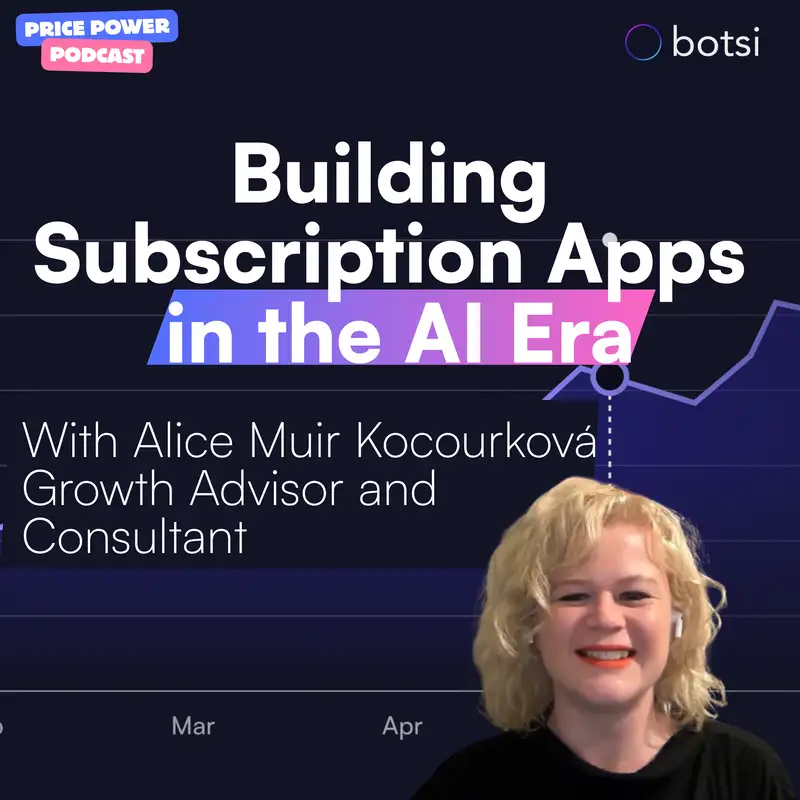
Alice Muir, independent subscription consultant who's worked with Headspace, VSCO, Adobe, SoundCloud, and MyFitnessPal, explains why "higher engagement equals lower profit" is the new reality for AI apps, how to use strategic friction without choking activation, and why most consumers don't actually care that your app is AI-powered.
What you'll learn:
- How strategic friction worked for MyFitnessPal, and what they got wrong by gating barcode scanning too late
- Why "protect the learning actions, charge for the outcomes" beats free-vs-paid debates
- How to handle the 90% of installs that never subscribe when free users now cost real money
- When hybrid monetization actually makes sense and when it just adds complexity
- Why weekly subscriptions are a proxy for usage-based pricing on novelty AI apps
- Why margin-qualified acquisition matters more than CAC alone for AI products
- How Flibbo used persona tiers on the paywall to get users to self-identify their willingness to pay
- Why a fitness app got a 6x paywall lift by removing strikethroughs, countdown timers, and stacked offers
- What the Subscription Stack framework needs to add for the AI era
- The back-of-the-napkin math founders should run before shipping any AI feature
- Why consumers may actually be turned off by "AI-powered" positioning
Key Takeaways:
- Protect learning actions, charge for outcomes. Users should learn what your product does for free. The thing that completes their job is what they pay for.
- GPU cost is a CAC line item, not a margin problem. If everyone you acquire gets one free generation, that compute cost belongs in your acquisition budget. Run worst-case-scenario math before you ship.
- Highest engagement is now lowest profit. Traditional subscription thinking inverts when each interaction has a real cost. The Subscription Stack engagement layer needs a full revision for AI apps.
- Weekly subscriptions are a usage proxy. AI apps see strong initial conversion and terrible retention because users have high intent for short bursts. Annual plans for a song generator are a fantasy.
- Self-identification at the paywall beats the questionnaire. Flibbo put basic, pro, and max personas on the paywall. Users picked the one that matched their use case.
- Simpler paywalls outperform copycat paywalls. Stripping countdown timers, strikethroughs, and stacked plan tiles from a fitness web-to-app funnel produced a 6x lift.
- Consumers don't care about AI as a feature. They care about the outcome. "AI-powered coach" can read as cheap, not premium. Lead with benefit, not technology.
- Don't add AI just to add AI. If a feature doesn't measurably improve retention or activation, you're paying GPU costs to compress your margin.
Links & Resources
- Alice Muir on LinkedIn: https://www.linkedin.com/in/alicemuir/
- Subscription Stack framework: https://phiture.com/resources/subscriptionstack/
- Andrew Chen on consumer reactions to AI: linkedin.com/posts/andrewchen_when-consumers-dont-care-that-youre-building-activity-7358342997639360512-wqKM
- Thomas Petit RevenueCat article on hybrid monetization: https://www.revenuecat.com/blog/growth/ai-hybrid-monetization/
Timestamps
00:00 – Intro
01:25 – Baby raves in Berlin and the new May Day
02:58 – How the playbook changed: from acquisition-first to retention-first
07:25 – Strategic friction and the MyFitnessPal example
10:43 – Hard paywalls vs letting users discover value
11:55 – Protect learning actions, charge for outcomes
17:25 – The 90% problem: monetizing low-intent users
21:36 – When hybrid monetization actually makes sense
26:15 – Apple tax, GPU costs, and the AI app profitability squeeze
28:55 – Why weekly pricing fits novelty AI apps
33:53 – Margin-qualified acquisition for AI apps
39:08 – Flibbo's self-identifying paywall personas
43:55 – The 6x paywall win: stripping out the fluff
47:56 – Revisiting the Subscription Stack for the AI era
51:55 – Switching models to protect margin
53:38 – What founders should get right before adding AI
56:58 – Hot take: consumers don't care about AI
00:00 – Intro
01:25 – Baby raves in Berlin and the new May Day
02:58 – How the playbook changed: from acquisition-first to retention-first
07:25 – Strategic friction and the MyFitnessPal example
10:43 – Hard paywalls vs letting users discover value
11:55 – Protect learning actions, charge for outcomes
17:25 – The 90% problem: monetizing low-intent users
21:36 – When hybrid monetization actually makes sense
26:15 – Apple tax, GPU costs, and the AI app profitability squeeze
28:55 – Why weekly pricing fits novelty AI apps
33:53 – Margin-qualified acquisition for AI apps
39:08 – Flibbo's self-identifying paywall personas
43:55 – The 6x paywall win: stripping out the fluff
47:56 – Revisiting the Subscription Stack for the AI era
51:55 – Switching models to protect margin
53:38 – What founders should get right before adding AI
56:58 – Hot take: consumers don't care about AI