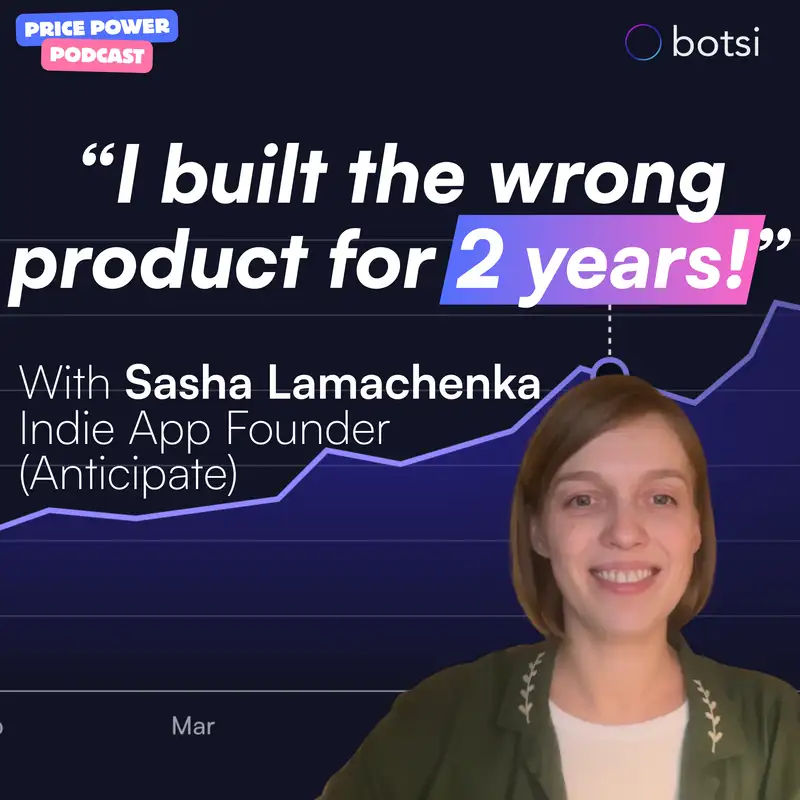
Sasha, founder of Anticipate (a mental health app), explains why she accepted an overly broad problem statement during validation, how she used Reforge's product-market fit narrative framework to test hypotheses without building, and what she learned after eight rounds of iteration that still didn't land product-market fit.
Sasha came into this with a real edge: years of marketing technology and data consulting for companies like Flo Health gave her the insight to use behavioral data for mental health. But translating deep domain expertise into a focused, sellable product turned out to be a different problem entirely. She walks through the specific moment her PMF interviews led her astray, why the Blue Ocean Strategy canvas revealed she was charging for features users get for free elsewhere, and the five pieces of advice from advisors that finally helped her reframe everything.
What you'll learn:
• Why emotionally compelling answers in user interviews can mislead you into solving problems too large to tackle
• How Reforge's PMF narrative framework structures hypothesis validation before a single line of code is written
• Why product-market fit interviews need to go past the top-level pain and drill into specific, solvable sub-problems
• How the Blue Ocean Strategy canvas revealed Sasha was charging for features available for free
• Why willingness to pay and perceived value are not the same thing, and why conflating them kills monetization strategy
• How Apple in-app events can give early-stage apps a meaningful boost in rankings and visibility
• Why Reddit feedback, brutal as it is, beats feedback from friends and family every time
• How to identify your real competitors by talking to people who don't use any product in your category
• Why going viral before you understand your retention is more dangerous than growing slowly
• How Gamma's "ruthless focus on the first 30 seconds" applies to any early-stage product
• Why "hell yes" should be the bar for every slide in your demand validation deck before you build anything
• How to layer in analytics tools incrementally rather than setting up a full stack before you need it
Key Takeaways:
Sasha came into this with a real edge: years of marketing technology and data consulting for companies like Flo Health gave her the insight to use behavioral data for mental health. But translating deep domain expertise into a focused, sellable product turned out to be a different problem entirely. She walks through the specific moment her PMF interviews led her astray, why the Blue Ocean Strategy canvas revealed she was charging for features users get for free elsewhere, and the five pieces of advice from advisors that finally helped her reframe everything.
What you'll learn:
• Why emotionally compelling answers in user interviews can mislead you into solving problems too large to tackle
• How Reforge's PMF narrative framework structures hypothesis validation before a single line of code is written
• Why product-market fit interviews need to go past the top-level pain and drill into specific, solvable sub-problems
• How the Blue Ocean Strategy canvas revealed Sasha was charging for features available for free
• Why willingness to pay and perceived value are not the same thing, and why conflating them kills monetization strategy
• How Apple in-app events can give early-stage apps a meaningful boost in rankings and visibility
• Why Reddit feedback, brutal as it is, beats feedback from friends and family every time
• How to identify your real competitors by talking to people who don't use any product in your category
• Why going viral before you understand your retention is more dangerous than growing slowly
• How Gamma's "ruthless focus on the first 30 seconds" applies to any early-stage product
• Why "hell yes" should be the bar for every slide in your demand validation deck before you build anything
• How to layer in analytics tools incrementally rather than setting up a full stack before you need it
Key Takeaways:
- Don't take big emotional truths at face value. When Sasha asked users about mental health, they told her they never wanted to experience a crisis again. That's real. But it's so large and ambiguous that no small startup can solve it. She should have pressed further — what specific behaviors or sub-problems sit underneath that fear? One reachable problem beats ten important ones.
- Sell before you build. A slide deck that walks users through a problem and proposed solution is a much cheaper way to iterate than building product. If you're not getting "hell yes" reactions slide by slide, the product wouldn't have landed either. Change the deck first.
- Willingness to pay is not the same as value. Some use cases are genuinely valuable to users but they'll never pay for them because they see the data as theirs, or because it's available elsewhere for free. Knowing which features fall into which bucket before you write your pricing page saves a lot of pain.
- Your real competitors are probably not in your app category. Anticipate doesn't compete with Headspace or Calm. It competes with Apple Health, fitness apps, and the mental math people already do in their heads. Talking to non-customers revealed this, and it completely changed the product strategy.
- Be deliberate about your first 100 users. A Reddit launch spike or a Product Hunt bump feels like traction, but the signal is noisy. The first users should be chosen for the quality of feedback they can give, not for their contribution to MRR. Get 10 people who genuinely love the product, understand why, then figure out how to find 100 more of them.
- Virality is math, not magic. If viral growth is part of the strategy, it has to be built into the product and marketing engine from the start. A one-off spike from the wrong audience will tank your retention cohorts and give you data that doesn't mean anything.
- Build your analytics stack incrementally. Start with your database. Add simple app open events mapped to user IDs. When you know what's missing, layer in Amplitude for product analytics and AppsFlyer for attribution. Don't install tools you don't have a clear use for yet.
- Prepare for the long run. One piece of advice Sasha received that stuck: figure out how long you can stay in the game without damaging your quality of life. Early-stage building is a long game. Sustainability matters.
Links & Resources:
- Reforge (Product-Market Fit Narrative Course): reforge.com
- Blue Ocean Strategy: blueoceanstrategy.com
- Rob Snyder / Harvard Innovation Labs (Path to PMF): search "Rob Snyder Harvard Innovation Labs PMF"
- Prolific (user research panel): prolific.com
- Amplitude (product analytics): amplitude.com
- AppsFlyer (mobile attribution): appsflyer.com
- Gamma (AI presentation tool): gamma.app
- Anticipate App: https://apps.apple.com/us/app/anticipate-ai-therapy-notes/id6746043684
- Sasha on LinkedIn: https://www.linkedin.com/in/aliaksandralamachenka/
0:00 Beginning
1:21 Intro and Sasha's background in MarTech and mental health
2:20 How the Anticipate idea was born from behavioral data
4:41 Using Reforge's PMF narrative framework before building
8:26 The PMF interview mistake: accepting a big ambiguous problem
14:38 The flight analogy for finding specific, solvable problems
15:22 Should you research less and build faster?
20:47 Why you should start with demand, not a product
21:51 Willingness to pay vs. perceived value in consumer apps
23:37 Being intentional about your first users
27:21 Why Reddit feedback is actually valuable
31:49 Current growth channels and why Sasha paused scaling
34:51 Five pieces of advice from advisors
40:10 Blue Ocean Strategy: mapping competitors and finding gaps
45:21 Why non-consumers are the most important interview group
47:21 Who Anticipate's real competitors actually are
56:18 How to set up analytics step by step as a small team
1:01:15 Gamma's "first 30 seconds" strategy and why it matters
1:02:51 Sasha's next steps and final advice for founders
1:21 Intro and Sasha's background in MarTech and mental health
2:20 How the Anticipate idea was born from behavioral data
4:41 Using Reforge's PMF narrative framework before building
8:26 The PMF interview mistake: accepting a big ambiguous problem
14:38 The flight analogy for finding specific, solvable problems
15:22 Should you research less and build faster?
20:47 Why you should start with demand, not a product
21:51 Willingness to pay vs. perceived value in consumer apps
23:37 Being intentional about your first users
27:21 Why Reddit feedback is actually valuable
31:49 Current growth channels and why Sasha paused scaling
34:51 Five pieces of advice from advisors
40:10 Blue Ocean Strategy: mapping competitors and finding gaps
45:21 Why non-consumers are the most important interview group
47:21 Who Anticipate's real competitors actually are
56:18 How to set up analytics step by step as a small team
1:01:15 Gamma's "first 30 seconds" strategy and why it matters
1:02:51 Sasha's next steps and final advice for founders