Lucas Moscon: and also if you tell me That
you are saturating meta TikTok Google and
Apple apps it means that you should be
spending at least million a month At least
Jacob: how do, how do these
traditional MMPs fit into your
current mobile marketing stack?
Lucas Moscon: Depends on the use
case So for example if you want
to run up loving you're fucked You
need to pay them to run up Loving
Then if you want to run Web
Lab on Google then you need
another reason why maybe you will need
an mp It's if you are spending money
on You have your application on flat
or React native then you will meet
at m and p And the main reason behind
it is because Victor does not support
SDK with these languages For the
Jacob: Hmm.
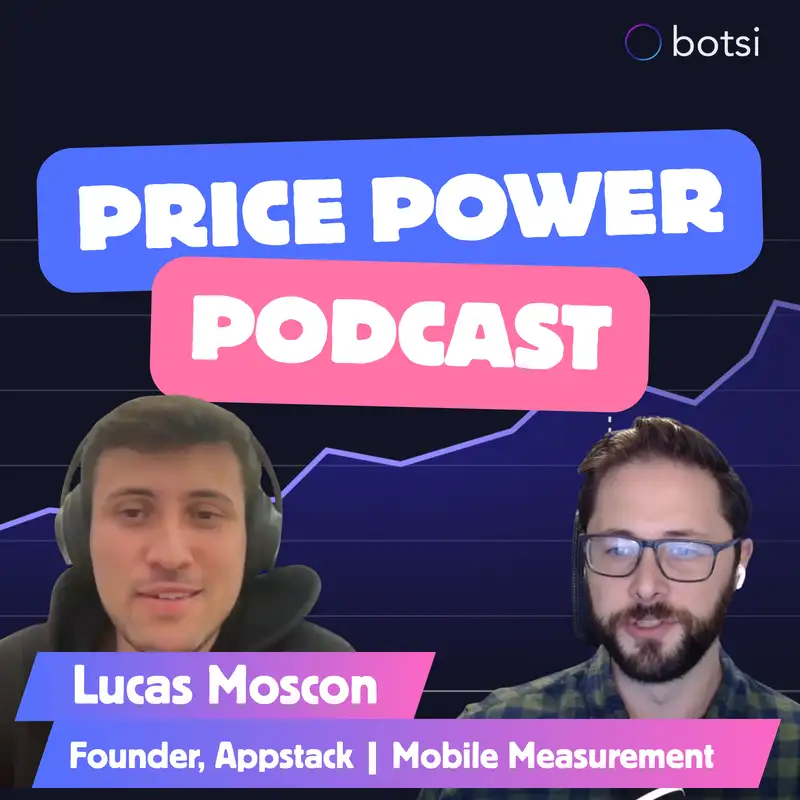
My name is Jacob Rufin,
CEO, and founder of Botsy.
Botsy is AI power dynamic pricing
for your subscription app.
Today on the Price Power podcast,
we're talking with Lucas Moskin.
I was pretty excited to talk to
Lucas because he is likely one of
the most knowledgeable people in
the world on how mobile attribution
actually works under the hood.
He was a senior acquisition
manager at Monkey Taps.
He's been an advisor to large
companies like Life 360 and is
now the founder of App Stack.
A new type of mobile analytics
and measurement platform.
Lucas has some spicy takes for you
on Apple, traditional MMPs and more.
If you wanna truly understand
how mobile measurement works,
this episode is for you.
Jacob: Hey Lucas, happy to have
you here and excited to chat.
You know, you are a mobile attribution
wizard and so I thought I'd start with
asking, you know, just to kick it off,
how has mobile attribution changed
since a TT implementation, iOS 14.5,
and you know, what are most marketers
still getting wrong about the new
reality of the mobile attribution world?
Lucas Moscon: Well thanks for having me
here Jacob It's always a pleasure to chat
with you so that's a really interesting
and good question for multiple reasons The
the best answer it it's like it depends
but the most accurate one It's I think it
force marketers to see the full marketing
picture try to look uh or performance or
marketing That's one element of the full
picture when it comes to the business that
they're in I think it also push people to
think in terms of aggregated aggregated
data Thinks of way to how on how they
can match a source to a user uh within
the application with onboarding questions
and so on I also believe that it force uh
companies to test new ways of acquiring
users like web to app app to web uh et
cetera They also being forced in the first
years after a TT was implemented to focus
on retention remarketing was hard to do
think it also and took the control of the
attribution pipeline from the traditional
slash legacy attribution players like the
MMPs Uh I think a lot of things happen
Uh I think that although the intention
from Apple the good ones I don't believe
it was executed in the right way I think
the technology makes a shit ton of sense
to be honest But you know recently I made
a link I made a link in post with the
community the feedback that I gave to the
Apple team that it's responsible to build
infrastructure Uh and people are saying I
wish all of the things you're mentioning
uh are true But the thing is that So you
can see today are like moving away from
deterministic attribution coming from
Apple and trying to rely mostly on the
ip Uh and we can dive into this uh during
this uh call but I can share like a bunch
of learnings that I having when it comes
to fingerprinting users now that I'm doing
this in AppSec uh with the deep linking
infrastructure So I'm learning a lot when
it comes to that and how it actually works
So yeah I think those are the main changes
Jacob: Do you think generally it's um.
It seems like it's positive for
the overall app ecosystem where
there maybe was too much confidence
in your attribution previously,
that what was unfounded where
you thought that you knew exactly
or come from, came from, or kind of
the performance of this channel where
maybe now kind of the veil has been
uncovered of maybe your attribution
wasn't so accurate before and, and now
that actually aggregated is, is better.
Um, or, or maybe not.
I don't know.
What do you, what do you think?
Lucas Moscon: I don't think it's better
or I think it's like it just forces
you to see all the layers It forces you
to see the blended deterministic the
probabilistic Like again it's just it's
all about I think that for example when
I talk with apps And they're like oh I
want to see if my campaign is on iOS have
a return on ad spend of 100 on day seven
Or they even want to know if the ad has
a Rose Day seven of 100 I tell them like
dude that's not how it works today Uh I
wish that's the case and basically what
I try to help them is to build To try
to abstract their business from robots
metrics and focus on ROI which ensures
like more realistic numbers So for example
I've been advising really big uh health
and fitness application and basically
their main source of truth and where
they make most of their decisions an ROI
chart where they just basically fetch
ad spend from the ad networks revenue
coming from the store consoles or their
subscription platform and also divide
that by install date so they know okay
these cohort of users it's profitable
the ad network level or even at the
company level day in 60 You know so by
focusing on that level of aggregation
it's super safe for them to double
spend or double down current strategy
Jacob: Yeah, that makes sense.
Where don't get too caught up in like
every single ad set or even every single
channel as long as you're spending.
Profitably and, and your business
is growing and you're making
money at, at a whole, like, that
should be successful, right?
Like that's, that's what, how
you should measure yourself.
Lucas Moscon: And also believe that
for example if you are if you have the
mindset to extend The time in which you
get the money back I think that's also
an interesting growth lever because most
people will be optimizing towards the
other way and most of them will realize
that it's almost impossible and it's
when you want to scale the return out
spend it's even harder more ad spend the
the lowest is the robot for companies
that are really taking the risk and
willing to go a little bit further and
say okay I'm getting my money back on
day 60 happens if I push these to 180
days They will be outspending their
competitors and they they will be by
doing this they will be able to spend
more money and grow more Still you
you need to have cash The cashflow is
important to do this strategy But I also
believe that this approach or this might
to go beyond of instead of decreasing
increase the target for your return spend
Jacob: Do you think that increases
risks for advertisers where it
takes longer for you to find out?
Um, if, if something is profitable,
what if something changes in your
product, changes in your conversion?
Um, does it, uh, can you project
that early on and, and, and, or, or
is that an increased risk because it
takes 90 days or 120 days to find out?
Lucas Moscon: I think that it'll depend
on the confidence level that you have
on your proxies for the early days So
if you historically you see that on
day seven if you have a rise below 0.5
it means that you will never get your
money back And that has the case for the
past two years Then maybe that's a strong
proxy that this cohort is not going to
perform as expected But I agree with
you It's it's of course it's more risky
but because it's more risky it means
there's a reward on the other side Uh
Jacob: Yep.
Lucas Moscon: It's a trade off between
of what you want to prioritize but
again I also believe that there is
a way to get really strong practice
Jacob: what metrics do you like
as proxies or, or these kind
of custom, uh, custom formulas?
Lucas Moscon: I saw a company putting a
the 1 2 3 4 5 6 7 8 9 10 so Most of the
correlations they were doing was that
even though so it was like a waterfall
effect So let's say if day three there was
not they were not hitting this benchmark
then the level of confidence was going
down If day four or five things this was
still the case they reduce it again If
on day 8 9 10 was still going down They
know that it's not going to happen So
they were like adding layers of securities
for this cohort they were able to get
this on day 10 instead of waiting for
day 180 which was the target But that's
that's something that I saw written
d and I thought was quite smart to do
Jacob: Yeah, I've, I've in the past
used like, you know, cancellation
rates after a trial conversion.
Okay, let's look at the cancellation
rates in the first 15 days.
This is usually pretty predictive of
renewals and conversions, you know,
for subscription apps specifically.
And, and you know, that
can be pretty valuable.
Um, yeah.
Lucas Moscon: more More proxies the better
Jacob: Yeah.
Got it, got it.
Um, so, so maybe we take a step back in,
in terms of the world of attribution.
And I think myself included, a
lot of people don't really just
understand how mobile attribution
providers work kind of under the hood.
Um, can you explain like how tracking
works from ad click or tap to
someone downloading the app and the
ad platform actually attributing
that install to a specific ad?
Lucas Moscon: Okay so First you we need
to separate there two type of ways of
measuring stuff The first one is have
the self attributed network and then we
have the non self attributed networks and
also within the self attributed networks
like meta Google and so on Uh you can run
web to app acquisition Okay so focusing
on this first segment which is the self
attributed networks the way it works I'm
going to talk after a T Okay uh yeah I'm
not going back to the Golden era let's
say So basically the way it works is let
let's say you you are you have a mobile
app and you want to run meta ads The way
it's going to work it's two ways to send
back events to meta It could be through
the conversions API Through the Facebook
SDK up to you which one you want to send
I also uh created like a document recently
that explains people how to send in-app
events to meta uh depending on the needs
and the type of events that they want to
trigger back And once you send this to
meta okay what it's going to happen is
that admitted going to depending on the
IDFA and a EM Okay So there's like The A
DFA cohort a M using IP and other signals
or parameters that the that meta gets
from the user And the third one is the
SKA network API So the A DFA of course is
the cohort that consents with the A TA is
the probabilistic layer and SK network is
deterministic layer So in those in this
case you can see everything Okay So for
example let's say you run a campaign will
do is thing with SK network I'm not going
to go into the details I I can share like
uh an extensive guide that I created for
this It's published on the Revenue Cat
article Um and the second one it's which
basically it's going to fingerprint the
user and there's a high chance it's going
to over report against SK network Still
a lot of people complain that it's under
reporting And then you have the idea
of a users which basically you have the
idea and you can match this to the sort
like in the Google old days Then it comes
for example the case where you have a
web two app I can tell you this because
at AppSec uh we build the web laptop
infrastructure uh and we are working
right now on publishing how actually it
works in the backend So everyone can build
something like this uh which is pretty
cool I guess So we're going to show like
Behind the teams that have the backend
and the repository actually correlate with
each other and how you can fingerprint
the user and then send this post web
back through the conversion API to meta
So basically um the way it works on the
web to app infrastructure that the user
clicks of the app okay And then that click
sends a request to the let's call this a
links API I don't know how to call it And
then this link API is going to register
the user information like thing like the
fingerprinting id IP country and so on
Then the user is redirected to the app
Sir the user installs the app opens the
app what you need to do in this case is
to have an SDK Okay Then what's going
to happen is that at SDK it's going to
generate a user id could be any SDK you
can build it uh on your own this SDK is
going to send a request to the links API
and basically it's going to match app
stack ID to the right attribution sorry
parameters from the previous steps And
then you will be sending this with the
install ID through the ions API and meta
again I will be sharing all of this Uh we
can attach this link to the um to the uh
webinar or pop and so everyone knows how
to build it by their own means internally
which is going to be pretty cool which is
not that hard to be honest So you're gonna
have your own infrastructure running uh
and then you have this non self networks
like LOV in Malco basically forced you
to pay for the middleman which in this
case the middleman is the MMP to do the
attribution for you Let's say uh I am not
a big fan of this work when it comes to
DSP and companies that towards you to add
a middleman in the middle by the way It's
just like it's that's the definition I'm
not that I'm kind of skeptical about how
they do stuff because I I have friends
working there and The things they tell
me it's not that nice to hear Uh they can
they can fake fraud They can do whatever
they want And I've been I've know cases
where they were pushing fraud to the mps
and the mps were not able to detect that
even for companies that were paying for
the upfront solution So I will recommend
people to stay away from this these
networks and also if you tell me That
you are saturating meta TikTok Google and
Apple apps it means that you should be
spending at least million a month At least
Jacob: And so for,
Lucas Moscon: way of saying
Jacob: for, for most people, you
never need to go to ad networks.
You don't, you never, for most apps,
there's, it, it just, the, the percentage
of traffic that you'll get from
them comparatively is not necessary.
Lucas Moscon: Maybe if
you're in the gaming space
Jacob: Hmm.
Lucas Moscon: we work mostly
with subscription apps Maybe it's
worth trying up loving or unity I
don't know But again for most apps
out out there like stay away As
Jacob: Yeah, I,
Lucas Moscon: Also it's in terms
of safety the transparency layer
they have They're not the good
Jacob: yeah.
Yeah.
So.
One.
Thank you for breaking that all down.
It's super helpful and clearly it,
it illustrates that things are still
quite complex and probably more
complex now because you have multiple
attribution sources you need to track.
You can't just rely on your MMP,
you have data coming from multiple
sources, even more so if you have, you
know, web to app acquisition funnels.
So I, I think really you're, you're
probably taking an accurate view of, of.
Um, new users coming into your app
where they're coming from performance
roas, like you need multiple sources,
you need multiple measurement sources.
Um, what do you think, I, I mean, I think
you've talked about it a little bit.
What do you think the measurement
stack realistically looks like
today for top performance marketers
where it's kind of a, an aggregation
of multiple sources, right.
Lucas Moscon: I think that first people
need to be pragmatic when it comes to
select choose the right numbers they want
to see to make decisions And what I mean
that they need to be what I mean by this
is that you need to be realistic that
more granular you go the less accurate
it will become Okay I'm talking on iOS
I'm not talking Android is just like do
whatever you want All the numbers will
be there but I will assume that this goes
mainly for us um so that's something you
should know And what I always recommend
to people is depending on the metric that
you want to see or attribute or measure
you need to have your store the truth
layer So for example if you if you want
to see the total revenue it's up to you
to choose store or maybe as a script from
that firm you know up to you but you need
to choose one Of course you're not going
to use the Facebook et k to measure total
revenue You know it's risky and also you
have other sources that you will trust
more I mean at the end of the day apple
is the one paying the bill So if you don't
see the proceed it's something wrong It's
on your side Then when it comes to for
example installations um again Try to
see the full market marketing picture Try
to see installations coming from Network
Connect Try to see installations coming
from Meta Try Installations coming from
Network Try installations coming from your
product analytics s the case Try to have
multiple sources and then you can stack
one against each other For example let's
say you want to see uh I dunno in-app
events like first trial for example when
it comes to the start trial Depending
if you want to see the total attributed
or non attributed you'll have different
sources I can give you an example if
you want to see um non say attributed uh
trials You can fetch these from the app
networks or Apple API when in this case
that scale network If you want the total
maybe you can use um the subscription
platform Or you can use uh apps or
connect you know like again it's all
about choosing the right sources that you
trust and stacking them up against other
other sources so you can see the full
picture in a really easy way and manner
Jacob: Got it.
So it's, it's more, um, different metrics.
You wanna rely on different sources
of data, and even for single metrics,
probably having a few and going, well,
this is the high end, this is the low end.
It's probably somewhere in the middle
and no longer saying it's this exact
number, but going, this is a range.
We're confident in this range, uh,
and, and it's, we're even, you know,
more confident in, in kind of, you
know, this middle ground maybe.
Lucas Moscon: Try to triangulate
Jacob: that sound right?
Lucas Moscon: idea
Jacob: Yeah.
Lucas Moscon: exactly
Jacob: Got it.
Got it.
Um, and so like, let's just like, maybe
we, we pick one example to kind of
dig into, like, let's say, um, let's
say, you know, return on ad spend.
Um, what does your, like
measurement stack look like?
Or, or what kind of sources do
you rely on for that or for,
let's say for subscription apps?
Lucas Moscon: Okay That's a risky one
Jacob: Okay.
Lucas Moscon: Um so when it comes to
return on then There are two main ways
of doing this Um the first one is you
rely on the ad network okay Which is Hey
this is what we believe this campaign
generated And then it's how granular you
want the terministic attribution to be
depending on the conversion value mapping
So if you have a wide compression value
mapping range then you will go for the
medium average on the mapping And then
that maybe it's going to inflate numbers
or maybe it'll happen the opposite So
when it comes to raw keep in mind that
on iOS it's risky to rely on that metric
It's I think if you ask me it's
the metric with less level of
confidence that I have That's why I
Jacob: S
Lucas Moscon: move away
from RU as much as I can
Jacob: what do you, what do
you try to substitute with?
Lucas Moscon: Total revenue Like
look at the blended at the end
Jacob: it.
Lucas Moscon: day you know if I'm running
a business course I want to know like
and Android Like if this ad is the
one generating the revenue of course
I'm not stupid But at the end of the
day if you need to run a business you
just want to ensure that more money's
coming in than what's going out and
robot is not going to give you that
Jacob: Got it.
And so it's better to look at
the whole of our, is the money
we're spending on advertising.
Making us more money.
And then for actually optimizing our
ads or optimizing channels, we look
at, you know, CTRs or, or kind of more
traditional performance and go, look,
we know if we get a better click-through
rate and we, we generally see better
performance, that we're, we're gonna
see better ROI and better RO, you
know, return on ad spend, but we can't
be confident in the exact numbers.
Is that right?
Lucas Moscon: mean you can also
use installs cost per in-app
Jacob: Yeah.
Lucas Moscon: Like you can use
those metrics as proxy like hard
pro hard proxies like and you will
not have the revenue attached to
Jacob: Got it.
Lucas Moscon: do it on the
probabilistic and theistic but
it's like it could be too proud
Jacob: Yeah.
Yeah.
Is that just because there's, um.
The tracking isn't right or
there's not, it's incomplete
and there's cannibalization of,
cannibalization of other channels.
There's some, you know, organic halo
where it's not actually capturing all
the impact or it's over attributing.
Um, yeah.
Why, why do you think that?
Lucas Moscon: uh just
because there's no idea Faith
Jacob: Yeah.
Yeah.
It's just, uh, what we, we only
have, you know, 15, 20% of users
to the IDFA that we can actually
track and it's all just estimated.
Lucas Moscon: Yeah because if
Jacob: Yeah.
Lucas Moscon: was there then
everything in psychiatric again
like it's just about that Id
Jacob: Yep.
Yep, that makes sense.
And then, then that's like why
everything is probabilistic now,
where it's just extrapolated, you
know, based off that data we know.
Um.
And then there's some
fingerprinting, right?
Is is like, what is, is
probabilistic for most channels.
Like is that actually is fingerprinting,
what, what is, what does that
actually mean when, when, when it's
like probabilistic measurement.
Lucas Moscon: Just scrapping the
IP for the user from the user
Jacob: Yeah.
And hoping you get some
percentage of matching and.
Lucas Moscon: Actually I can give you
some some interesting insights So at
tack we did a test internally and we
did I asked the team to see was the
the accuracy rate when it comes to this
fingerprinting matching What was the
accuracy rate without the ap we simulated
some scenarios where didn't have of
course we did have the AP from the user
we compare both uh experiments The AP was
the reason behind plus 90 of the matches
Jacob: So everything, everybody
says that we have these algorithms.
We're doing this complex matching.
It's just IP address.
Lucas Moscon: Oh yeah of course
Jacob: Yeah.
Yeah.
Okay.
Lucas Moscon: Then of course you can use
os os uh version or battery life whatever
but ips that's why I I'm trying to push
Apple to block the AP from the device
Like I really believe they should be doing
that through private relay or whatever
But they told me they will I don't know
if I should detain this but I don't care
they told me that happening anytime soon
Jacob: Yeah, that's,
that's super interesting.
Um, what was kind of, what,
what would be the benefit to
advertisers of blocking the ip?
Lucas Moscon: It's not about the
advertiser it's about the user
Jacob: Yeah.
Or it's better, uh, uh, privacy.
If apple's committed to
actually, you know, privacy,
then this is the right move.
Lucas Moscon: Imagine putting years and
years of dedication into a technology that
you push to the industry and no one uses
Jacob: Yeah.
Lucas Moscon: That's what happened
to Apple Instead they allow everyone
to fingerprint their user and nothing
is happening I'm just describing a
Jacob: it is pretty interesting, huh?
Lucas Moscon: we agree or we don't
but the truth is that they just don't
Jacob: Yeah.
Yeah, I think it, uh,
well, at the end of the
day, like the whole privacy
message was marketing, right?
It was further iPhones and
it was to hurt Facebook.
It was to try to hurt their
competitors, uh, at that time.
And, um, you know, it was a
move and it was, it was done.
And now the world is how it is
and we move on and they have big
other priorities it seems like.
Lucas Moscon: Yeah And also initially
I would say to you maybe that's not
the case because I believe that the
technology had like um an honest and moral
But then when you look at what
they did with their own advertising
platform which is Apple Ads and
you see that the technology they
develop doesn't apply to them
Are you sure you are trying to do good
for the for the wall with this or not
then what happened was that I don't know
if it was the French on the or the German
authorities government fine Google with
200 million or 150 million uh dollar fine
Um and the same day when this was public
they say oh today we're announcing that
Apple Ads is adopting SK network API
But then when you dig into what they did
realize the structure and architecture of
this implementation on Apple side it just
sucks It's useless And the reason for that
is because it doesn't allow the users to
do a conversion value mapping first and
second match the raw post against the
right campaign id Uh it's like yeah I'm
just pushing this to avoid the fine So
everyone thinks that we are compliant but
the truth is that it just sucks also I've
been talking with the Apple Ads team like
the customer like the account manager from
Apple that uh yeah I think they work on
the Apple ads division Um and they were
telling me Lucas you know we have no we
didn't know that it even was adopted like
even Apple in place I have no idea
what's going on terms of the adoption
of the uh privacy API and they are not
even recommending this to their clients
cause it's not in their interest So how
would you tell me that you believe that
this is the best for the other companies
except for you Why would I trust you
Jacob: Yeah, it's crazy.
It's crazy where those, you know, there's
the actual, probably the people that built
the solution ha had good intentions, uh,
for, for kind of the future and how they
could evolve it and improve privacy.
But then, uh, there's, you know, always
kind of the, the strategic corporate
level about how do we actually, what,
what's in the best interest of, of
Apple as a company and all that.
So yeah, it's wild.
Lucas Moscon: I know the guys
that are behind this project
Cupertino and you have no fucking
clue to be like that's the truth
Jacob: Okay.
Lucas Moscon: not going to lie They have
no clue actually they were like they were
asking me So for example I think a few
months ago I made contact that I have in
Meta reach out to me and I and telling
me that basically they were adopting
the latest version of the SKSK network
API And I was like okay this is pretty
cool I will share the news to everyone I
made a LinkedIn post about it and after
I published this post I dunno if it's
two or three Apple employees send me a
message or an email Hey you think this
is happening We didn't know this was
going on Like even Apple has no fucking
glue That Medi is adopting their own
technology I don't know what's going on
on their side So they they they're not
only disconnected from the developer
itself and the advertiser but also from
the ad network side these are like Just
doing what they believe they should do
and asking I don't know who they were they
even asking to do this but I don't believe
they know what they're doing And also I
can guarantee you and everyone that is
listening to this podcast that Apple has
no fucking clue on how to push massive
adoption from the A or the attribution
key a P They have no fucking idea Like
Jacob: Yeah.
Lucas Moscon: trying to find a way to make
it happen And they're like oh I don't know
Jacob: And, and now, you know, all
the advertisers just stuck with
this, you know, convoluted mess.
And you go, okay, well I guess we
just have to deal with it and figure
out how to make the best of it.
Lucas Moscon: You have no other option
Jacob: Yeah, yeah.
Yeah.
Lucas Moscon: money on
Jacob: Yeah.
Which is not an option usually.
Uh, yeah.
Yeah.
It's, it's, uh, you know, I, I, I know
these things at kind of a surface level,
but like, it's so interesting to hear
your kind of view of, of really in the
trenches and talking to these people.
It's, it's a's a mess, huh?
Yeah.
Um, so.
Lucas Moscon: I don't know
Jacob: Yeah.
Yeah, yeah.
Well that's why you're building a
company around it, so it better be fun.
Um, yeah.
Yeah.
It's, it's, uh, it's so interesting.
I, I, I'm, uh, yeah, A lot of questions.
Yeah.
We'll, we'll have to do.
Well, we'll, I think we'll have
to do some follow up episodes.
Uh, there's many more things
we could dive into there.
But, uh, so coming back to kind
of MMPs, if, if this is the
world today and, and you know how
you're explaining things like.
There's much less value in the, the
traditional MMPs than there used to be.
Right?
Like how do, how do these
traditional MMPs fit into your
current mobile marketing stack?
And, and like, do you, do you still need
that SDK in your app to track conversions?
How does that work?
I.
Lucas Moscon: Depends on the use case So
for example if you want to run up loving
you're fucked You need to pay them to run
up Loving Um From fact recently I had uh
a chat with the I think it was the general
manager the European division I don't
remember the exact position that he had
but I was like Hey dude you know I have
$10 million to spend every single day on
app 11 10 million a day And he was like
oh sure Let's do a joint venture let's
do a deal whatever And I I was like you
know what but sorry I don't have an MP
And he was like oh no Then we cannot do
it So basically that's just to show that
they they force you to pay the middleman
So if you want to run this DSPs then you
need an m and p Another thing is you if
you want to run a Web two app on Google
I'm just using like use cases for people
Jacob: Yeah,
Lucas Moscon: see if it's a good fit
Jacob: I.
Lucas Moscon: Then if you want to run
Web Lab on Google then you need I mean
it depends You still uh my recommendation
is maybe you will need them because in
order to run web to app or Google will
need a certified link infrastructure by
Google you can get that pretty easily
Uh I mean you still need to go through a
process It's depending there to be honest
but you can do it Uh so if you want to
run web laptop and Google maybe the m
and p makes sense If you need to pitch
pitch to your boss that you are buying
an ad for solution Again maybe you need
an m and p if you um have like more to
server integrations uh going on and you
have like a but if you're a corporate
and need this data clean room solution
so on maybe it's a good fit Um what else
I don't think there are other
Cases where it is like Hey if I cannot
get this if it's not with an m and p I
think that's it mainly Uh one thing you
should know if you are working with iOS
and you are running let's say TikTok
met and Google if you don't work with
an with a traditional MMP you will be
forced to maintain uh Like the same
mapping infras uh mapping schema on
all the other networks at the same time
Jacob: Hmm.
Lucas Moscon: So it could be a
pain the as to make sure everything
matches also another thing could
be sorry I'm giving a lot of reason
Jacob: No, this is great.
This is, this is, this is perfect.
Yeah.
Keep going.
Keep going.
Yeah.
Yeah, please.
Lucas Moscon: Another another reason
why maybe you will need an mp It's
if you are spending money on You
have your application on flat or
React native then you will meet at m
and p And the main reason behind it
is because Victor does not support
SDK with these languages For the
Jacob: Hmm.
Lucas Moscon: still and for the moment
because we we recently uh find a way to
we app that we build a bridge that we
allow People that wanted to test TikTok
and use the outside bridge so that they
can run to ads without paying thousands
of dollars to the middleman which in this
case is the MP So this is going to be
live pretty soon on our side so we can
unlock for a bunch of apps that before
that they couldn't run on TikTok ads Um
then when it comes to Web two app uh you
can basically do your own infrastructure
with no legal problems on Meta and TikTok
Uh then when it comes to Apple ads you
want to see in-app events and revenue uh
it's not that you need an m and p You can
also use subscription platforms too like
I dunno bot maybe or or your competitors
Uh but you're not stick only with the m
and Ps You can use other tools You will
need an SDK you will need an SDK for
this Um I'm thinking Any other situation
Uh yeah I don't think so I think
well I listed a bunch of them Maybe
Jacob: Yeah, no, that it is
super interesting to hear.
So it sounds like.
MMPs are more kind of this infrastructure
layer that kind of maps conversion
value to different networks.
So it can simplify a lot of the complexity
with you're running on multiple channels.
You don't have to maintain
all this yourself.
And then there's still some channels.
Um, we add network specifically, you,
you, you, you don't have a choice.
Uh, but then there's
still some channels that.
Uh, it, it, it, um, like TikTok, you're
saying for certain frameworks, for certain
SDKs, you, you might still need that.
And so probably there's, and, and yeah.
Correct me if I'm wrong, but, but
maybe there's evolutions here for, for
an advertisers, when you start off, a
lot of people start with meta, right?
And in that case, you, you
can maybe rely on a EM.
For Facebook for Meta, and you don't
need kinda a full MMP, uh, but then
maybe as you evolve, it can still help
simplify things or, or make things
easier on you, uh, in some cases.
But it's not like, it, it's, it's not
kind, kind of required it anymore.
Lucas Moscon: I mean to be honest like
the m and p game it's also the the fact
that you can just use one TK instead of
and maintaining or four of them at the
same time Still I don't have good memory
if it is but I never heard a case where no
one would complain about Hey I don't find
this event in the m and p I don't know
why this is not matching with Google Like
discrepancies happened people complain
So let's say the myth of having one of
the case will fix your problems based
on my experience it's not true at all
Jacob: Yeah.
Yeah.
It's a, it's, yeah, it's a myth.
Uh uh, yeah.
Yeah.
And it's, it's, it's just kind of like,
okay, you're gonna have one problem,
one set of problems using an MMP.
Maybe you have less visibility
into kind of what's actually
happening in the middle.
If you do it yourself or use, you know,
uh, Facebook, SDK, TikTok, SDK, maybe
there's a little more setup you have
to do, but maybe you have a little more
visibility into what's going on, where you
can kind of control things more granular.
But it's a different set of problems.
It's, there's no, like,
there's no perfect solution.
It's kind of just what problems
you want to, to tackle.
Um, and maybe App Stack can
solve some of these, uh, for you.
Lucas Moscon: Yeah I wish
Jacob: Yeah.
Yeah,
Lucas Moscon: that's the
Jacob: of them.
Some of them.
Um, and Okay.
Lucas Moscon: like that's
my only take to be honest I
Jacob: Yeah.
Yeah.
Lucas Moscon: makes sense in a bunch
of cases most situations for most
applications they don't So for example
I can share this experience with It was
advising a company This was an app that
was doing I don't know if it was doing
like 20 million a month It was a big
app Um I remember like asking access to
the MMP and they were like sorry what
The MMP Do you have an MP I have I don't
know What is an m I was like maybe you
know supplier adjust singular branch
Oh yeah supplier We know Appli we have
applier Can you gimme access to it And
when I entered the MP the last login was
six months ago And when I checked the
invoice the billing how much money they
were paying for this it was 350 KA year
And I was like asking Hey
Why Why are you paying for this Like
explain that to me And they were like
the XVP recommended this and you just
stick with us I guess but are you using
it They were like but we need to have
an MMP for what They were like not even
able of listing one thing you know And
sometimes it's like I think because they
have been going around for 13 years which
is a lot more than a decade I think that
they did will give the credit to dps
because of this they pushed a mindset in
the industry where you cannot run your
app without them even though it's not true
at all in a bunch of cases which from a
business point of view it's not that moral
to say maybe They need to run a business
I guess And if people are voluntarily
willing to pay it seems like a good deal
So yeah I I've been encountering a lot
of these cases where companies are just
lagging this case in their code base
because someone years ago told them that
it's the best or the only way to do it
Like when you tell em that you can run
me ads without an MP they're like how is
this like a new technology Or like and
they were like shocked you know So think
that most people working in the field
like they don't care Maybe uh they
just want to get their quarterly
bonus and go and play in football or
whatever live their personal lives
but most of them they just have
no no fucking clue what's going on
Jacob: Yeah.
Yeah.
It's so interesting.
I, I think it, uh, it's good to hear like
your examples of specifically when you
do need it, because I think that helps
paint the picture of like, okay, these
are use cases that are gonna make sense.
But if you think about all the use
cases, you said they're very specific
use cases where, uh, uh, probably most
people, they, they, they don't apply to.
Yeah.
Yeah.
Um, it's, it's, it's,
Lucas Moscon: case
Jacob: yeah.
Yeah.
Lucas Moscon: good use case is you
have no idea about the app industry
Jacob: Right.
Well, that's probably most people, right?
I think most, uh, um, there's
so many new people entering.
The app world today that don't
understand how everything works
on the backend, haven't been
working in mobile apps for a while.
And, uh, you know, you, you, you
read the marketing messages, you
see, okay, well I guess this is
just what I need to get started.
Uh, and um, it probably simplifies
things for you some cases.
Uh, but if once you grow, once you start
to understand or you, once you grow, you
should start to understand things better.
Uh, yeah, it.
It's, it's not quite necessary.
Yeah.
It's, it's interesting.
It's very interesting.
Uh, I think it, it should be, hopefully
it's informative to a lot of people
to actually understand how things
are actually working on the backend.
Uh, and in terms of mobile attribution.
Um, this might be, um, um, a more
complicated question and, and, and, uh,
you can let me know, but I think that.
Kind of segueing from not using MMPs,
you know, how do we, uh, how do we
actually design like our, our conversion
values with scan to actually, you know,
help our campaign performance rather
than just provide reporting, rather
just the kind of the bare minimum.
This is something that, you know,
I, I understand at a high level
that, you know, we're sending these
conversion values, but like I.
I don't understand it very well.
I don't think most people
understand it very well.
Um, do you have any guidance, and I
know you, you had a, um, you said you
had a kind of a whole kind of document
that can explain things better.
We can link that in the show notes too.
But I guess where, where do people get
started and kind of actually using scan
effectively and using conversion values
effectively to, to improve performance
rather than just, um, the basic.
Lucas Moscon: Okay I I'll try
to put this in a really easy way
Jacob: Okay.
Lucas Moscon: a conversion value The
meaning of a conversion value is what is
the in-app event that matters the most to
you you want to pass this back to the ad
network a signal to optimize the campaign
Therefore can only use one in-app event
to optimize your campaign You cannot use
two actually in Google ads you can use
uh or but let's say with meta you can
only use one So by putting this into this
level of obstruction the best way and
the most reliable strategy when it comes
to conversion volume mapping To simplify
it as much as you possibly can Don't go
to the 63 bit that's my recommendation
Just keep 63 the main conversion event
and the one you're optimizing for And
second So for example let's say you are
a subscription app and let's say 80 of
the revenue are in our signals are coming
from subscription direct subscriptions
or purchases And the second one it uh the
remaining 20 is coming from STAR trial
What I will do in this case is I will set
the 63 to subscription or purchase the
62 to start trial That's it done Maybe if
you want to add an intermediate layer on
the client side for example via pay will
view event or like a pay you can trigger
The pay will view when someone click
on the continue button and lands on the
next page That could be a strong proxy
if there is no trial either purchase but
still the ad network Network gets the the
signal Uh but that's it Like you don't
need that much And also when it comes
to the course values try to keep the low
as a session event You want to ensure
that the course uh conversion value is
always going to be triggered by a client
side event which this is going to be
good session is like an app open Okay
Jacob: Yep.
Lucas Moscon: not first up open It'll
be first up open if it's in the first
window but if it's in the second and
third it'll be just an app uh an app
open So just keep it simple Don't look
for tricks Don't overcompensate your
stack It's already complex Don't try
to mess it up So don't know if you or
the audience will be expecting like a
complex streak or secret conversion value
mapping Just just ignore all that shit
Don't focus on complex stuff Just focus
on what matters to you and the business
Jacob: That's great.
Yeah, I think in chat almost everything
in life, simple is usually better.
Uh, and so I think that's super helpful.
I think people really appreciate that.
Can, they can just push out all the noise,
uh, of kind of all the different setups
and go simple for performance there.
Um.
That's, that's super helpful.
So
Lucas Moscon: noise
Jacob: is there, um, does it matter
if my trial is longer or not?
Is, is there a kind of a speed or a timing
element where I need that conversion
value faster if like a subscription
conversion doesn't come till later.
Lucas Moscon: Trial converted
Jacob: Yeah.
Trial converted.
Yeah.
Lucas Moscon: Uh well it depends So
because of the let's say the composition
under structure of the SGL Network
framework slash api Um you need the client
the user sorry to open the app to trigger
an update of the conversion value So
Jacob: Yep.
Lucas Moscon: this correlation between
user retention the amount of post bugs
that you will get on window two and three
So I'll give you an example Let's say
that your retention rate on day 10 it's
100 I know this doesn't exist okay But
Jacob: Sure.
Sure.
Yeah.
Lucas Moscon: You will get 100 of the
conversion value update and therefore
you will see 100 of the trial converted
Okay
Jacob: Okay.
Lucas Moscon: But since maybe your
attention rate on day 10 is 15 maybe
a lot of users converted into a trial
because they forgot but you won't be
measuring them to the network API Okay so
you should keep that in mind that These
trial converted events depend on user
retention and then you can extrapolate the
rate that you know for this date assuming
this is happening on the conversion
value window And then you say okay if um
let's say I have a retention rate of 10
and I know that only 10 users converted
from converted uh from store trial to
sorry one user converted from trial
To try to convert it then I know that
maybe 10 people uh actually convert it
Jacob: Right.
Lucas Moscon: that's a month
you do in-house It's not coming
through the reporting APIs
Jacob: Yeah.
Yeah.
That's super interesting.
That makes a lot of sense.
And that kind of illustrates what
we were talking about before, that
you need these multiple sources.
You understand the nuances and
differences in each one, and you use
them appropriately, where you know
this is off for these reasons, this.
Offer these reasons and you kind
of assemble this aggregate picture
of, of kind of performance.
Um, yeah, that's, that's, uh, uh, super
helpful and I think people will appreciate
that, uh, kind of guidance there.
Um, so.
I think we can end on that.
I think that kind of wraps things up
well and kind of ties back to what
we were talking about originally.
I, I, do you want to, um, I, I know you've
told a little bit about Apps Stack, uh,
uh, throughout, but, um, do you wanna
give a quick, uh, um, pitch for Apps
Stack and why, when, or where it might fit
into a, a, a marketer's tech stack today
and, and where it kind of provides value
and kind of what your, your vision is?
Lucas Moscon: So basically uh AppSec
is an app marketing analytics tool So
we help to centralize all the multiple
data sources Show the full marketing
picture so that you can see all the data
points and all the touch points and all
the layers deterministic uh totals and
you can create really great dashboards
in a matter of minutes Okay No SDK is
needed to start with on iOS and it's
pretty fast to connect so it's easy to
use fast to connect Shows reliable data
depend working using the sources that
you already work with we can also you
build a foundational model that basically
helps us to audit the AT networks I'll
tell I'll tell you for example if meta is
over or under reporting by X percent uh
where the budget is generating the most
revenue and so on So it's a simple tool
for a lot of marketers and app studio
companies that are working with it today
basically replace their legacy solution
Have like a more modern stack easy way
of working with numbers also it's it's
pretty cool because with most of the big
clients that we work with we work CLO
really closely and we are able to give
them like a really high quality support
they were not able to get any in any other
place So basically the way you see it is
it's a that company but we also equip the
top consultants with the best attribution
solution that they really know for end
to end So there's nothing that we cannot
answer and fix really fast It's like a
let's say this apps that gives the clients
it's like a consultant with asteroids
uh that no other consultant in the world
will have Because we have access to the
backend We build infrastructure That's
something that most consultants in the
world will lack but we do and we only
work with top people Uh advising the best
clients So it's like uh let's say it's
a really cool software a really great
product that works with really enterprise
accounts and we go deeper by providing the
best consulting on top of that So it's not
like we don't run the company with sales
guys just sending you emails saying Hey
you're you're reaching the billing cycle
you want to renew if we don't work with
um executives that have no idea what an
app is or what how attribution actually
works uh that's not how we treat uh the
relationship with the apps we work with
And that's also something our clients
value a lot that we go deeper and that we
provide like sometimes like we reach out
to them saying Hey you're fucking things
up here And because of that they we saved
them thousands of dollars So it's it's a
different approach and a different type
of product which is starting to work
pretty pretty fast in a really good way
which I'm really proud of Uh and also
yeah we build around them for them So
it's built by developers For developers I
Jacob: Yeah, it's been a, it's been
amazing to watch what you've built and
I'm really excited to see kind of the
future of Apps Stack and, uh, so yeah, go,
go check it out if you're having issues
with your, your mobile measurement today.
Uh, you, you can probably get some
help and you'll, at the least, you'll
be able to talk to Lucas maybe and,
and, and get some of his knowledge.
So I, I think that's a,
that's a win on its own.
Um, cool.
Any, anything else you'd like to,
uh, uh, plug or share here today?
We'll, we'll include links in the
show notes to all the different
documents, uh, uh, you mentioned.
Lucas Moscon: For sure Yeah I I I I really
encourage everyone to give a try to botsy
Jacob: Thank you.
Thank you.
Yeah.
Yeah.
And, and, uh, um.
We will, we will, uh, we'll be
excited to see if we can kind of
have, uh, some integration with
the app stack in the future.
Um, and uh, yeah, go, go follow
Lucas on LinkedIn as well.
He's always sharing
gems and insights there.
You can definitely learn a lot.
So.
Cool.
Well, uh, thank you for joining Lucas.
This was awesome.
I certainly learned a lot.
I'm sure everyone listening
Will, will as well.
Uh, yeah.
Thank you again for joining.
Lucas Moscon: Time for having
me Um wish you the best
Jacob: Thanks.
All right.
Bye.
Thanks for listening.
Hope you enjoyed.
Please go to price power podcast.com
to see all the episodes.
Go to Spotify and YouTube and
give us a subscribe and follow
so you don't miss any episodes.
Alright, talk to you next time.
All.