Jacob: If we see 10% of people are
creating fake email addresses or getting
things delivered to different addresses
or ref, you know, just having their
friends sign up and it's really them.
How do you think about
that, that trade off?
Anthony Scarpaci: I absolutely love that
you've asked this question because this
has been something that has come up in
my career as a source of debate on, on
fraud and trying to eliminate fraud.
Uh, I can't remember the source where
I first heard this, but somebody much
smarter than me said the optimal level of
fraud in a business is not zero, right?
Because there are trade-offs.
It's all about trade offs.
The, the more you can guarantee
the reduction of fraud, the more
friction you are creating for good
intended, well intended customers.
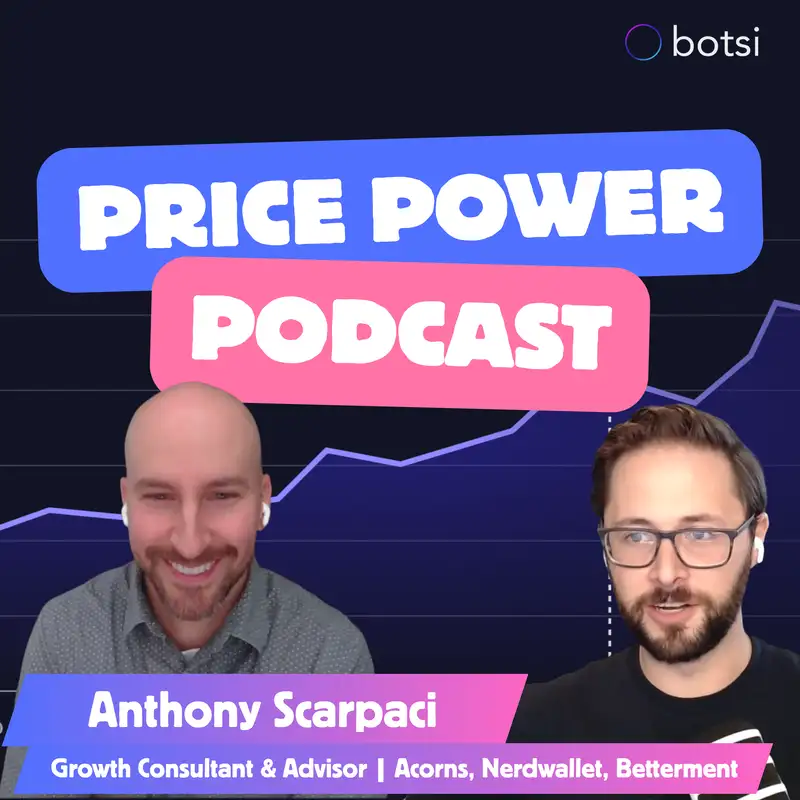
My name is Jacob Rushin, CEO, and founder
of Botsy, and today on the Price Power
Podcast we're talking with Anthony Scarce.
Anthony was a global VP of Growth at
Acorn's, senior director at NerdWallet.
He's also worked in growth roles
at Betterment and Blue Apron.
He's now a growth consultant and
advisor for consumer subscription brands
through his own consultancy, t Nomatic.
And today we're talking referral programs.
Everybody knows what they
are and how they work.
But in reality, most are kind of mediocre.
Anthony shared an amazing framework.
He calls, right.
The acronym stands for
relevance, incentive, guardrails,
human timing and Tracking.
And we can use design a
great referral program.
Let's dive in.
Jacob: So, uh, referral programs and can
be pretty powerful for viral growth loops.
Thinking back to the early PayPal
and Dropbox days, uh, I, I'd love to
start with breaking down the different
elements of a referral program.
Anthony Scarpaci: Yeah, let's do it.
Uh, so when I think about referral
programs, there are quite a few key
elements of what makes them successful.
When you mentioned Dropbox and
PayPal, the first thing I would
share there is them being some of
the earliest brands to do this space.
Uh, the, the world of this incentive
based structure was generally pretty
new, so, uh, it drove a lot of
interest and enthusiasm from the base.
Uh, and so the testing of these.
Two-sided offers of either
free storage or, um, additional
incentives worked really well
for them to start to drive scale.
And in the case of Dropbox, there's also
something really endemically, um, sort of
natural within the product experience that
makes sense for, uh, that, that growth
loop from an organic perspective as well.
Um, for brands that are, uh.
Not necessarily, um, ones that
have a sharing component, uh,
naturally baked into their product.
Uh, and they're starting to think
about referral programs beyond
natural word of mouth after they
have really strong product market fit
and have hit a good level of scale.
I like to think about it in,
uh, what I like to call the, the
right framework, um, which is just
something I, based on what I've seen
and then what I've led at Acorns.
Um, and so we could break that
down of the different components.
'cause I think it would be
helpful to think about all
the various, uh, facets of it.
Um, the first one being r is relevance.
So one area that a lot of brands
struggle is they think, well, they
just need to do cash incentives.
But if cash is not aligned to
the, the product delivery or what
the customer's relationship to
the brand is, it can be jarring.
It could not be motivating.
So you need something that is both
relevant for the referring individual as
well as the customer on the other side.
Um, the next one is, uh, okay.
How do you think about that incentive
structure and beyond the relevancy,
you need to think about something
that is gonna get somebody out of
bed, if you will, to start to refer.
'cause one of the biggest challenges that
I see in a lot of referral programs is
businesses have, uh, this small evergreen
program that sits in the background.
Um, it's a small incentive.
Not necessarily the most compelling.
It's not, uh, well promoted and so it
doesn't get a lot of participation.
Um, so really thinking about what
are gonna be the incentives that
you use to get people excited
and motivated, but also are gonna
further entrench both your existing
customer and your referring customer,
customer deeply into the product.
Um, so I've done, you know, a lot of
testing at brands like Acorns where
we were testing, you know, certain
types of incentives, uh, and then
identifying, well those things.
May not match, uh, as well to the
long-term customer behavior that we want.
So we continue to experiment with
ultimately what are the incentives
that are gonna lead to a satisfied
customer on both sides, who's in
love with the product, and further
becomes, you know, an authentic
advocate for the brand going forward.
Um, so that's, I, um, g is guardrails.
So while that's great, while you have a
lot of these compelling incentives, you
need to make sure that you're putting
the right mechanisms in place to prevent
fraud, gaming, uh, all of those factors.
Um, a good example of where this went
wrong, earlier in my career, I was at,
uh, uh, blue Apron when it was pre IPO,
um, seemed like a rocket ship at the time.
And within that meal delivery kit
space, everybody was effectively
doing referral programs where there
would be a free box that you could
send to a, a friend or family member.
No strings attached.
No questions asked.
So one, there would naturally be some,
uh, some gaming from individuals just
by changing locations or individuals
who live at the same address.
But then also for the friend side, there
was no mechanism to acquire them to build
that habit or give them a chance to build
that habit paired with the incentive.
And what you see now is, um, in the
remaining leaders in that space, like
HelloFresh, uh, any sort of referral
programs require that there is, you
know, a, a series of deliveries for the
customer to really try the product and
make sure, um, you know, and really give
it a chance to see if it's, you know, a
fit for their lifestyle and, and for them
to fall in love with it, which leads to
more sustainable, you know, profitable
customer acquisition through that channel.
So I think that's one area that
some brands also get it wrong,
not thinking about guardrails and
the, the right requirements of the
program when getting it started.
Um, the next one, uh, h
So this one is really key.
And this one I think, you know,
broadly from a marketing perspective,
there's always areas that are missed.
Uh, this is about being human-centric
and by being human-centric, I
think there's a few layers there.
There is, uh, transparency, um, and
authenticity, but there's also the
consistency of the customer journey
and how you present the program to
those customers, uh, within your app
experience, through email, even through
paid or organic social amplification.
Um, when I look at some referral
programs of existing clients that I
have now, um, or just other brands.
Sometimes I see, well, maybe they
have the right incentives in place,
but they're not getting them in front
of the customer, uh, in a really
prominent way or at the right time.
Um, so that's a key area to think about.
Well, okay, let's take this,
the journey, one step at a time
for the referring customer.
How do they learn about the program?
As we talked about before, make
sure those incentives are compelling
enough for them to be interested
in, in activating and participating.
How do you reduce all of the frictions
to make it as easy as possible for their
them to share the referral opportunity
with their friends and their network?
And then how do you make sure every single
touch point along the way continues to
reinforce, um, what are the, what are
both sides getting out of it, reminding
them they're in the right place, providing
the education on the product to that
new customer along the way, and making
sure that as they go through the signup
process, they know I'm in the right place.
I'm still, I still have this
incentive following me so
that I'm gonna get rewarded.
I know my friend will get rewarded.
Um, and, and close that full loop,
um, to make sure that it feels
consistent and congruent, uh, from
an experience perspective versus.
Piecemealing all these components
that don't feel natural or
make sense to a customer.
Um, and that's one area that, that
people sort of fall off as well.
Um, and then the, the last one of
t is really sort of two pieces.
It's timing and tracking.
So timing, we talked a little bit
upfront about like when is the right
time for you to have a referral program?
And part of it is you have to be
post product market fit, you have
to have customers who love you.
Um, you have to already have
hit some of those milestones.
And then you also have to have a
meaningful scale of your customer base
to make the program do anything sort of
really meaningful for you because you
have to be careful about cannibalization.
Organic word of mouth.
So the moment that you start to
incentivize in any meaningful way, uh,
sharing, you're, you're naturally gonna
have some level of cannibalization of
those who have come in before, uh, who
would, sorry, who would refer otherwise.
So you really wanna make sure
that you cut that piece down.
Um, or, or you can, sorry, I should
say you really wanna make sure
that you consider that before uh,
you start to incentivize things.
'cause it will change your blended.
Customer acquisition costs and
economics for the business.
Um, and then lastly on tracking,
this is underlying fundamentals.
You need to make sure you have a
system so that you can track, uh,
successfully all the referrals that are
happening from your existing customers,
um, so that you maintain a really
positive experience for both of them.
And ideally, uh, you get to a place
that you can create some transparency
and visibility for them to know the
status of their referrals and when
they're getting paid for successful
referrals, all of those pieces.
So, um, there's a lot there.
But yeah, to reinforce sort of the
framework is this right framework, right?
Relevancy, incentives, guardrails,
uh, human centricity, um,
and then timing and tracking.
And I think by making sure you consider
and walk through all of those steps,
a brand can understand, is referral
the right thing for us right now?
Do we have the capacity to start
to test into this and, and where
it might be the biggest gap so we
can refine the program over time.
Jacob: Yeah, that's unreal.
Uh, I, I love that framework.
That's, that's, that's so helpful.
And, and I've, I've so many
questions coming out of that.
Uh, so yeah, relevance, incentives,
guardrails, human being, human,
then timing and tracking.
So right with, with two T's on the end,
uh, uh, it, it, it makes a lot of sense.
So.
For relevance.
Maybe you can give examples of something,
uh, referral program of the good and
the bad side, maybe of, of a program
that you, you've seen that is quite
relevant or, or does a good job there.
And then maybe examples that are, are
not quite as good or you don't have
to call out specific brands, uh, if
you don't want to on the bad side.
But I think it'd be interesting
to compare and contrast that side.
I, I, when I think about the other ones.
Um, yeah, I'll, we'll go into those.
I have more questions
Anthony Scarpaci: Yeah,
Jacob: there.
Anthony Scarpaci: yeah, yeah.
Let's do it.
So another example of a, of a brand
that I think right now is doing.
A, a good job with thinking about the
relevance factor is a company that
I work with called Go Hunt, and they
are a hunting, uh, subscription app,
uh, subscription business for research
mapping and also has an e-commerce arm.
And one of the, the key components
of their referral program is they
give points that can be used at their
e-commerce store for purchasing, sort of
hunting equipment and camping equipment
when these individuals go hunting.
So the incentive is directly tied to,
you know, the ecosystem, the industry,
and the goals of their end customer.
It's helping them have an even better
hunting experience enabled by this brand.
Um, and that happens on both sides.
So that's one where it's really
dialed into further enhancing
the customer experience.
Uh, one that I think, uh.
You know, is, was not as strong
when I was there and I, I've since
seen that they have evolved and
changed it is, uh, dish Network.
When I was there as a performance
marketer very early in my career,
there was a very significant, um,
investment in the referral program,
which was heavily direct mail focus.
'cause as you'd expect, it was,
um, there's not a lot of sort of
in-app, uh, activations outside of
the connectivity with the TV screen.
At the time it was all gift cards.
It was all just pure cash that was
used to try to drive activation.
Um.
But while it worked, it didn't, again, pay
back to sort of any of the, the endemic
value or value proposition for the brand.
And now, uh, you'll see that they've since
evolved that program to be also point
based around things like getting access
to sort of movies they would otherwise
have to pay for on demand and other
things that further get them to have a
great viewing experience, uh, for tv.
Um, so I think that's sort of one of
the, the key things is you really wanna
make sure it ties to why should I care?
And, and also if you, if you take it
away from cash for brands where cash
doesn't make sense and to be clear, cash
or investments makes a lot of sense.
In FinTech, you can't really avoid that.
But in cases outside of the finance
financial services industry, um, if
you can take it away from cash, you
can adjust the consumer's mindset
to thinking about this as the next,
what's the next best alternative of.
Participating in this
program to get some money.
Like there's other side hustles,
there's other mechanisms that
people can use to to get cash.
But if you reframe it into something
that's more relevant for the
experience, uh, you can dislodge
people from doing that sort of
comparison in their head and hopefully
drive better participation rates.
Jacob: that makes sense.
So it seems that a lot of times the
relevance and incentive are, are
intimately connected, where if you can
have an incentive that feels relevant,
connected with actual product value,
it's has a higher likelihood of success.
Of course, in FinTech, the,
the money is the product.
Cash incentives make sense because
it's, it's, you know, all, all about
if you know financial products,
that, that makes sense there as well.
Um, yeah.
And on the incentive side, do you
think it's gotten harder to have
real, truly motivational incentives?
I think going back to the PayPal
and Dropbox days, you're saying
that type of incentive was just
exciting because it was new.
People hadn't seen that before.
Oh, I want, yeah, I want free money.
This sounds great.
I'll just do it.
Where now consumers are bombarded
with these referral offers of Give
x, get X, and I find personally
it's, I usually just ignore them.
Right.
They're, they're everywhere.
Every app, every brand seems
to need them, want them.
So I, I guess, yeah, two parts are
incentives harder to really, uh, uh,
make motivational and persuasive now.
And then how do you make an
incentive that is, is motivational.
Anthony Scarpaci: Yeah, yeah, yeah.
Great question.
Uh, so the first thing that I
would say there is, it is harder.
And because of that higher hurdle,
you need to think about how do you
structure these incentives that make
it both compelling, but also hit your.
Your unit economic
requirements as a business.
Um, so, you know, in the case of Acorns,
you will see that the brand does have
some really large incentives for those
who participate in really big ways.
Um, and there's also an
urgency, uh, component to it.
There's a time bound component to
when some of those offers exist.
So urgency is, you know, direct marketing,
you know, growth marketing 1 0 1, right?
So anytime you can make sure that
there is an urgency component that
increases the propensity to action.
Um, the other key thing I would
say is, uh, you know, as you
mentioned, like getting, you know,
do I wanna, do I wanna participate?
I'm just bombarded.
I don't, like, there's so many things
going on in my life, I don't know.
Um, one of the contributing factors
to that is a lack of a guarantee.
So there has been countless testing,
you know, and experiences I've seen,
either things I've directly managed
or, or team members have managed of
testing sweepstakes, for example.
Um, or a chance to get something
versus a guarantee of something
if I take X, Y, or Z action.
Um, and I, I often have found, um,
in my experience that whenever people
are doing this opportunity to win
something really big, even though it's
a compelling, you know, number or value
or prize, people don't feel confident
that they're actually gonna get it.
So they also don't participate.
So when you can remove the, the
sense of luck from it and make
it really, really clear that.
If you take X, Y, and Z action,
you will get this reward.
That's another key component
to, to driving action.
Um, so those are some of the initial
things that come to mind there.
Jacob: I would imagine also that
the, in the sweepstakes concept.
People might sign up because they wanna
win the reward, but they might not
actually use the product long term.
And so you might give out this big reward.
It may be, lower total cash value than
if you had this guarantee for each user.
But in the end, it doesn't result
in as much because people are, it's
kind of the lottery effect, right?
Once, uh, once the lottery gets to
mega billions, mega billions, whatever
gets to a certain value, everybody and
their mother signs up to do it because
Anthony Scarpaci: Yep.
Jacob: and it's, it's
this, uh, I think, um.
Did, did you ever read the, the, the
book, uh, thinking Fast and Slow?
Daniel Kahneman, where I, I think in
there it's something about, you know,
there's, I think he has some equation,
but when it, we reaches a certain value,
the expected gains in our minds, uh, you
know, emotionally motivate us, that it
doesn't really matter if the chant is
so low, it's still seems like it's worth
Anthony Scarpaci: Mm-hmm.
Jacob: where there's that effect
where people get excited and
they'll sign up and they'll do it.
But in the end, is it really going back
to the tracking, uh, is it really gonna
be valuable for your product in the end?
Anthony Scarpaci: Yeah, I think
that that's such a great point.
And I, there's a few sort of mental models
that makes me think about, or frameworks.
One is, uh, in what you described, it's
a combination of, well, how attractive
is the prize or the incentive and what
is the level of friction to participate?
I could win a million dollars and all I
need to do is give you my email address.
For a lot of people.
Sure.
Why not?
I, that could take five seconds
for me to add my email address.
Um, but then on the other side of it,
you have, okay, well what do you do
with this group of leads that you have?
'cause their inherent propensity
to convert their likelihood
and intent levels are so low.
Um, the ultimate equation,
and this, it goes to a broader
conversation about just, um, ROI of
of customer acquisition channels.
You think about your spend.
Your, your cost to get people to a
certain milestone, and then that down
funnel conversion rate, uh, for if a
million dollars gets a million customers,
but um, only or a million leads, but
only one of them converts, whatever
that point, point, point, point, 0.1%
value is.
That's not gonna be efficient for you.
And I have been in cases at previous
brands where we've done incentive
programs with sweepstakes where these, uh,
influencers have promoted a sweepstakes.
Customers have flocked to it to hit
levels of lead volume that the business
had never seen in a day before.
The CEO was so excited about it,
um, and thought, oh my gosh, this
is going to change everything.
Um, but you know, as we gave it time that
cohort of leads converted so low that
economics were not terrible, but they were
not as exciting as what we were expecting.
So I think the quality piece
and the intent of the customer
is really, really key.
Um, so, you know, taking it back to
some core referral programs, uh, you'll
see, you know, some of the brands
who are doing really well at this.
Uh, make sure that the incentive
is something that continues to
reinforce that habit and behavior.
We mentioned the hunting experience.
And with a company like Acorns,
you'll see that they use recurring
investments, um, because they, they
wanna build the habit of the customer
to continue to find, um, you know,
you know, achieve the goals that, that
align with the mission of the business.
And so all of, all those things
reinforced are, are, are gonna be best
to make sure that when you're referring
customers to the business, you're
making sure you're getting people who
are reaching your requirements and
the goals that you know they need to
succeed and become long-term customers.
Um, and also make sure that you're
reducing your, your cost to unlikely
leads, um, that won't convert.
Um,
Jacob: that makes sense.
That makes sense.
So how, how do we figure out the
right incentive to give people?
I, I, when I'm, when we're,
Anthony Scarpaci: yeah.
Jacob: just look at, you know,
customer acquisition costs or
what we're paying for paid ads.
People that come
Anthony Scarpaci: Mm-hmm.
Jacob: don't, aren't gonna convert.
Uh, at the same rate.
Maybe they convert better,
maybe they convert worse.
In my mind, is it, is it just
about running some different
tests and seeing what works is
just putting something out there?
How do you think about starting
from zero and figuring out
what incentive to start with?
Anthony Scarpaci: So yes, always
experimenting, always be testing.
As one of my former managers
like to say, you know, Glen,
Gary, Glen Ross, adaptation.
Um, but the, the other key thing, and
this actually should come from your,
your insights on the, on the product
from the product team or your connection
to it, what are those key actions that
are happening in that first session?
First seven days that most likely
correlate to a long term customer.
Um, and if you can start to identify
those key actions that lead to that
surprise and delight or aha moment for the
consumer to say, yes, this meets my needs.
I'm excited to, to use
this over the long term.
You can use that as a starting place on
where you align your incentives to require
people to take those actions, uh, and
actually start to use your app or, um,
whatever product or service, um, you're
offering to make sure that, uh, that gives
you the highest chance to really let them
try, try it out, uh, love it, fall in love
with it and, and retain going forward.
So looking at those, those product
experiences, features and benefits,
uh, is a good place to start on
what, to align your incentives to.
Jacob: Do you have any rules of
thumb of where to get started
in terms of like cash value?
Let's say, I know, um, uh, two year
user, LTV is a hundred dollars.
Uh, do
Anthony Scarpaci: Mm-hmm.
Jacob: okay, well I can, I'm willing
to give out $10 or $20 or like,
just, uh, in terms of where do I
even this, I'm, I'm, I have an app.
I'm, it's a subscription app.
I'm launching a new referral program.
I just, I'm
Anthony Scarpaci: Mm-hmm.
Jacob: Where, where do I start?
Anthony Scarpaci: Yeah.
So generally, yes, you wanna look at,
well, what are the unit economics you
need to hit and, and back out to that.
Um, the things though that, that
simplified approach doesn't account for,
once you decide what those incentives are,
is considerations like cannibalization on
the downside, but also halo on the upside.
Uh, it also, if you're doing
non-cash incentives, the value
may be asymmetrical to both sides.
Meaning to the customer, they perceive
something as a hundred dollars of value.
But if you're giving them a hundred
dollars t-shirt, that takes costs,
$10 to make, oh, you're effective.
Hack outlay is maybe $20 for two t-shirts.
So where you have that asymmetry,
you can increase the perceived value
and, and real value to the customer.
Uh, you know, their, their value
of it, but make the cost equation
for you significantly lower,
which can change the economics.
So I would think about the, the halo
cannibalization expectations there.
And then think about also some of
those, those rates of, if it's something
like, you know, credits within a,
a product, well how many people
will fully utilize those credits?
And do those, does the utilization of
those credits result in a one-to-one
sort of point to dollar value to you?
Or is there some margin there?
Because that all the, that
further compresses the actual
cost of running the program.
Um, and the last thing I
would say on the Halo side is.
This is hard to control, but there are
often cases I've seen where sometimes
it takes one influencer or personality
to promote the program on their social
accounts, and it goes viral and it creates
this massive, very real incremental halo.
Um, it's hard to, hard to, you know,
structure that in an ongoing basis,
but that's a real potential upside
depending on, uh, the program design.
Jacob: Cool.
Okay.
I, I've, I want, I want to get
into kind of the influencer side
in a, in a, in a second too.
And, and so we've got, um, we've
got through incentive and I
think that's a good transition
to guardrails in terms of Yeah.
What are, like, list of, are, are there,
should you think of guardrails as check
boxes that you want to be measuring?
Are, are there, is it, is it a more,
um, qualitative view into guardrails?
And I think.
It's, it's also intimately
entwined, right?
Where the, the, the relevance
is connected to the incentive.
The incentive and the guardrails
have to be connected where
you're already getting into that.
A little bit of guardrails in
terms of making sure that it's not
this one-off thing where people
don't actually do product actions.
If we can create guardrails where,
and the meal delivery concept of
ordering multiple times or getting
a, a multiple times delivery, that,
that's one form of guardrails.
What, what other guardrails, like,
should we, should we think about?
Anthony Scarpaci: Well, I think
that the first piece that you hit on
up top is how do you analyze this?
And, uh, it comes down to making
sure that you're looking at your
historical cohorts on an ongoing basis.
Um, monthly and in some cases, maybe
weekly, if there's, depending on the level
of risk, uh, within the program of, of.
The outlay of incentives
that you're giving.
But you wanna look to see how are
these different cohorts maturing?
What are their actual, um, sort
of paying conversion rates if your
incentive is before a paying milestone.
Um, but even if it's after a paying
milestone, what is their ultimate
sort of lifetime value, whether it's
retention or sort of, uh, sort of further
sales, uh, after that initial period.
So you could start to see versus your
expectations of an LTV curve, if you
have that level of sophistication.
Are these customers behaving
similarly, better or worse?
Um, and if you see that they're performing
worse, then it gives you, you know, um.
For that, the motivation to dig in a
little bit more and understand, okay,
well where are things breaking down?
And then you can start to see if
customers of certain profiles are
really just using the program to get
an incentive and get out the door.
Um, some of that, again, like you
said, comes back to making sure your
incentives are the right ones that, um,
that correlate to the, the product value.
Um, so I think those are, those
are some of the key things.
Um, you also were talking could, yeah.
What else on the guardrail side were you
Jacob: Um,
Anthony Scarpaci: asking about?
Jacob: terms of guardrails there are
we, are we aligning it to product
actions in terms of, are, are
people gonna do things long term?
That's critical.
I, I mean.
And that ties back into
the tracking as well.
Can, can you actually
understand these cohorts?
I'm sure there's, there's a lot you
can talk about on the fraud side.
I, um, I'm sure I have fraudulently
used some referral programs in terms of
probably Blue Apron or some meal delivery
to get multiple free meal deliveries.
Uh, maybe it was Hello Fresh.
How do you, that, that,
this is an interesting one.
H how do you, there's, have to
accept some level of fraud and I
think a lot of programs, you hope
it is more positive than negative.
If we see 10% of people are creating
fake email addresses or getting things
delivered to different addresses
or ref, you know, just having their
friends sign up and it's really them.
How do you think about
that, that trade off?
And maybe it comes back to the tracking
we were talking about before, but
just measuring the cohorts long term,
seeing if it's net positive, but yeah.
Any thoughts on, on that?
Anthony Scarpaci: I absolutely love that
you've asked this question because this
has been something that has come up in
my career as a source of debate on, on
fraud and trying to eliminate fraud.
Uh, I can't remember the source where
I first heard this, but somebody much
smarter than me said the optimal level of
fraud in a business is not zero, right?
Because there are trade-offs.
It's all about trade offs.
The, the more you can guarantee
the reduction of fraud, the more
friction you are creating for good
intended, well intended customers.
Um, so there is a balance and you need
to accept for this goes sort of broader
sort of entrepreneurship, but for your
business and also for your referral
program, you have to accept some level
of fraud and risk and inefficiency
to maximize the total contribution,
um, and scalability of a program.
Um, and another good way that's
helpful for me to think about it in a
referral context is one, am I comparing
referral to, I'm not comparing it
to not doing a referral program.
I'm really comparing it to the next best
opportunity of how to spend money or apply
incentives to drive customer acquisition.
So the alternatives are
things like digital marketing
channels, you know, like.
Like Meta and Google and others, um,
we know there is, there is fraud and
inefficiency and tricks played on that
side as well, particularly when you get
into the, the true programmatic space.
So there is inefficiency in
all of these, um, systems.
Uh, it's all about on a relative basis,
where is your best next dollar spent?
Um, and you can build referral programs
where you accept that there's gonna
be some level of, uh, game gamers or
fraud serves that you can't prevent.
But that still doesn't mean it can't be
your most efficient source of acquisition
that you should be comfortable sustaining.
Um, so I, I think that's really critical
first for how people think about, um,
sort of what they do and making sure
they're not solving for zero game of
zero gamers or zero for fraudsters.
They're solving for, um,
a tolerable level where.
You reduce, uh, risk and waste through
some reasonable, smart means of how
you design the program, but you still
enable a very natural, um, delightful
experience for the customers who are
participating it in it in good faith.
Jacob: I love that.
Yeah.
The, the correct level of fraud
in a business is not zero one.
The, the, the friction point is critical.
Where if you're making, if
you're eliminating all fraud,
you're making it so difficult and
painful that no one will do it.
But also, if there's probably no
fraud or no sharing, people don't
care about your business, uh,
you're not getting any attention,
people aren't coming to your site.
And so
Anthony Scarpaci: true.
That's,
Jacob: uh, uh, could be right, right.
It's positive.
It, it should be viewed differently.
It's a, uh, cost of doing business.
Yeah.
That, that makes a lot of sense.
Alright, so we've got
human timing and tracking.
How do we, human and timing, feel
like they're, they're, they're
pretty connected to each other.
Anthony Scarpaci: Yeah.
Yeah.
On the hu uh, on the human centricity
side, um, one thing that I have
seen, especially now that I've, um.
I've been, uh, working as an
independent consultant and an advisor
looking at, um, other businesses
and helping other businesses is I
see, uh, that inconsistency in the
customer journey, even in just a
general, um, a general sort of macro
sense, meaning, uh, there's a lot of.
Ads and organic media or, or
messaging at the top of the funnel.
And then when you go into the product
from a registration onboarding experience,
it feels different or positions, things
and talks about the brand and the,
the benefits to the customer slightly
differently or maybe not at all.
And then once you're post registration
and you're, you're onboarding and starting
to experiment with the app, sometimes
that's also a very different experience.
And some of that is a result of
different people owning these parts
of the funnel and not a single
person looking at it holistically.
Um, so you take something like
that and you think about it in the
microcosm of a referral program,
that same thing, uh, can happen.
So it's, I highly recommend anybody
who's running referral programs or
thinking about starting referral
programs that you really map out.
The customer touch points in a single
place, like do a, a fig, fig jam,
figma file or something similar where
you actually look at every single
part of the journey and you see if
you're reinforcing the key elements.
If the new customer who has
no awareness of your business.
Understands what, who you are, what
you stand for, what you're providing
them, what problems you help them solve.
Um, as well as make sure you're
reinforcing the context that this is
coming from a trusted friend of yours
and you're, you're both going to get an
incentive by you participating and do
that at every single step along the way to
the point of, uh, achieving that action,
getting that reward, and then ultimately
getting notified of that reward.
That's another place that people,
uh, forget to follow up on, is once
somebody has earned an incentive,
letting them know in a very
clear way that gets them excited.
That then becomes a mechanism
for the loop to grow to say,
great, you got this referral.
It worked for you.
Now you can start to think about
other friends and family members
that you wanna share this with.
Jacob: Right.
That's, that's an important point
of the referral is not person.
Shared it and got another person to join.
The power of the referral is
that person shares another person
and that person shares again,
and that person shares again.
Uh, and so yeah, we, we can dig into
that as well in a sec in terms of how
we optimize that, that whole loop.
Um, cool.
So then, and the timing perspective,
how I'm thinking about it is when do
we the, the referral program to people?
Anthony Scarpaci: Yeah, it's, uh, I really
think about it like in three pieces.
It's, well, when is referral the right
time, uh, is when is it the right time for
your business to do a referral program?
Which we talked about.
Um, what is the right time
in the customer experience to
introduce the referral program?
And oftentimes.
That is either at the point of trial,
um, depending on your industry, where
it's, Hey, I'm about to try this.
You should try it too.
Let's do it together and see
if this is, if this is cool and
interesting and valuable to us.
In other cases, it's the point of.
Of that sort of product delight
and delivery on, um, on its value.
So once you've achieved something,
um, through the app, a key milestone,
uh, remind them to, you know,
you've had a great experience.
Glad you're loving it.
We want to give you more, you
know, incentives as a thank you.
Tell your friends.
It's as easy as clicking this and sharing.
A quick text, text message,
um, those sorts of things.
And then, uh, lastly from a timing is
just reinforcing the urgency piece.
Um, because if you only maintain
a low level, um, program that has,
uh, some evergreen component to
it, it's gonna be really, really
hard to drive scalability from it.
Um, as your existing base, who has seen
it has become a larger and larger portion
of your total customer base, meaning,
right, if you have 50 customers today,
but you're acquiring 10 customers a day,
you know, you're just getting started.
The influence of a referral
program would feel stronger.
Because you know, more people
are seeing this for the first
time out of the relative base.
But after you have a million customers
and you're still acquiring, let's say
10 to 20, um, even if they have the same
rate of referral, you know, uh, I know
before this, you and I were talking about
KF factors, if they have, uh, if they, if
10% of them participate in the program and
each one refers to people successfully,
um, and then each of those follows that
same economic, that power of the program
is gonna be diminished over time as
you reach a more mature customer base.
Jacob: That makes a lot of sense.
Yeah, that is interesting to think
about where it's the same impact.
But a lower of the overall
contribution to, to user acquisition.
Anthony Scarpaci: Mm-hmm.
Jacob: it's a lower percentage.
Um,
Anthony Scarpaci: Exactly.
Jacob: interesting.
And then in terms of tracking all
of this, you know, attribution and
tracking is a never ending battle.
We never get it right.
How do
Anthony Scarpaci: Yeah.
Jacob: and I think you talked about this
a little bit in terms of cannibalization
and making sure that your referral
program is actually incremental.
How do you, how do you figure that out?
How, how do you know if your
program is, is incremental?
Anthony Scarpaci: That is, I would
say probably one of the hardest, uh,
attribution puzzles of any, any sort
of part of your acquisition mix.
Uh, with other channels you can
often do things like geo holdout
experiments, um, and you could
also apply media mix modeling,
um, as well for, um, for referral.
It's, it's definitely gonna be a,
a, a combination of signals that are
ultimately going to leave you with, um.
Something to react to and, and make an
intuitive sort of decision based off of.
So those factors that I would
consider that come to mind, one
is your post, uh, purchase survey.
Your, how did you hear about a survey?
Uh, so ideally you have some
mechanism like that before you
turn on a referral program, if
you have any meaningful scales.
'cause you can understand a baseline
of those who said they heard about
it from a friend or family member.
And then you can see how that changes
after you've launched your program.
See if there's a meaningful delta there.
And you could take the total cost of
the program by that delta regardless
of using link usage, but more so from
a, well, how does a customer feel
that they got started on this journey?
Um, to use that as one component.
Another piece that I would say is, this
is really like the most empirical one I
can think of is you look at your blended.
You know, customer acquisition costs
over a period of time, and it's really
a pre post, um, analysis of saying,
once you launch this program, um,
well, how many more or less customers
did you get if you can do this in
a period, right, that there's not
seasonal or external factors at play.
And let's say you got, you know,
a similar amount of customers, but
your CAC exploded because now you
have this additional cost item of a
referral program, uh, you can start
to surmise it wasn't very incremental.
So that's a way to gauge in, in some,
dimensionalize it in some level.
Um, the other thing that you can do is
you can hold out a, a segment of your
customers from participating in the
program, but that's also really hard
because it's hard to think about that
on any sort of, uh, geographic level.
Um, because right, people's
friends are all over the place.
Um, and, and also for those who
are, uh, not participating, how.
How do you know?
Yeah.
How do you know what those interaction
effects are within their, their networks?
Because you can't really isolate,
um, you can't know, for example, that
this person has this network of people
and then, you know, if they ever
sign up that you suppress them from
sort of saying the program exists.
There's all those dynamics that just
make it really, really hard from
a, a pure analytical test design,
um, to, to set it up appropriately.
Jacob: Yeah, I guess you could try
something where, you know, 50% of new
users coming in don't see the referral
promotion, but if they join through
referral, they still get the incentive.
But it's, it gets probably pretty
complicated pretty quickly.
And then if you're,
Anthony Scarpaci: Mm-hmm.
Jacob: you know, if you have web assets
as well that promote it, you know,
it's, it's a bit potentially a bit
easier if you only have a mobile app.
You don't have web assets where you can
Anthony Scarpaci: Mm-hmm.
Jacob: those promotions
and, and segment better.
But, uh, it, it'll
always probably be hard.
Anthony Scarpaci: Yeah.
And I think the, the other more,
like most important to me side of
it is imagine these cases where
you have something go viral, right?
Somebody talks about this program
broadly and you know, if you, in your
example, 50% of customers don't see it.
They come in, they get angry,
they're like, well, I thought
there was this program.
Why can't I participate in it?
That's part of why I'm
excited to be a customer.
Um, 'cause I see all of this
value, uh, and so you have
to answer to those customers.
Um, and so I think in cases like referral,
uh, it really is, you know, best to
try to make sure that the majority,
if not all of your customers have a
chance to participate in a way that,
um, that has those right guardrails
to, to incentivize the right behavior,
Jacob: Yet
Anthony Scarpaci: and dissuade bad actors.
Jacob: makes sense.
And realistically, when we look at.
Who is using these referrals and
who's giving the referral bonuses.
It's not everybody is inviting one person.
It's 5% of our user base is inviting
thousands of people where, where it's
not, you know, an even distribution.
Right?
It's, it's, it's uh, um,
whatever the mathematical
Anthony Scarpaci: power
Jacob: Yeah.
Anthony Scarpaci: distribution.
Yeah.
Jacob: but even probably stronger
than that where it's not like 80
Anthony Scarpaci: Yep.
Jacob: probably like 1 99, uh, in,
in terms of where the, the impact.
And, and then if you get this,
influencer or someone like that, that
you can participate as well, then it,
then it's maybe even more magnified.
Anthony Scarpaci: Yeah, absolutely.
I think a good, uh, rule of thumb, at
least from my direct experience, is
it generally if you, you have a mature
program and you look at what is that
distribution of referral rate by your
customer base, uh, a histogram view
of it, it's, it maps pretty similarly
to a mature affiliate program as
well, um, where you have, like you
said, a few, uh, sort of key players
driving the majority of your traffic.
Um, and then that there's that long tail
that happens very quickly, um, throughout.
Jacob: That makes sense.
That makes sense.
Um, so we talked about
K factor a little bit.
Uh, how do we, what are these, if you
wanna get quantitative into this, you
know, how do we figure out this impact?
How do we figure out like what
is this, uh, formula in terms of
understanding the, the potential
for viral growth, but just the, the
potential for, for growth overall?
I.
Anthony Scarpaci: Yeah.
So, uh, so we started to hit on you first.
Wanna think about what is your
base of, of who can refer you?
Then wanna look at, uh, the
referrals per customer, um, and.
And so that measure may be sort of
less than one, greater than one.
Um, and then you wanna look
similarly as you would at your total
funnel or other channel funnels.
What is that stepwise
conversion through the funnel?
You know, at the highest level
it's how many people did you
refer, how many became customers?
Um, and that you could look at your
KF factor and also your effective
customer acquisition costs.
Um, but you wanna break it down and
segment it even further into those, those
key points within the customer journey
we were talking about earlier to see are
these parody or better or worse than.
Sort of your baseline organic experience
and versus other paid channels,
because you may use that to identify,
well, these are the key levers on
where we have to reduce friction.
We gotta provide more
context or education in this.
Or, oh, we're adding too many steps.
So we gotta see if there's a way that
we can re remove steps, but still
sort of protect the program design.
Um, and then the other piece that I
think is really key to think about is
as you, your program matures, there's
gonna be a degree at which a lot of your
existing customers will have already seen.
This program now, so it's
gonna lose its luster.
Um, and so as you mature, you need to
start to look at, well, what is, uh,
what is the effective referral rates
by, uh, customers of different tenures?
Because naturally people who
see the program for the first
time, it's gonna be new to them.
It could be exciting, and they
likely are probably going to have.
An increased rate of referring
and interest in referring because
they haven't done so before.
Whereas a customer you've had for
five years, you've told them about
the referral program already.
Um, they may have referred everybody
that they, they think would be
great customers, and they're done.
There's nothing else to do there for them.
Um, so you can expect your, your rate
of referral on your total customer
base to be the same over time.
You need to look at it from,
um, uh, in a shifted way towards
your most recent customer base.
Often, um, or your, you know, your
highest value customers who are, um,
most engaging, who continue to want
to participate in the program because
they're, they're starting to do things
outside of their direct network.
You know, they have a community
or social presence or some other
means that they want to regularly
promote the program as well.
At which point, as you see that, you
wanna start to look at, well, do we
develop a direct relationship with
them, um, that is bigger and different
than this core customer program.
Jacob: One thing I saw with Acorns,
uh, was that you would do these kind of
periodic, like large incentives where
you'd have $600, $800, $1,200 referral
bonuses for referring five people.
Would you, a few questions there.
Is that a tactic you were talking
about where the, your, your program
becomes more of a mature, so you
have to introduce these more exciting
moments, and then would you make those
offers available for everybody or would
those be, or maybe they're available
for everybody, but the promotion is
targeted at uh, customer segments.
Anthony Scarpaci: So in general, uh, yes.
That.
Right.
Those, those bigger
incentives were a way to, uh.
To create some sort of, you know, stopping
factor in our customers to actually
drive curiosity and engaging in the
program beyond an evergreen program.
Because at the time, um, which
has since evolved, right?
The, the average subscription revenue from
a customer, uh, was such that if we start
to think about that over one to two years,
we have to be really thoughtful about
our willingness to pay for a customer.
So if every single customer,
um, sort of referred.
Many people and got that reward, or
maybe we, maybe we wouldn't be as
excited about the unit economics of it.
So we, you had to think about
the structures to, to drive
engagement, but also understand
actual participation rates in it.
So it, I would just say a lot of it
experimentation was done and every
brand should, you know, do that in
their own way to see what makes sense,
uh, for them to reach that bar of
driving engagement and enthusiasm.
Um, and then as we were talking about
on the human centricity side of it,
it's making sure that your program is
impaired and you're getting in front of
the, you know, all or the right customers
that you think, um, could refer quality
customers most, uh, most effectively.
Jacob: Yeah.
Yeah, that makes sense.
I think go, going back to that
incentive, it's about how do you, yeah.
How do you cut through the noise
of everything else going on?
How do you actually
capture people's attention?
And then can you do these?
Going back to the urgency, these are,
you know, short term incentives, right?
Where, uh, people get excited about this.
There's, you have x
time period to do this.
It motivates them.
Maybe if they were considering referring
a friend before, but they forgot.
This pushes them over the
edge to do it quickly.
And then would you, how do you
think about influencer marketing?
Is, is, um, everybody wants
to try it out right now.
Everybody wants to, to figure out
how to make it work for their brand.
Would you try to pair, when you would
do these larger incentives, would you
try to pair this with paid marketing
promotion to get that offer out there?
Would you try to do it with influencers?
How do you think about.
Maximizing the impact of the
shorter term referral incentives.
How do you, uh, uh, pour
more fuel on the fire?
Anthony Scarpaci: Yeah, I think
there's a few things to tap into
there that I think you, you tease out.
One is at the highest level what
you don't want to do, what you
wanna be very careful of is.
Over condition your customers
to expect, um, really compelling
referral incentives all the time.
Um, because if you start to condition
them, then you can't walk it back ever.
Um, and so if you go.
All in across broader marketing channels
and potential influencers who have really
broad reach with this program, you could
run the risk of, um, you know, a one-way
door where you can never come back, um,
and recalibrate customer expectations.
An analogy of that is, you know,
cyber Monday, black Friday, right?
Like everybody in the e-commerce
world is now conditioned to expect.
These discounts.
Um, and some brands I, I love, like,
I believe REI or, or Patagonia,
they just don't participate.
And it's so well tied to their brand
values and ethos that they're able to
do that, but it's really hard for others
in that category to peel away from that.
Um, and that precedes
some company's existences.
So they're kind of, it's kind
of the nature of the space.
But in a case of a, of a referral
program, that's also something you
wanna be really cognizant of, uh, of
not, um, overdoing it to the degree
that it becomes the expectation that
you can't pull back at any time.
That being said, though, on the
other side of it, the thing I
love about referral is it's one of
those channels that you fully own.
Uh, you can set all the levers in
the way that you see fit to make
responsible decisions to help yourself
grow the business, and it also then
has a higher degree of predictability
once you reach scale, whereas.
As we know, right, the, the world
of customer acquisition across
marketing channels and and SEO
is, is rapidly changing sort of
every year, quarter month now.
So, uh, it's harder and harder to
predict the reliability of some
of those other channels for how
they help you acquire customers.
Whereas if you can build a really
strong referral program that aligns
to your mission, vision, values,
and your customer, um, experience,
that could be a very predictable,
resilient, uh, sort of part of your
acquisition mix as some of those other
things become more volatile over time.
So it's definitely a
balance of, of all of that.
But, uh, I, I, the last thing I would
say is I wouldn't start by saying,
let's go all, all in across every single
imaginable touchpoint outta home ads, you
know, everything to go promote a program.
When you start experimenting.
Jacob: That makes sense.
It seems like a lot of it comes back to,
always, understand your unit economics.
Understand the impact that each
incremental user is driving.
Model out your conversion rates.
If you understand this well, you're
gonna be much more confident about.
What, how to scale this, what
additional incentives you can
add that'll still be profitable.
Maybe you, for, for certain periods,
you can, um, go towards break even
to, to go, to go a large promotion.
Uh, and you think net net it'll weigh out.
And some periods you can aim for
larger profitability margins.
But again, you know, it, it's not
a, um, it's, it's a science, right?
You need to understand what, what
the returns with the LTV users
are, what really the, the, um,
acquisition costs come down to.
And then back to your opportunity cost.
It's not, it's not this or nothing.
It's this first, the next best thing.
And I think that's a, that's a useful
thing to think about when you're thinking
about these costs, where it's, okay, well
it costs this much to get a new user.
Well, yeah, but that's, uh,
we're getting, you know, 50% more
users that refer more people.
Even if it's the same cost as paid
marketing, uh, we where it can essentially
still, still be, uh, a larger impact.
Yeah.
Um, makes a lot of sense.
Anthony Scarpaci: Yeah.
And yeah, and I would say, um, the
last piece on that too is if you
structure everything correctly, those
customers coming from a referral,
referral friend program on average,
on average, should have a higher
quality level as well, right?
Because in the cases that your product
is, um, is something that doesn't have
really high awareness and you do feel like
really, really delivers excellent value.
Um, a friend being able to explain
that in their, uh, in their own words,
um, and that trust and social proof
really goes a long way in terms of
overall conversion and retention of the
customers coming in from there versus
those who, you know, the, uh, just the
generic, you know, digital advertisement.
Jacob: And that's one of the reasons
referrals can be so powerful because it's
not only acquisition, it's acquisition
boost for new people coming in, but
then it improves the retention of who
are referring, which is, you know, you
don't have a lot of tactics that actually
can, can do both of those things.
Anthony Scarpaci: Yeah, I know.
Yeah, it's very, it's very magical when
it works out well, and especially if
those incentives are aligned so that the
person who's referring gets something
that makes them further achieve the
goals that they have for the product.
Um, yeah, it's a win-win, win.
Jacob: Nice.
Nice.
Uh, my, my, my last question here
is, is it are referrals, right?
For every product?
I, I see that for social products
where, where there's some network
effect, I think that there can
definitely make sense for a lot of apps.
It can still be incremental.
I think that's what I've seen for
products that inherently have some word
of mouth that you're already seeing,
some sharing, that can be a good sign.
But can you expand upon that from, from
what you've seen in your experience,
are there, is there, should every
company just have a referral program?
Should Yeah.
How do you think about that?
Anthony Scarpaci: Yeah,
it's a great question.
Um, I, I don't necessarily, I
wouldn't default to saying everybody
should have a referral program.
I think you need to understand, uh,
the, the word of mouth considerations
in the community considerations there.
I also think there's,
there's an axis of, um.
The, the risk of being wrong, um,
when referring somebody to something.
So a good example in a financial
services context from my prior
experience is, let's take acorns.
Two people are saying, okay, we
want to go start investing some
spare change or some small dollar
amounts in a diversified portfolio.
If, if they get it wrong, right,
or they don't love the experience.
The, the cost to the person
referring is really low.
Oh, no, I may have lost you
$5 if the stock market went to
zero, which it will never do.
But like, right, there's
the risk there, um, is low.
Whereas, you know, in a case like
Betterment where maybe the customer
is really thinking about moving
their full retirement or IRA or their
primary investing strategy for their
lifetime to another platform, that's
a big decision to trust to your
friend who's not a financial advisor.
Um, so that's a much higher hurdle.
And also for the friend, how high does
the incentive have to be to make it worth
their time relative to the, the, their
relationship with their friend and the,
the level of, of burden that they may
feel or obligation they may feel, um, of
this being the best solution for them?
So.
It's not to say that those programs can't
work for those higher consideration,
sort of higher reputational risk
referral programs, but that is,
uh, very much a, a key barrier for
some industries, um, making less
sense for referral than others.
Um, the last thing I would say
too is there is, there could
be in your space, a nature of a
cultural consideration as well.
Um, for example, in, in the nonprofit
space, people may not feel great
about, you know, getting money to
refer their friend to help them support
their mission of their nonprofit.
So you need to think about the,
the psychology too, and the, and
the incentives of the user, uh,
and the customer, because sometimes
those, those motivations may be
very different across industries.
Jacob: That's so great.
Yeah, this was, this was awesome.
I love the, the right framework,
relevance, incentive, guardrails,
human centricity, timing and tracking.
that's, I think, super valuable.
Uh, this was, this was really awesome.
Um, the last, last piece we've
been doing on the podcast is,
uh, AI is such a hot topic.
Uh, I, I kind of feel silly,
but, uh, I'm gonna ask it anyway.
I, I love to just learn about what
people are learning, trying in AI today.
Maybe, uh, you can share any
of, any, anything you found
really productive, uh, recently.
Uh, tools you like, anything
that's act actually making your
job easier versus just fun.
Be would, would love to hear any, any
quick insights, tips we can share.
Anthony Scarpaci: I, I would say on
the true utility from a professional
standpoint, uh, the, the no coding
tools of lovable rep V zero, um, that.
That category has been
really helpful for me.
Uh, 'cause it allows me and other people
I work with who are non-engineers or
designers or even PMs to bring real
mockups of, of taking our ideas to life
in ways that get far enough there to.
More easily and quickly communicate our
ideas, uh, to, to get to good solutions
and move faster on, on shipping ideas.
So, uh, that has actually been, you
know, very, very helpful for me.
The other B one is, um.
In, in many of my calls, I'm using
Gemini's transcription, uh, services.
So I'm transcribing calls, and
then we use that as a reference
point to just align on strategy and
opportunities to make sure everybody's
on the same page of next steps.
But where it becomes really fun, um,
is in cases where I've worked with
founders where we're, we're really
digging into their how, what should be
their messaging map, uh, and their value
proposition and positioning, and start
by doing a few sessions that we record
where we dig into their origin story.
Go all the way deep into like
their, you know, childhood memories,
motivations, um, and, and prior
companies that they've run and sold
and get all those stories together.
And then I use, uh, a tool like Claude
or Chat, GBT, that integrates with Google
Drive as a way to say, now source from
all of these conversations that we've
had and help extract, or the key themes
and insights that we could go deeper into
from our general positioning or even how
we wanna tell stories in our, our social
platforms or in different blog posts.
And that's been really, really cool
and powerful to like, get closer to
what are, what are the seeds that then
we can build, build a content upon.
Um.
Also I, from a creative standpoint,
I would say the tool that I've most
consistently used is Opus, uh, for,
uh, editing, uh, video content.
So that has helped accelerate for some of
the teams that I work with, their ability,
uh, for in increasing their creative
velocity, uh, for organic and paid social.
And then.
The last thing I would
flag is, uh, perplexity.
This is a little bit more on the
personal side, but I definitely use
it as my default browser now whenever
I'm doing research for work, um, if
I'm helping support troubleshooting
something in HubSpot, even if I'm
really getting in the weeds, I.
It will, it will go through all of the
documentation HubSpot has and get me
the answer I need without me sort of
spending all this time, um, going link
to link to link to link, you know,
whether it's Google Ads or, or HubSpot.
Um, any platform like that.
It's been really, really helpful.
And then sometimes when I'm eating lunch
and I'm trying to take a break from screen
time, I'll just use the voice version of
perplexity and I'll have a conversation
with it to, to dig into something deeper
at work or just learn something new,
random, just have it teach me about
something I wasn't even thinking about.
Like I, I, I was learning all about
octopuses the other day, um, which was,
which is a really fun journey to go down.
So it's just like, it just works
for my natural sort of curiosity
in keeping, keeping me sharp.
Jacob: I love it.
I love it.
Those are great.
Yeah, I, I've started doing the
prototyping as well, uh, with different
tools just to sometimes get my ideas
outta my head where, where, just to
Anthony Scarpaci: Mm-hmm.
Jacob: look like.
And I'll admit also, I, uh, I
did use Perplexity to do some
research for this podcast, and I,
I think it, uh, it's, it's great.
I got, um, the, uh, I, I pay for Lenny's,
uh, newsletter and so you get a, uh.
The Pro Perplexity subscription from that.
Um, yeah, it's pretty great.
I guess he gets, he
gets a free plug there.
Uh, but, uh, yeah, th those are awesome.
Those, those are so great.
And, and I, we'll, we'll include those,
uh, in, in the show notes and, and links
out there for, for people to go find.
Yeah.
Um, yeah.
This was awesome, Anthony.
I, I really appreciate you kind
of sharing all this wisdom.
Um, yet anything you'd like to promote,
uh, you, you wanna quickly promote
your advisory services or newsletter
or tell people where to find you.
Anthony Scarpaci: Sure, yeah.
Uh, just in general, people can find me
on LinkedIn, uh, Anthony scarce, but,
uh, yeah, I call my advisory practice to
Nomatic, so you could check out tma.com
for more information, or I have a
infrequent newsletter right now as
well that's linked there on Substack.
But, uh, yeah, say hi on LinkedIn.
That's a great place to start.
Jacob: Awesome.
Well, this is, this is really great.
Uh, yeah.
Thanks for joining.
Anthony Scarpaci: Of course.
Thank you