Bernard: In this episodeâ¦
Cristian: So we have around 40% of users
on a yearly plan converting to at least
one upsell, which is quite a big number.
And obviously as you go down, so
let's say someone on a six-month or a
three-month plan and on a weekly plan,
you will see that conversion decreasing.
The higher intent they have, the, more,
they'll be, willing to, to spend later on
because they already got their wallet out.
I think it's very important to, you
know, kind of understand how to monetize
that intent and not kind of just l-
leave it unattended, because, you know,
there is intent, and, they're gonna
take their money elsewhere otherwise.
Speaker 3: My name is Jacob Rushbin,
founder and CEO of Botsie and the
host of Price Power, the podcast for
subscription apps to grow their revenue.
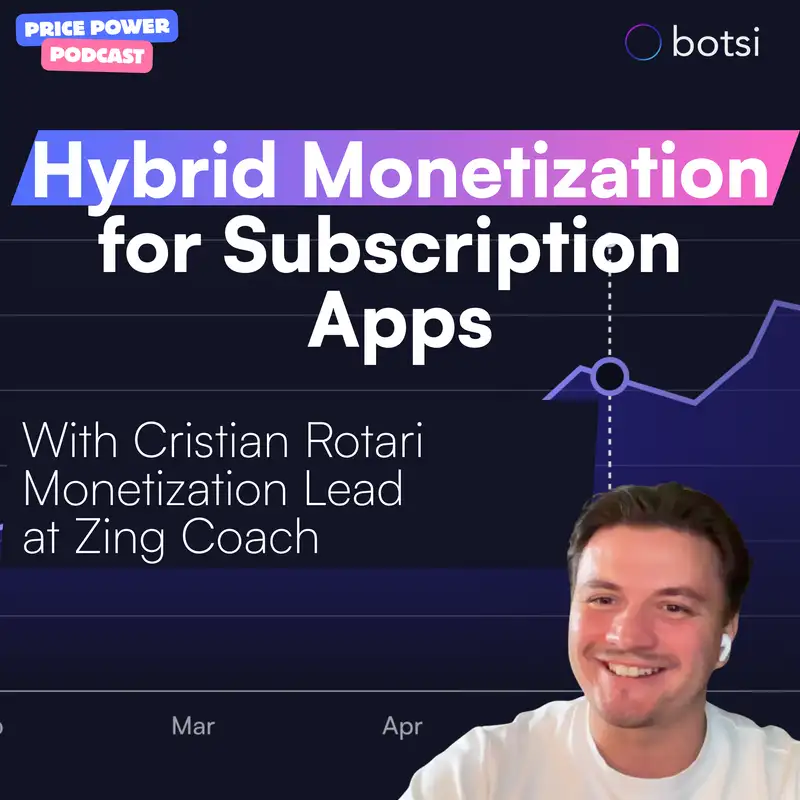
Today, we're talking
with Christian Rotari.
Christian is the monetization lead
at ZingCoach, was a growth product
manager at Lingokids, and also does
independent consulting and advising.
We dive deep into all things hybrid
monetization, like why hybrid monetization
is hard to get real guidance on, how the
demand curve reframes pricing, why apps
should start with in-app purchases, not
ads, how do you add affiliate revenue,
why you should sell more to paying
users, not to free users, and much more.
Jacob: Hey,
Cristian: Good, Kingston.
Jacob: Uh,
Cristian: Well, thanks
for joining the podcast.
Really enjoyed having
you Thank you, Jacob.
Uh, it's, uh, it's good to
see, uh, to see you again.
And, um, yeah, I've been watching and,
uh, and listening to some of the other
guests, uh, on-- that you had on the
podcast, uh, and I hope to be on the level
Jacob: Oh, uh, I, I'm sure you will be.
But, but, uh, uh,
amazing you're listening.
really excited to chat today.
So, you know, today we wanna
chat, um, hybrid monetization.
I think this is a, a really
interesting and, and a topic that's,
uh, you know, growing in importance
quite, quite a lot recently.
Uh, but I don't think there's tons of
people with real in-depth experience
in hybrid monetization, so this is
one of the reasons I was quite excited
to, to chat with you and, and kind of
hear your takes, um, from, from your
experience and, and from looking at
other apps in your consulting work.
So start, you give everybody an
explanation of hybrid monetization?
What is it?
A- and then maybe some different types
of monetization tactics for apps.
Cristian: Sure.
So yeah, I mean, uh, I think hybrid
monetization is a bit of a buzzword, um,
but you do see a lot of talk about it.
Um, but it's very hard to find, you
know, a proper guidance, I would
say, uh, regarding this topic.
And it was mostly done
before by, uh, by games.
Um, so the, the gaming, uh, industry
was doing a lot of hybrid monetization.
Uh, but now more apps, uh,
are doing this as well.
Um, and, um, it's not just
subscriptions and ads.
Um, there's multiple
ways of doing it, right?
There's, uh, credits, uh, for the,
like, in the tokens and so on.
There's enough purchases,
physical products, affiliate,
uh, et cetera, et cetera.
So there's multiple ways of
combining, uh, all of these type
of monetization, um, layers.
Um, yeah.
Uh, there's a very wide range,
and you see a lot of apps doing,
uh, different type of layering.
Um, for example, uh,
TikTok, they're doing ads.
They have, uh, you can buy all
of these, uh, coins as well.
Uh, you have, uh, Spotify, they're
doing different, uh, subscriptions,
ticketing, merchandising, et cetera.
So there is, yeah, a wide range
of examples, uh, out there
Jacob: Yeah.
Uh, I think it's an important point
to note that it's not just ads, right?
This is traditionally what people
think about in- especially coming
from the subscription app world.
You go, I have a subscription,
now can I add ads?"
And, uh, that- that's not always
the best first thing to do, but the-
we, we can get into kind of all the
different options and, and how to
kind of structure different tactics.
But yes, essentially hybrid
monetization, uh, multiple monetization
tactics at, at, at its core.
Um, and, and so you gave a
presentation recently, uh, around
this, I think at, at Apps Forum.
Uh, you know, youâ¦
I- in this you reference the, the
kind of demand curve framework.
a- and this idea that, um, you
know, subscriptions are binary
or, or have a single price.
Someone paid or they didn't.
But, but in reality, willingness
to pay is not, uh, uh, binary.
It's, uh, distributed across many,
uh, different willingness to pay.
There's different ways to monetize
users, um, and then there's different
kind of, uh, uh, demand levels.
When, when did that concept first click
for you, a- and, uh, how did it change
how you think about monetizing, uh,
uh, the apps you've been working with?
Cristian: Yeah.
This, uh, this demand curve, um, first
heard about it from, from Thomas Petit.
Uh, and, uh, we worked together at
Lingokids before, uh, when I was
a growth product manager there.
And, uh, I remember even back then,
uh, we were doing a lot of price
testing and, uh, there is a point
at which you're like, "Okay, howâ¦
Like, what else can I do to, you
know, kind of make the, uh, to,
to move the needle," uh, right?
And I remember at the time,
uh, Thomas c- came up with some
ideas regarding, you know, like,
printables as an in-app purchase.
Um, and that was back in, I think, 2022.
Um, so a few years ago, uh, already.
Um, but yeah, overall, I think the concept
is that you do a lot of optimization
around pricing, uh, and, uh, you try to
move the needle there, as I said earlier.
But, um, you have those users that will
purchase no matter what, let's say, right?
Those are what you could call whales.
And then you have the plankton, as Thomas,
uh, said as well, that no matter what
you do, they're not going to convert.
Um, right?
Um, so there is a point in which
apps can start introducing hybrid
monetization after they have, let's
say, optimized a lot their subscription
model, um, their current subscription
model, to, uh, start monetizing the
different segments of, of users.
Um, right?
So, um, that's when you can come
in and introduce this different
type of monetization, uh, to
go after the whales, right?
Maybe, you know, try to get some
more, uh, revenue, uh, out of that,
uh, or to try to kind of come to find
some, some middle ground, uh, to, to
convert that plankton, uh, let's say
Jacob: Yeah.
It, it, that, that makes sense.
And interesting to think about that.
It's not necessarily,
you know, you're showing users,
uh, um, plans or packages.
It's that some people will never pay,
some people will pay, some people will pay
times and more than you think they will.
And so s- for, for the users who will
pay, maybe it's, you know, stacking
types of monetization, uh, tactics for
those people because they have, they love
your product or they get a lot of value.
And then some users, uh, are, will
never pay for a subscription in
their life, don't, you know, just
are, are, are extremely adverse, but
they're still using your product.
And I, and I guess at its core, this is
because of the freemium model, right?
Uh, that you have, you have users using
your app and, and this, this freemium
model is built on the idea that, um,
you convert only a small percentage
of those people, and those people kind
of sustain the rest of your user base.
And, you know, of course, you
can give, give away different
levels of value for free.
But I wouldâ¦
it right that the, there's a lot bigger
hybrid monetization opportunities if you
have that large free or freemium model?
Cristian: For sure.
I mean, the, the biggest apps
out there are doing some sort
of, uh, hybrid monetization.
So, you know, social apps like Instagram,
um, TikTok, they are doing ads as the main
stream of revenue, but then they have also
some subscriptions to remove ads, uh, you
know, kind of enforced by GDPR and so on.
Uh, but then they're also
introducing, like, other things,
you know, like you purchase your
blue check mark and, and so on.
Um, and then, um, for many of them,
let's say YouTube, uh, the biggest,
um, USP for YouTube Premium is you
need to pay to remove the ads, right?
Which is kind of, let's say,
the biggest pain for users.
It's not so much about what else you get.
It like, okay, you can download
videos and so on and so on, but it's
specifically about removing those ads.
So, um, I think the bigger the apps
and especially, you know, um, these
social networks that I mentioned as
well, uh, they, they rely a lot on,
on ads as the first one, and then
going into, um, into some in-app
purchases, uh, and subscriptions.
Uh, and then other ones, you know,
that do, my- let's say MyFitnessPal,
for example, um, is, is one example.
They do, um, they do ads, um, and,
um, it's kind of to, to cover for that
amount of users, that large amount
of users that they have using the
app for free that they won't convert.
Um, so yeah.
Jacob: Yeah.
Do you think-- this is, this is a, a
bit of a tangent, but think thatâ¦
From, from what I see, any-- a lot of apps
are starting with hard paywalls today.
That essentially means they have no
free user base or freemium product.
Do you think that to get big, to get--
reach large scale, you have to have
some free product or have to have
some free version of your product?
When I look in the market today,
essentially any very large company,
maybe like 95% of them essentially
have operate on this freemium model
Cristian: I think that is, that is true.
Uh, and we saw it at Zing as well.
Um,
when I joined a couple of years
ago, there was even no trial, uh,
on the, on, on the app, uh, and
it was just like a hard paywall.
Uh, it wasn't-- Well, it was kind
of a skippable paywall, but, uh,
yeah, there was, there was no trial.
It was the, the barrier to, to enter,
uh, the app and to start using, uh, was,
you know, um, was, was a blocker there.
Um, so as soon as we opened the gates
a bit and, uh, eased, uh, down on the,
on the paywalls and on the rules, we
saw that, um, we could get more users,
especially on that, you know, kind of,
let's say, not so ready to pay, but those
would bring more users as well later.
So, uh, for sure, doing some
sort of, of freemium, uh, is, uh,
is important in, in this case.
Jacob: Yeah.
A-and I think that's point to think
about that as you scale, freemium
not only unlocks hybrid monetization
tactics to monetize those free users,
but also increases your ability to grow
organically because the larger user base
you have, the more opportunity you have
for word of mouth and people sharing.
And so once you get good at converting
the users, moving away from a hard
paywall to a soft paywall and a freemium
model, you're probably not losing too
much subscription conversion because
you're pretty good-- You've figured out
how to convert people to subscriptions.
And so you lose a f- a couple percentage
points in terms of start rates maybe.
Uh, but in the end, it's, it's
net positive for, for your growth
Cristian: Yeah, I think that also
if we look at, at it the other way
around, so I think, yes, freemium,
uh, is important for, for growth.
Uh, and but when we talk about especially
hybrid monetization and when we talk
about these whales, um, right, um, we
would see that we could have some sort
of, let's say, pricing that made sense.
As long as we started doing some
price kind of, um, increases, the
conversion would drop, so we didn't
want to, to make it too restrictive.
Therefore, we would keep some sort of
balance to allow for these users who had
intention to pay, uh, to, to convert.
Um, then obviously have some plans for
others that maybe are not so ready.
Uh, but then we would see a lot of these
users, a very big, big chunk, I would
say, of these users who converted then
convert into some in-app purchases, uh,
and to upgrade their plan and, and so on.
So I think it's kind of--
it goes both ways, right?
So it depends on how you want to grow.
Um, you can do, uh, also, uh, not
just monetize your plankton, you
can also monetize your whales.
Jacob: Yeah.
Yeah.
That, that makes a lot of sense.
And so what is the right time to
start thinking about adding different
types of monetization methods in
terms of your app growth maturity?
I- is this, is this only a matured
strategy for the largest apps?
Should newer apps care about this?
When do you, when should you start
prioritizing these types of tactics?
Cristian: I think that this is not a day
zero or even a day one type of thing.
Uh, you have to nail product market fit.
You want to nail one specific
monetization, uh, model.
Um, in most of the cases
would be, um, subscriptions.
Um, and then from there, once you
understand the behavior of your
users, once you can segment your
users, uh, then you can go and try
to add new monetization layers.
Uh, and that can be, you know, uh,
in-app purchases, it can be consumables
or non-consumables, uh, it can be, uh,
ads if you have the volume, uh, for it.
Um, but I think that, yeah, probably
the, let's say kind of the easiest is
once you have found some sort of ceiling,
let's say, to your pricing experiments
and your, your packaging experiments,
that's when you want to, to start
looking at other, uh, models as well.
Uh, and personally, I would start for,
for most of the apps with, uh, some
sort of, um, in-app purchases, um,
because ads really are not for everyone.
Ads are a volume business, uh, and
they are not easy to, easy to manage.
So, yeah
Jacob: That makes sense.
And adding on IAPs or other purchase
types in your product also just in
with your existing subscription model.
Probably to start, you're probably running
them through Apple and Google as well.
You don't have different payment
processors, different kind of platforms to
manage, and all is kind of consolidated.
You understand these mechanics much
better for paywalls also, and, and so
it's probably an easier thing to add on.
Um, this, this, this makes a lot of sense.
One, one question, um, I had, and I
think this is important recently, is
with AI apps, where, uh, potentially
it is a earlier tactic you need to
do for AI apps because of the cost
layers, because of the token costs.
How do you think about in-app
purchases, credits, subscription model
for, for these apps that have these
different kind of cost layers than
a traditional subscription product?
Cristian: That's a very good question,
and I think it's one of the biggest,
let's say, problems that we see out there.
A lot of founders are just kind
of like opening the gates and
they're like, "Oh, uh, we have a
free trial, uh, come try our app."
And then they wake up in the morning
and some power user just spent thousands
of dollars in worth of tokens, and
they're just like shocked about it.
So you have to be very smart, um, about
how as an AI app, um, you're going
to, to price and how you're going to,
let's say, let users try your product.
Um, at Zingg, for example, um, we have
an AI coach, uh, and the AI coach is
integrated with, uh, OpenAI, uh, API.
And, um, we obviously have to pay
specific, you know, amount of money
per, per each, uh, per each request.
Um, and at first it was only available
for, um, premium users because it was
kind of, you know, like calculated
within the, um, the business model.
But then we were like, okay, this is one
of the main things that Zingg has, one
of the main, um, value propositions, so
how do we allow for users to try it out?
Uh, and that's when you
want to, to model it a bit.
You want to understand, uh, what is
the, the pricing that you have right
now, uh, let's say average user,
how much they're spending on it.
Um, and, uh, we did some, some
calculations back in the day and, you
know, okay, do we allow trial users?
Uh, do we allow free users to,
to, to talk with the coach?
And how much can we allow
them to, to do that?
You know, like it's not
just going to be a chat.
Some of them, um, they, um, will upload
pictures and ask, uh, AI to analyze
their meal and so on within that chat.
And it's even more terrible for
apps that are doing actually image
generation, for example, not just
recognition, but generating images.
That's like really burning,
uh, burning tokens.
So yeah, you have to be, you
have to be very careful about it.
Um, I think many of the apps
today, they're not even allowing
their, um- trial, uh, users to,
to use up a lot of these tokens.
Maybe they have some sort of limit that
they know, okay, they can get some value
from here, and then they can unlock more.
Um, but, um, yeah, it's a, it's a
bit of, I would say, a whole podcast
conversation about, uh, AI apps.
Uh, there's a couple of very interesting,
uh, articles from, uh, from Alice Muir.
Uh, she was, uh, on, uh, on
your podcast, uh, before.
And, um, yeah, she has a, a couple
of articles especially on this.
Um, so I just recommend whoever's
listening to, to check it out
Jacob: Yeah, that's what I was gonna
say too, that, yeah, Alice and I did a
podcast a couple episodes ago, and, and
yeah, she has some really great thinking.
But it-- And, and for, for AI apps,
it's not necessarily-- You shouldn't
think about it as hybrid monetization.
It's, it's kind of the status quo.
If you're, if you're bolting on an AI
feature, it's a little different, right?
Uh, a little different cost structure.
But if you're an AI app that has image
or video or some type of generation,
like, it's-- you shouldn't think
about it as hybrid monetization.
It's, you just need credits,
you need in-app purchases.
It gets a little more complicated and
sophisticated from day zero, and so that's
probably, yeah, the one exception, right?
Most apps, um, don't think about this.
Focus on your core business.
For AI apps, y-you gotta--
different cost structures.
You, you have to think about it earlier.
Um, that, that makes a lot of sense.
And so one piece you, you alluded
to, um, a couple minutes ago is
that ads aren't right as a, as
a starting point for everybody.
But I think that most apps,
this is the, the default.
You go, "Oh, well, I can, I can put
some ads to show to my free users."
Can you, can you elaborate
on why ads aren't a great
starting point for most apps?
Cristian: Yeah, as I, as I said earlier,
I think ads are a volume business.
Um, so if you have a very limited user
base and you try to get, um, um, to get,
let's say, more s- uh, revenue from ads,
you're probably not going to succeed, um,
because there's a few, uh, things that
you need to, to take into consideration.
So number one is that in order for you to
set up the whole infrastructure around,
uh, ads in your app, it's gonna take
some, it's gonna take some work, right?
Um, so not only the technical part,
but also the UX part and how do you
integrate that into the product and so on.
Um, so that whole thing is
going to take some time.
Um, then you need to consider
other things such as, okay,
w- where does it make sense?
Does it make sense to, you know,
kind of, um, introduce it in,
in certain, uh, certain points?
What is the, the session
lens, uh, in this case?
Like, what would be the impression rate?
You know, like all of the different,
like modeling around it, uh, and the
different like entry points and so
on is going to be, uh, one of those
not so fun things to, to work with.
Um, and I think that, uh, at certain
levels, uh, for most small to medium apps,
uh, they will probably get more money
from in-app purchases or, or other type of
hybrid monetization than, than from ads.
Uh, I remember doing some like
calculations, uh, around this and yeah,
um, ads will almost always lose, uh, when
we're talking about, uh, smaller apps
Jacob: Yeah.
The, I believe the important point that
people don't think about is they see
all these games monetizing through ads.
Let me know if this is correct, that
most subscription apps don't have the
frequency of usage necessary to, or,
or the, the, you know, volume of usage
plus the frequency of usage, where you
need daily active users and you need
a high f- in that usage, you need a
long session so you can show multiple
ads and, uh, show high-value ads that,
that actually earn you money, and then
you need to be doing that every day
for these users to, to actuallyâ¦
And this is why it works for, you
know, these kind of, uh, these
g- games versus subscription
apps where it's a workout app.
You use it once a week.
You open it up, use it for,
you know, a little bit.
You're not, maybe not in
the app the full time.
And so I think this is an important
distinction people forget to
Cristian: For sure.
I mean, we can take a couple of examples.
Um, I think Duolingo is
the classic example, right?
They have ads.
Uh, and now they have ads
after each one of the lessons.
Um, so you do a lesson,
it's like super short time.
They kind of, you know, reward
you with some sort of, let's
say, psych, "Yay, you did it.
Great.
Next lesson.
But in the meantime, let's watch an ad."
Um, and they also combine, by the way,
what we were talking about earlier,
that, uh, one of the main, um, let's
say, drivers of subscriptions for, um,
for Duolingo, but also like YouTube, for
example, is you can just remove the ads.
So they have ads that are either,
let's say, partners, um, or they
have ads that are, uh, just Duolingo,
um, the-- their, you know, their
max, uh, and, um, their other tiers.
Uh, so you can just, you
know, convert to Duolingo.
So it's kind of a funny thing to,
you know, you do get the ads, but
they are actually Duolingo, uh, ads.
Um, then you also have, as
another example, apps that are
more utility, uh, like, uh, you
have, uh, f- Flightradar, right?
So you see a plane flying overhead.
You're like, "Okay, I'm gonna
check which plane this is."
You try to open it, and you have to,
to watch, you know, a 15, 20-second ad.
You have to wait for that, and
then you're like, "Okay, good.
Let me see what model
of the plane that is."
And then you get another ad, right?
So, like, it's kind of like blocking
you in this, let's say, core actions.
Um, and obviously, uh, Flightradar, uh,
they have, they have a lot of users.
Uh, but they do have all of these, let's
say, core actions, uh, where you really
want to get some sort of information
or some sort of, you know, kind of
gratification, and that's when they
very smartly place the, place the ads
Jacob: Yeah, and so it's not even
about just adding ads, it's about
is your product engaging enough,
interesting enough, and offering enough
value that people just won't leave?
I- is there enough incentive on
the other side for people to watch
the ad and still want to continue?
Where probably for a lot of apps, be
a not-- it's gonna be a net negative.
People are just gonna leave, they're
gonna lose users, fewer subscribers.
They get a little revenue, but it won't
actually improve things and, and their
time will be better spent elsewhere.
I think this is, is really helpful
to understand the, the difficulties
of ads and, and it's, it's harder
than it looks to make this work,
have it be right for your business.
And so, um, we, we talked about
up- or we talked about in-app
purchases and, and kind of upsells.
I, I wanna talk a little bit more
about upgrades and upsells in a minute,
but let's go through some other, um,
other types of monetization tactics,
and, and maybe some examples of those.
So I think you, you've also
talked about, um, affiliate
deals and, and physical products.
Can you tell me more about, uh, those?
Cristian: Yeah.
So affiliate is an
interesting one, um, right?
Because you might have, first of all,
a subscription, uh, and then those
users that are, let's say, using that
subscription, they might find some sort
of like a product inside of your app, and
then you are generating some additional
revenue, uh, through affiliate links.
But maybe someone doesn't have a
subscription, and then you can still,
uh, use that, uh, y- that revenue.
An example, um, of, uh, of an
app doing affiliate very well
is, uh, Lovey, uh, Skincare.
Um, so they, uh, scan your
face with, uh, with AI.
Uh, you do a, you do a selfie, kind
of like you do from like multiple
angles, and they tell you, "Okay,
you have this imperfection here,
you have this acne here," whatever.
Um, and then they recommend different
products, um, that are kind of rated
specifically for those things that, uh,
that you need in order to, you know,
like those products that you need to,
to, to improve certain conditions.
Um, and, uh, the way that they
integrate affiliate in their
product is, I think, very smooth.
Uh, you should check it out.
Uh, it's, uh, it's very interesting.
Um, then I would sayâ¦
Yeah, sorry.
Jacob: what one question, are
there, are there kind of standard
SDKs or platforms to like, to add
affiliate deals, affiliate products?
Do you have to build that yourself
or are there just platforms that
can basically facilitate the
end-to-end experience for you?
Do you know?
Cristian: Uh, I, I'm not
so sure, to be honest.
I know, like, uh, Amazon, for
example, they have affiliate links,
uh, and anyone can, can use that.
Um, so it's, it's super,
super easy to, to do.
Uh, you don't really need
a, a separate platform.
You'll see that with, uh, apps.
You'll see that with YouTubers.
Uh, they always have, like, some sort of
affiliate, uh, links from, from Amazon.
Um, so it could be a good way to start
if you want to, to test something, uh,
without having to do any, you know,
sort of difficult implementations.
Um, it's just a URL with some sort of, you
know, appendix on that URL that, uh, would
give you some additional revenue, uh, if
someone bought, uh, something through it
Jacob: Got it.
Okay.
Makes sense.
Makes sense.
I'm sorry, I, I interrupted you.
W- was, was there anything
else on affiliates?
Like, who, who does this make sense for?
Cristian: It's, it's a good question.
I think, um, it has to, to be, um,
probably a use case where you can
Recommend different type of products
outside of your app without really,
you know, kind of cannibalizing
anything inside of the app.
Um, now that, um, you know, my wife
and I are expecting a, uh, uh, a baby,
we're been, like, th- there were so
many different apps and trying to kind
of see what's out there, and there's,
like, see how to dress your baby today.
You know, like, your temperature, uh, in
the house, or if you're, like, going to
be going outside, and it uses location.
Uh, and then it's like, "Oh,
actually, you know what?
You want some products that would
match today's, you know, like,
weather, today's, like, outfit.
Check these out."
So, um, I think it's, um, it's
specially about those apps that really
have that use case of, like, being
able to recommend products out there.
You know, even, like, Spotify, um,
they can recommend concerts, right?
Like, you have your favorite artists
in Spotify, and, uh, they know that.
They know who your favorite artists
are, and they know where you live, um,
because they have access to your, to
your location, and, uh, they recommend,
uh, concerts around you, or they can
just recommend merchandise from your
f- your favorite artists and so on.
So kind of that sort of, let's
say, linking as well those
products to your experience.
So let's, um, if I'm in Spotify
and they're recommending me baby
products, that'll be weird, right?
So it has to be that kind of
sort of value, uh, linking.
Uh, you know, Strava, and they're
saying, "Hey, actually, you know,
uh, maybe these shoes are nice for
you," even though they don't do that.
Um, but, um, that would be,
that would be an example.
Jacob: Yeah.
So what is the core value and
how do you extend that value
and connect onto it in a, in a
weird way that,
Cristian: Exactly
Jacob: actually appreciate?
Um, this makes sense.
I was talking to, um, some app
founders that have, you know,
the, uh, um, kinda like barcode
scanner to detect healthy foods.
and you know, I was saying to them,
"Hey, maybe you have a lot of influence
over people's purchasing decisions and,
and recommending healthy foods to them.
This could be something you
could think about, uh, um, some
type of affiliate links orâ¦"
And this is, this is maybe a
good transition into the next one
of, of actual physical products.
And is this a brand like
creating their own products?
Is it the licensing from other brands?
How, how do you think about that?
What, what, what have you seen there?
Cristian: I think it's, yeah, it's
multiple, uh, ways of looking at it.
Um, we have, at Zing, one of our
main competitors is, uh, BetterMe.
And BetterMe, uh, they're
doing a lot of things well.
Uh, they're, uh, reference
in, you know, in-app purchases
and web funnels, et cetera.
And, uh, they have an online store
where you can buy, you know, uh,
equipment for Pilates, for yoga.
You can buy, um, you know, um,
like clothing, uh, as well.
So it's kind of taking those users that,
you know, are already familiar with
your brand and, um, they trust you and
they're paying for a subscription already.
Uh, and then you can offer on top of that
something physical, uh, that is again
linked to, uh, the product usage, right?
Because you do Pilates with the,
uh, with the app, and then on top of
that, you're wearing the outfit that
you bought from the BetterMe store.
Um, um, and then another
example, uh, is, uh, Lingokids.
Uh, and, um, you know, if you wanna
do some offline, um, kind of gaming
with, uh, with your child, you can
buy a memory game, uh, from the
website that is Lingokids branded.
Um, so it kind of stays within the brand.
Um, and, uh, those physical products can
be extensions, uh, of, of your brand.
The most likely they will still be
purchased just by your users, not so much,
you know, by let's say external users.
Uh, but it's a good way to
kind of keep monetizing, um,
the, um, the current user base.
Jacob: Yeah, and standing up an e-commerce
shop is so much easier than it used to be.
Like, you never even have to have physical
products ever touch any warehouse you own.
It can all just be
managed by third parties.
And, and I see, um,
AllTrails doing this as well.
AllTrails has a big shop online, and
I, you know, still get emails for their
new backpack they launched, uh, though
I don't really use AllTrails much.
So yeah, that makes sense.
Um, saw, um, at Zing, you guys have
done a lot of partnerships recently.
Uh, is-- I feel like this is a
harder tactic and you have to
have a larger brand, to kind
of think about partnerships.
Maybe not.
Uh, how do you think about partnerships?
Cristian: Yeah, I mean, we've done, uh,
we've done a few partnerships recently.
So we have a new partnership with,
uh, with PSG, Paris Saint-Germain,
the football club, um, which, uh,
were champions of Europe, uh, last
year, and they're playing, uh, the,
the final, uh, again, uh, this year.
Then we did some partnership
with, uh, Les Mills.
Uh, they offer like they have a very
big on-demand library, uh, of, um,
um, you know, body pump and, uh,
other type of exercises, um, which we
also allow our users to, to purchase.
Uh, and then we're doing a partnership
with New York Sports Clubs, where
their users, uh, their gym members are
getting Zing at, uh, a specific fee
with a branded experience inside of
Zing that matches New York Sports Club.
So, you know, challenges from them and,
uh, the kind of the app looks different,
more on brand for them and so on.
So there's like different ways
to, to, you know, uh, monetize,
and it kind of goes both ways.
Um, one of the examples can be, you
know, uh, again, Spotify doing some
sort of partnerships with, uh, you
know, some, some big, uh, artists
or they're doing partnerships with,
uh, um, you know, record labels on,
you know, kind of vinyls and so on.
Uh, or Strava doing partnerships with
Adidas, uh, or with Nike on challenges and
then kind of giving visibility to, to the
brand through certain, you know, in-app
mechanics, uh, to, to drive, you know,
activation with those, with those brands.
So there's a lot of, there's
a lot of kind of ways to, to
drive partnerships out there.
I know I've just given you like so
many different examples, so I'm happy
to, to stick to one of them, and maybe
we can like go deeper into, into it.
Jacob: No, th- those are great, and
I think this partnerships in B2B are
kind of intimately connected, right?
Where sometimes i- if I, if I break
down some of the things you've talked
about, sometimes it's that, um, you're
allowing, uh, people to monetize their
product through your user base, and,
and they're giving-- you're giving
people access to your user base.
this is more kind of a white
label experience where you're
creating something custom.
You have built this product, so it's
very easy for you all to kind of create
something custom on top of what you
did, like the New York Sports Club.
Uh, um, and actually I, I
go to New York Sports Club.
I saw it on the TV there and I was
like, "Oh, I bet, uh, Christian
had some involvement in that."
And, and, and so it, it was a
funny, uh, funny connection, and I
was like, "I'm g- I'm gonna bring
this up and ask him about it."
So, a- a- and thenâ¦
And I think that, you know, a lot of
people see maybe what like Calm has
done with like B2B employer sell-
sales, selling their subscription
and, and bundling it as a kind
of wellness or health offer.
Now, not every app could do this, but
fitness apps, wellness apps, they can
have this be kind of an employer benefit.
And, and maybe this is less of a
thing in Europe, I don't know, but
in the US, you know, all theseâ¦
E- everyone's trying to
sell to these employers, and
it's, "Oh, get more benefits.
Bundle it into your, uh, kind
of what you get as an employee."
And so I think that's
a big business as well.
And so I think again, but it's,
you know, how do you, um, how do
you extend your product value?
And, and I think that people,
um, people underestimate theseâ¦
Like with an app, you actually have,
compared to a lot of other products and
a lot of other companies, you have like
massive amounts of users and visibility.
Like don't underestimate how
many, the eyes and impressions
you have in your product.
Like if you're an app and you have a
million downloads, like when you compare
to other apps, you go, "I'm not very big.
I only have a million downloads."
There's apps with 10
million, 20 million users.
But when you compare it to
other products and businesses,
this is so many people, right?
And, and so I think that's the
important part to think about.
Don't underestimate just the, the
amount of eyes that you can take
advantage of that are in your product.
Cristian: Yeah, that's
a very, very good point.
I think if the math works and there's
some sort of way that you can collaborate,
uh, and that you have the, let's
say, resources to work on this type
of collaboration, then, uh, it's one
of, you know, additional layers that
we've discussed that you can, you
can, you know, keep monetizing and,
uh, you can keep expanding your app
and your, uh, your revenue streams.
Jacob: Yeah.
Um, so on the flip side, we
wanna talk about cannibalization.
You mentioned a few times whenever
you're thinking about a new monetization
tactic, you have to make sure it's
actually adding to the whole and
not taking away from the whole.
How do we, how do we think
about cannibalization?
How do we measure this?
W- what are your, what
are your thoughts there?
Cristian: So I think to give you an
example of BetterMe, uh, again, um, this
is obviously, you know, I hope some, like
if someone at BetterMe listens to this and
they're like, "No, actually you're wrong.
Uh, that's not what,
uh, what we're doing."
But they have obviously the subscription,
uh, as the, as the main driver,
but then they have, uh, also some
sort of short-term programs like,
you know, 28-day abs challenge.
So maybe someone is like, "Okay, I don't
know if I want 12 months of, of this.
Um, you know, I don't want to,
to, you know, commit for 12 months
to work out every day, but, uh,
getting abs in 28 days, why not?
Let's do that."
So it's kind of like one of
those ways that, uh, we mentioned
earlier about monetizing users
with less, uh, intent, right?
To kind of give them some sort of,
of products that are not necessarily
going to be, um, you know, you
don't need a subscription for that.
It's kind of like, okay, here.
So, um, at Zing we have some,
um, uh, in-app purchases as well.
So we have a body scan, uh,
that scans your body and kind of
gives you, uh, body composition
results, muscle analysis and so on.
Uh, we have a nutrition guide, uh, where
you have, let's say, all of the data
that you've put into the app, and then
we can personalize some sort of meals and
your calorie intake and so on for you.
Um, yeah, what we've seen is
that, um, whenever we have
kind of the life cycle of how we promote
things and how we, you know, try to
engage users with, uh, with all of this.
We would always try to sell subscriptions
to those who didn't, who are free users.
Uh, only then when they have converted,
uh, in either into a trial, uh, or just
into a paid subscription, that's where
we kind of come in with other things.
Because the Let's say willingness to
pay of these users is already quite low.
Um, so if you are trying to, you know,
get someone who's not willing to pay
a lot, um, to first purchase a, you
know, let's say a nutrition guide for
25 bucks, uh, then they're gonna see
something like, um, you know, three
months of, uh, Zing Premium for another
30 bucks, and they're gonna be like,
"Oh, no, I already spent this much.
I don't wanna spend that
much on that," right?
So their willingness
to pay is already low.
Somehow they managed to,
to spend some money, right?
So, um, that's why from subscriptions,
that's where we will get the most
revenue, uh, and like LTV over time.
So we don't really want to kind
of push them into these like
one, uh, one-time purchases.
Uh, we want to, to push subscriptions
first, uh, and then from there kind
of build up, um, and to see, okay,
do we want to upgrade them into this?
You know, do we want to give
them less meals content?
Do we want to, you know, uh, ask them
if they are on a three-month plan
to upgrade to a yearly plan because
this way they will be getting, you
know, more value, uh, over time
for like less money, uh, and so on.
So the, this is a bit of an
oversimplification, I would say.
Um, but obviously you should, you
know, test for your app, uh, and, uh,
and see what are those things that you
will be, you know, kind of promoting in
the short span, I would say, of, of a
users, uh, of a free user in the app.
Because I think for most of the apps,
it's true that once someone is a free
user, they go through onboarding,
they-- If they decline the onboarding
paywall, which most of the apps have
an onboarding paywall, you really have
a very short amount of time to convert
these users, um, into, um, you know, into
a paying user, uh, in any shape or form.
That might, that might be, you know,
either a subscription or in-app
purchase, uh, or, or whatever.
Um, and therefore, you really have to
kind of choose your battle, uh, one
after the other, instead of trying to
kind of push too many things at the
same time, overwhelm the user, and then,
you know, maybe go with things that
on the long term are not going to be
that valuable, uh, for, for you either.
So,
Jacob: I think that's
Cristian: yeah.
Jacob: interesting, that distinction of
my intuition says, "Oh, well, someone
didn't convert to a subscription.
Let's sell those free users
additional, uh, uh, plans or
options or one-off purchases."
But really it's that someone
buying a subscription has told
you they have high intent.
Well, you should maximize that intent
and that level of purchase, and so sell
the people that have already purchased
something, that actually are getting value
from your product, that want the product,
additional options or additional packages,
and that's gonna be more fruitful 'cause
if subscription is your core business,
don't try to d- don't block that.
Still t- always be trying to build
your core business, but for people
who are, have already told you they
have high intent, those are the
people you should be trying to kind of
maximize the, the ARPU or the LTV from
Cristian: Yeah, exactly.
I mean, just to give you an example,
um, at Zing, especially on the web
funnel, uh, we have, uh, first you buy
a subscription, then you create your
account, and then we say, "Hey, would
you like to add this and this and that?"
Certain users, especially those on the
yearly plan, um, convert very, very well
to these, you know, upsells and upgrades.
So we have around 40% of users on a
yearly plan converting to at least one
upsell, which, uh, is quite a big number.
Uh, and obviously as you go down, so
let's say someone on a six-month or a
three-month plan and on a weekly plan,
you will see that conversion decreasing.
Uh, so the higher intent they have,
the, uh, more, uh, they'll be, you know,
willing to, to spend later on because
they already got their wallet out.
Uh, so, you know, might as well, you know,
okay, let's buy this and let's buy that.
Uh, and, um, I think it's very important
to, you know, kind of understand how
to monetize that intent and not kind
of just l- leave it unattended, uh,
because, you know, there is intent,
uh, and, um, they're gonna take
their money elsewhere otherwise.
Jacob: Yeah.
Yeah, that, that, it makes a lot of sense.
I think that's a, I think that's
a great nugget for people to
take away and think about, w-
with kind of real examples there.
Okay.
Uh, so one last topic I wanna talk
about here is subscription tiers.
you know, different packages, a light
plan, a pro plan, a premium plan.
This isn't exactly a hybrid monetization,
but it's similar, it's related.
Monetizing users different ways,
trying to get at their, um,
willingness or ability to pay.
Have you tried tiers?
What have you learned from, uh, there?
W- when is this a good, good idea to test
out different, uh, subscription tiers?
Cristian: Yeah, I think they
are not necessarily hybrid, but
they can also clash with hybrid.
Uh, right?
So if you have tiers, but then you have
in-app purchases, and then you have, uh,
you know, some, uh, affiliates and so on,
then what you're doing there is kind of
like making a bit of a, of a UX, uh, mess.
Uh, but also in terms of, like, the value
that you try to communicate to, to users.
Um, right?
So in, umâ¦
I would say that one of the most important
things for, for tiers is that you really
need to, uh, have a good understanding
of your user segments and the jobs
to be done for these user segments.
Uh, right?
So I'm gonna go back to, to,
to Spotify as an example.
Um, Spotify, they are not doing,
you know, pro, premium, et cetera.
They could be doing, let's say, "Oh,
you're getting, uh, AI recommendations,
uh, and you're also getting lossless
audio and whatever," but they're actually
segmenting more for the actual use, right?
So it's an individual plan, it's
a family plan because, or dual,
or you're a student and so on.
So it's not, they're not trying to
kind of overcomplicate their offering.
Uh, and they really are trying to
kind of say, "Okay, maybe, you know,
someone is, you know, sharing Spotify
with their, um, you know, with their
partner, so let's just do a dual plan."
You know?
And this way you just get more people to,
uh, to, to join, uh, and you have more,
let's say, better retention over time.
Um, in Zing, we have introduced the,
um, Less Meals, uh, as I mentioned,
um, which I would say that one of the
important things as well to do is that
you don't offer things that are kind of
expected to be in that basic plan either.
Um, so I think that once someone is
converting to, to Zing, they're not
really, you know, kind of expecting
that they will also get access, you
know, to a huge library from Les
Mills with, you know, all of this
content for BodyPump, et cetera.
They want a personalized workout plan.
And that comes at an extra cost that
only some users will get, right?
Um, so therefore you are not
overcomplicating your, your offering.
Uh, you're making sure that
things kind of go one by one.
Um, and it's very similar to also,
you know, dating apps, right?
So is it like Tinder Gold?
Uh, I don't even remember, uh,
these, uh, uh, the- these names.
Uh, but, uh, there are just so,
like, so many, like, and now I think
they've introduced some, like, crazy
expensive one, uh, as well, right?
And this is all about usage.
Like, okay, here, this
is like your basic one.
Here, you're gonna have already
some sort of, you know, mm, let's
say something is going to happen.
You're gonna get more super likes
or more boosts and whatever,
and this one is really going to
maximize success for you, right?
So it's like, it depends on how much
money do you want to spend in order to,
you know, to, to achieve that success.
But nobody's really expecting that
in their free, or let's say not free,
but their basic plan, they're gonna
get, you know, 10 boosts a month, uh,
because the value, let's say, uh, ladder
is very clearly explained to them.
And that's something that I think
most apps trying to do all of
this Pro, Premium, et cetera,
they're not really understanding.
They're just kind of trying to package
things in there without having that,
you know, sort of value ladder clearly
defined and clearly understanding the
user segments that, that they have.
Jacob: Yeah, that is a great point
that like a lot of this, you should be
very thoughtful and careful about how
you layer in these different tactics.
And that's, the, the key is kind
of understanding your users, what
value they're getting, what are
they expecting from your app.
if you wanna add tiers, don't take
away things, add value, and a-
maybe add that as an additional
tier that is, goes above and beyond.
That, that, uh, uh, i- is a great insight.
Um, okay, so I've got, uh, last
couple questions in our kind
of quick lightning round here.
how, uh, uh, so, so what is a hot take?
W- what's a hot take on subscription
apps you'd get maybe pushback
from people on LinkedIn or X from?
Cristian: I, I think to go back
into the topic of segmentation, um,
somehow to kind of relate it to that.
Um, there's a bit of a, you know, a
hot topic as well right now within
should you use trials, should
you not use trials in your app?
And then there's people saying, "Hey,
should I remove trials from my app?
How does this work?"
And it's kind of like, should you first
maybe try to understand your audience,
uh, if they are expecting a trial or
not, you know, kind of if your product
will have the nature kind of to allow
for a trial or not be-before just saying
kind of like, "Okay, I'm gonna remove
the trial and see how it works," right?
Like, um, that is to me a
more, let's say, powerful first
question to, to, to, to answer.
Uh, right?
So is it, uh, you know, is
your audience very, very young?
You know, maybe the mechanics of trying
an app and going through an onboarding,
seeing a paywall, okay, seven-day trial,
I'm gonna see how this works, et cetera,
or is it a different type of usage?
You know, maybe your audience is also
older, and they're kind of expecting
some sort of immediate access that
doesn't necessarily include a trial.
Um, so this all comes down to, to, you
know, like the value and the segmentation.
Uh, and people should really start
with that first instead of just saying,
"Should I remove the trial, uh, or not?
And this is gonna give me some sort
of adap- uh, advantage in signal
engineering and what I'm gonna
be sending back to the networks."
Jacob: Yeah.
That's hard though.
I have to actually do user research
or maybe do user interviews, look at
the data, not just throw something
out there and see if it works.
But yes, that ultimately, usually
that's the, the, the right move.
That, that's great.
Um, okay.
Last question we ask every guest.
What's the biggest pricing or packaging
win you've ever seen or had yourself?
Cristian: I think I'm gonna reference
again something that we discussed.
Uh, and in this case, um, it's about
introducing a body scan to Zingg.
So this was done before I joined,
uh, right before I joined Zingg.
Uh, but this body scan and the way that
really converted people into, into this
type of w- uh, in-app purchase really
made a difference for, uh, the unit
economics, uh, of, uh, of Zingg Coach.
Um, just to give you some, let's say, data
on that, by day 30, I think it was, like,
25% of the, of the revenue, uh, of, uh,
of RPPU was coming from, from upsells.
Um, which really allows you to, you
know, spend more money, to reinvest
money more quickly, uh, into,
into, into your, uh, UA budget.
Um, and, um, yeah, I'm still surprised to
kind of look back, uh, and to kind of see
the impact that this one, you know, in-app
purchase, um, what it did to, let's say,
the unit economics of, uh, of, of Zingg.
So whoever did that, um, they
did a, they did a very good job
Jacob: Yeah, that's an amazing lift.
Uh, that's, uh, I think probably
some people can take some
inspiration and are probablyâ¦
If you made it to the end here, you're,
you're thinking about that already.
Um, Well, this was, this
was amazing, Christian.
I, I really appreciate you joining.
Uh, packed full of, of kind of
real experience and learning, so
th- this was, uh, really great.
I really appreciate you, you joining.
Cristian: Thanks for having me.
Always a pleasure talking to you
Jacob: uh, anything else you'd
like to, uh, share or promote?
Um, go, go check out, uh, uh,
Christian has some articles and, a-
and contributions to other articles.
Go Google his name.
We'll, we'll try to link
some in the show notes.
Anything else you'd like to promote
or, or have people go check out?
Cristian: No, not really.
Um, I could give everyone a extended trial
to Zing Coach if they wanna try it out.
Uh, we can, we can put it in
there, but, uh, not really
Jacob: Okay.
Well, um, I, you know, y- y- I think
you, you've, uh, I, I know some clients
and you've done some consulting work,
and so if you, if you're interested
in potentially working with Christian,
maybe he's full capacity, but, uh,
him on LinkedIn, shoot him a message
Cristian: All right.
Thank you.
Thank you, Jacob.
Jacob: Okay, well, uh, this was great.
I, I really appreciate it.
Uh, uh, yeah, yeah.
talk soon.
Thanks.
Bye
Cristian: Thank you.
Bye.
Speaker: Thanks for listening.
Hope you enjoyed.
Please go to price power podcast.com
to see all the episodes.
Go to Spotify and YouTube and
give us a subscribe and follow
so you don't miss any episodes.
Alright, talk to you next time.
All.